How to Organize a Coin Collection: Archive Books, Pages, and a Searchable Catalog
The best coin organization system mirrors your physical storage: two levels — archive books and pages — plus editable ID records, private reference ranges, and photo search so every coin can be found again.
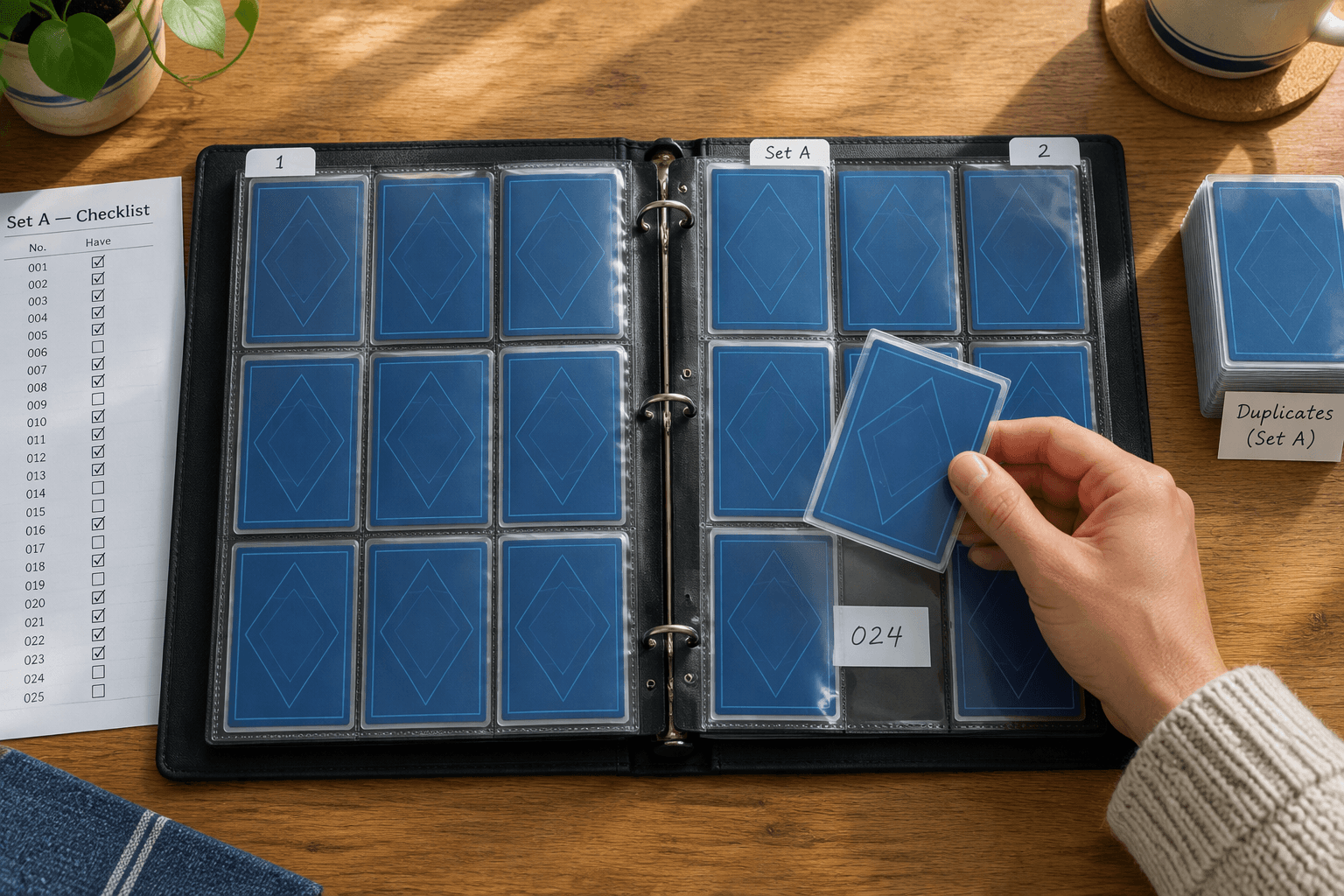
AI-generated editorial illustration. A collector locates a specific coin in a labeled album within an organized archive. · Source: GPT Image 2.5 · article-specific editorial illustration
Most coin collections do not fail from lack of passion — they fail from lack of findability. The tray grows, the album fills, a second shoebox appears, and one day you buy a coin you already own. Organizing a coin collection well comes down to one principle: every coin needs a home, a record, and a way to be found again. This guide walks through a system that works on paper, in a spreadsheet, or in an archive app like Folidx.
Key takeaways
- Use a two-level archive — books and pages — that mirrors your physical storage exactly.
- Record four fields per coin to start: identity, a reference value range, condition notes, and provenance.
- Photograph every coin, even imperfectly; photos enable identification, condition history, and photo search.
- Check for duplicates before every purchase — it is the cheapest money-saving habit in the hobby.
- Keep values as private, editable ranges with sources, not copied price-guide points.
- Export CSV or PDF backups twice a year, and store a copy outside the house.
Start with a two-level structure: books and pages
Deep folder trees look powerful and then collapse under their own weight. Country → era → denomination → variant hierarchies demand a decision at every level, and each decision is a chance to file something inconsistently.
Two levels are enough:
- Archive book — the big container. It can mirror a physical album, a tray, a country, or a theme: "US Type Coins," "World Silver," "Inherited from Grandpa."
- Archive page — the position inside the book: "Page 4," "Tray 2, Row 3," or "Slot 12."
The trick is to make the digital structure mirror the physical one. When the app says Book: World Silver, Page 6, your hand should know exactly which album to pull off the shelf. If your catalog and your shelf disagree, you will trust neither.
Record four things per coin — no more to start
Over-recording is the fastest way to abandon a cataloging project. For each coin, capture:
- Identity — country, denomination, year, mint mark if visible, series. Treat this as a draft you refine, not an exam you must pass on day one.
- Reference value range — a range, not a point. Coin values move, and a private range ("roughly $40–60") is honest and useful for insurance notes and trade decisions. It is not an appraisal, and it does not need to be.
- Condition notes — what you can actually see: wear on the high points, rim dings, cleaning haze, toning. Plain language beats grading jargon unless you already work with a grading scale.
- Provenance — what you paid, where, and when. Future-you (or your heirs) will thank you.
Everything else — die varieties, catalog numbers, storage upgrades — can be added later to coins that earn the attention.
Photograph everything, even badly
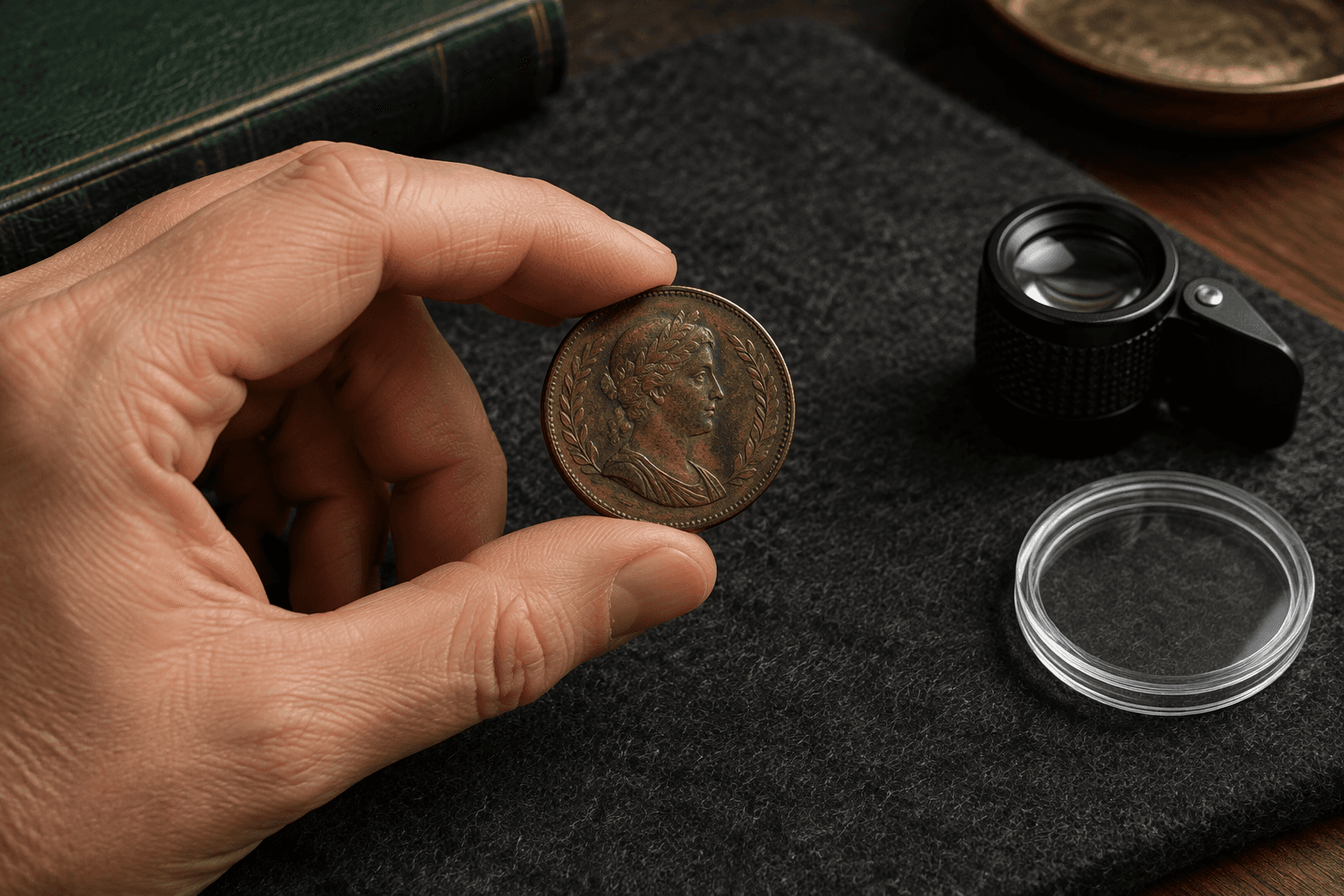
A mediocre photo today beats a perfect photo never. One overhead shot per coin (or one shot per tray) gives you:
- Visual identity — you can recognize a coin faster than you can read about it.
- Condition timestamp — toning and wear change; photos date-stamp the state.
- Photo search — modern archive tools can find a coin from a new photo, which turns your catalog into something you can query from a coin shop floor.
If you use an app that drafts ID reports from photos, review the draft before saving it. Photo-based identification is a strong starting point and a weak final answer — confirm the year, mint mark, and variety yourself. In Folidx every field of the report stays editable precisely for this reason.
Check for duplicates before you buy
The most expensive coin in your collection is the one you bought twice. Before any purchase, run a quick duplicate check:
- With a paper or spreadsheet system: search your catalog by country + denomination + year before paying.
- With a photo-based archive: snap the dealer's coin and compare it against your records on the spot.
A duplicate check is also a value check — seeing that you already own the coin, what you paid for it, and what condition yours is in changes many "sure, why not" purchases into "actually, mine is nicer."
Keep values as private, editable ranges
A common mistake is copying a price-guide number into the catalog and treating it as truth. Guide prices assume grades most raw coins do not have, and market prices drift. A better pattern:
- Store a range you would honestly expect at sale or replacement.
- Note where the range came from (auction results, price guide, dealer quote) and when.
- Revisit ranges only for coins that matter — insurance-level pieces — not the whole collection.
Ranges are planning tools, not promises. No catalog — including an AI-drafted one — replaces professional appraisal for insurance claims or estate valuation, and no app replaces grading services like PCGS or NGC for authentication.
Export a backup twice a year
Whatever system you use, it should be able to leave. A CSV export covers spreadsheets, insurance documentation, and estate planning; a PDF export makes a readable inventory for family members who do not share the hobby. Put a reminder on the calendar: export in January, export in July, store a copy outside the house (cloud drive or a relative's computer).
Where Folidx fits
Folidx automates the tedious parts of this exact system: photograph a coin or a whole tray, review an AI-drafted ID report with a reference range and condition notes, and file it into archive books and pages that mirror your shelf. Duplicate checks run from a photo, search works by image, name, tag, or location, and CSV/PDF export is built in. The report is always yours to edit — Folidx drafts, you decide.
Frequently Asked Questions
What is the best way to organize a coin collection?
Use a two-level structure — archive books and pages — that mirrors your physical storage, record identity, a reference value range, condition notes, and provenance for each coin, photograph everything, and keep the catalog searchable. Consistency matters more than the specific tool.
Should I organize coins by country, year, or theme?
Pick the scheme that matches how you actually collect and browse. Country works for world collectors, series works for type collectors, and theme works for topical collections. Tags can cover the other dimensions, so one coin can appear in multiple searches without being filed twice.
How do I track what my coins are worth?
Record a private, editable value range per coin instead of a single number, note the source and date of the estimate, and update ranges only for significant pieces. Treat ranges as planning references — professional appraisal is still required for insurance claims or estate valuation.
Do I need to photograph every coin?
Yes, even imperfectly. Photos give you visual identification, a condition timestamp, and — with photo-search tools — the ability to find any coin from a new picture. One overhead shot per coin or per tray is enough to start.
Can an app identify my coins automatically?
Apps like Folidx can draft candidate identifications with confidence notes from a photo, which saves significant typing. Accuracy depends on photo quality and coin rarity, so treat drafts as starting points and confirm key details like mint marks and varieties yourself before filing.
Summary
Organize coins with a two-level archive that mirrors your shelf, record four fields per coin, photograph everything, check duplicates before buying, keep values as private ranges, and export backups twice a year. Do that consistently and the collection stays what it should be: a joy to browse, not a puzzle to search.