Coin Display Ideas That Keep Your Collection Safe and Visible
Coin display ideas that protect what you show: frames, shadow boxes, shelves, and digital share pages, with materials and handling notes for each.
Coin Display Ideas That Keep Your Collection Safe and Visible
The best coin display ideas share one rule: the coin stays visible, but nothing in the display touches its face. A frame with mat slots, a shadow box, a desk shelf with stands, and a digital share page all achieve that. This guide walks through each option, the materials that keep coins safe in them, and the handling habits that decide whether a display ages a collection gracefully or ruins it.
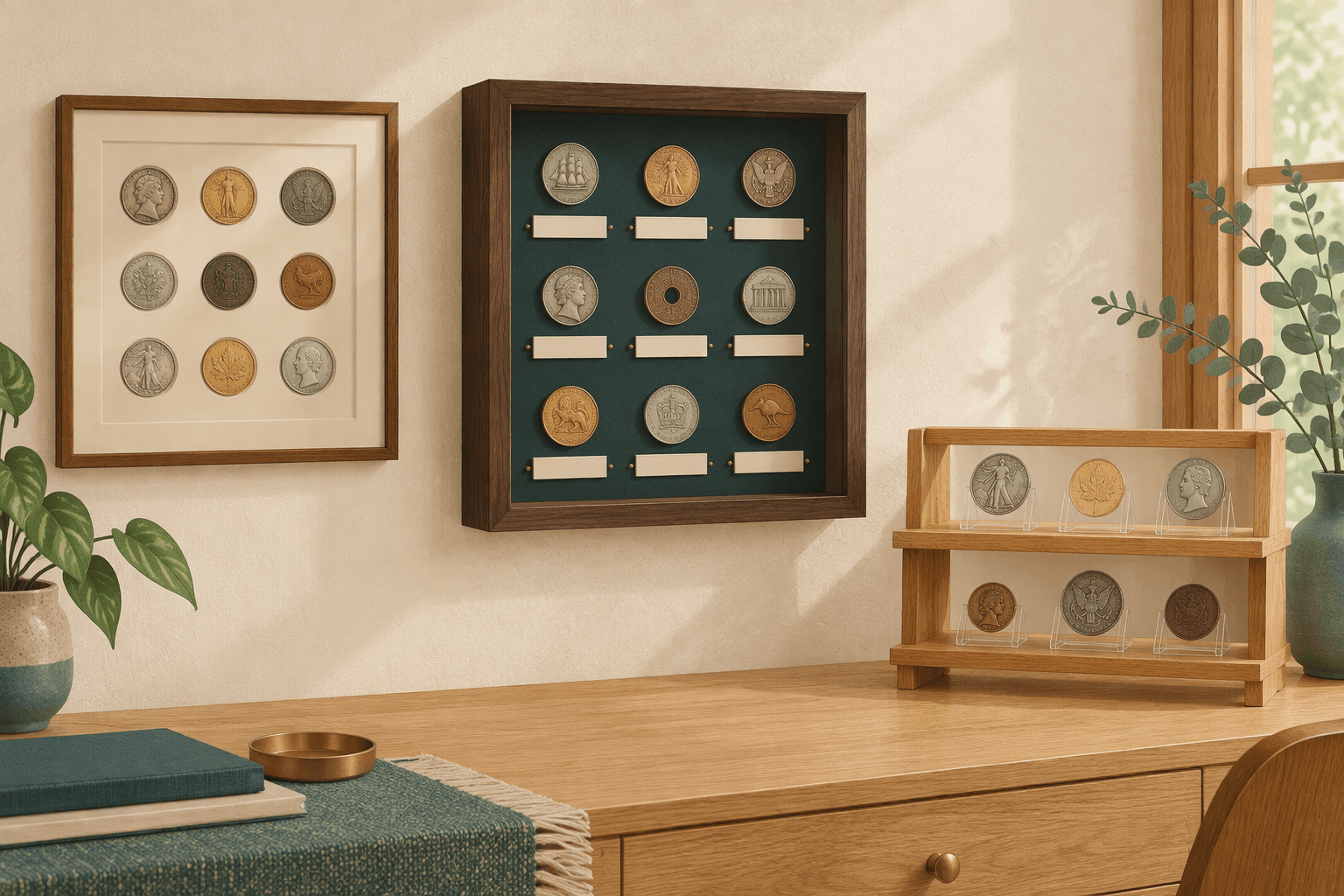
Illustration for this article. It shows the three physical display forms covered below; it is not a product photo.
The First Rule of Coin Display: Visible, but Untouched
Skin oils, moisture, and friction are what damage a displayed coin, not the display itself. The U.S. Mint's care guidance for collectors centers on careful handling and stable storage conditions, away from heat and humidity, and it warns against cleaning that strips a coin's original surface. A good display applies the same logic in three ways:
- No contact with the face. Coins rest in slots, capsules, or on stands. No glue, no tape, no adhesive putty.
- Reversibility. Every coin should come out of the display again with nothing added to it and nothing removed. If you have to pry a coin off cardboard to retrieve it, the display failed.
- A controlled environment. Direct sunlight, humid bathrooms, and kitchens near cooking heat are poor spots. Choose interior walls away from windows and vents.
Collectors' communities converge on the same shortlist of forms. Forum threads about display inspiration (Numis Forums, the Collectors Universe boards, and r/AncientCoins on Reddit) fill up with framed mats, shadow boxes, and shelf arrangements, and commercial guides echo the categories. That matters for this article's promise: everything below is a craft approach you can assemble yourself, not a product endorsement.
Framed Coin Displays: Mat Slots and Acid-Free Backing
A framed display is the most common way to put coins on a wall, and the craft details decide whether it is safe.
- Mat board with cut slots. Use acid-free, lignin-free mat board and cut circular openings slightly larger than each coin's diameter, so the coin rests on the board's edge without pressure. Cut a matching opening in the backing board so light reaches both sides of the coin.
- Depth. A standard flat frame squeezes a coin against the glass. Use a frame with enough depth (a shadow-box style frame works) so the coin sits below the glazing instead of touching it.
- Glazing. UV-filtering acrylic or glass reduces the light damage that fades toning and paper labels over years. Ordinary window glass does not filter UV well.
- Placement. Hang away from direct sun and away from bathrooms and kitchens. Interior hallway walls are stable.
A worked example: a twelve-slot year set, say a decade of state quarters, arranged chronologically in a 3 x 4 grid on cream mat board inside a deep frame. Each quarter sits in its slot, one row per mint year, with a small pencil-written label under the grid. To take the set down, open the frame backing and lift each coin out; nothing was ever attached to it.
One caution from the collector guides that rank well here: never glue coins to a backing board or frame them with the obverse pressed against glass. Both shortcuts are irreversible, and the glue residue alone can move a coin from "display" to "damaged."
Shadow Boxes: Display a Whole Theme at Once
Shadow boxes answer the reader question behind "coin collection display ideas": how to show a group with a story, not just a row.
- Theme first. A year set, a country visited, a denomination series, or coins tied to one family milestone all read well as a single composition.
- Depth and spacing. Pick a box deep enough for coins plus capsules if you use them, and leave breathing room between coins so the eye finds a focal point.
- Labels. Write labels with pencil on acid-free card. Pencil is chemically stable; many inks bleed or off-gas over years inside a sealed box.
- What belongs in one. Circulated coins you are happy to leave in place for a long time. Reserve the box for coins whose condition you are not managing as a primary asset.
Desk Shelves and Stands: Coins You Pick Up Often
Not every coin needs to be sealed behind glass. A tiered shelf or a set of acrylic easel stands suits the circulated favorites you actually want to handle.
- Stands hold by the edge. A coin seated in an acrylic stand touches only its rim, which matches the hold-by-the-edge handling rule.
- Rotate, don't crowd. Keep a few coins out and swap them from storage; a crowded shelf invites constant handling.
- Dust and placement. Shelves are open to air, so dust the surface with a soft brush before re-seating a coin, and keep the shelf away from windows and radiators.
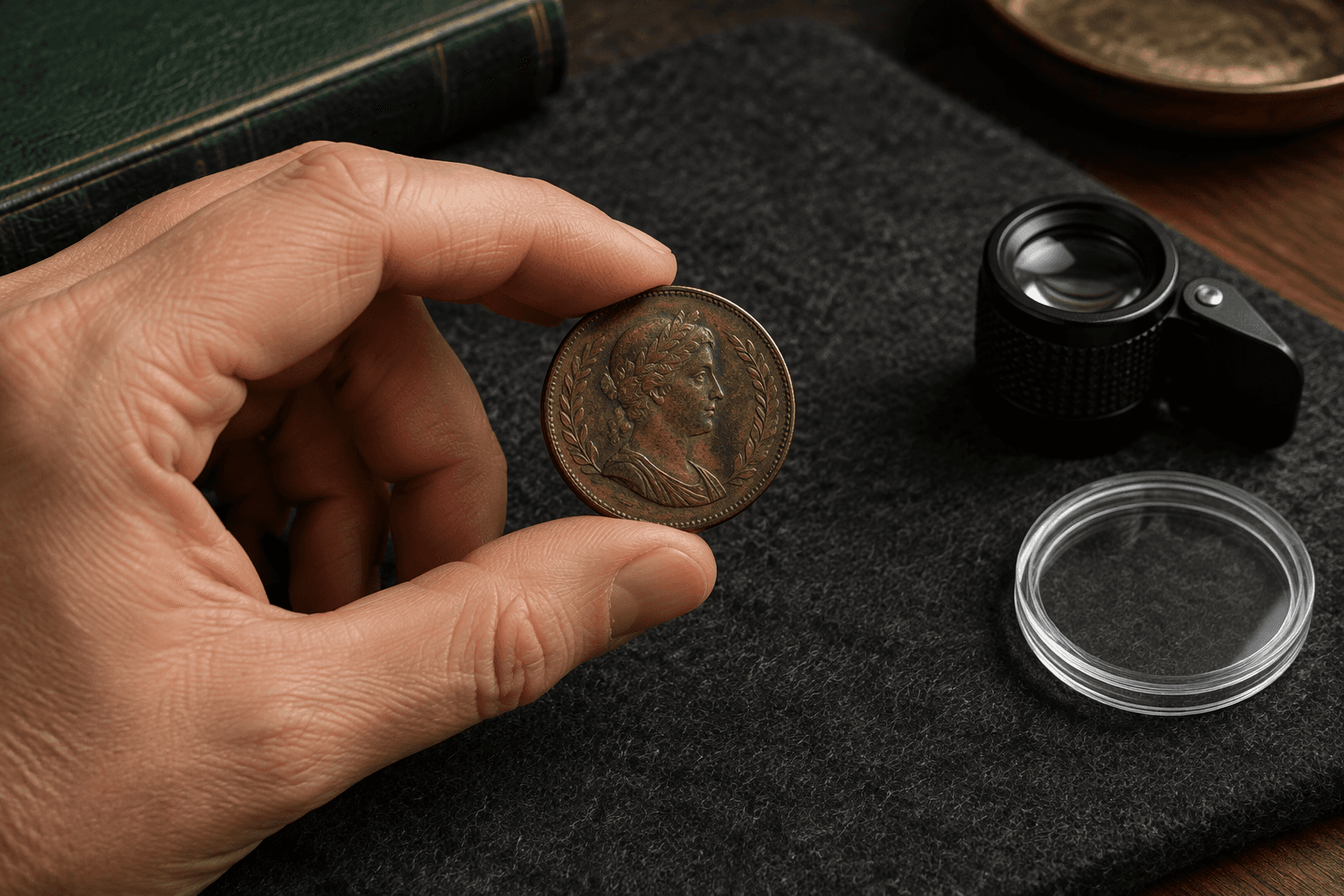
Wash and dry your hands before handling, hold coins by the edge, and set them down on a soft cloth rather than a hard table.
Keep High-Value Coins Out of Open Display
Any coin whose value or condition matters to you should not sit in an open room display. Sunlight, humidity swings, and air pollutants all act on exposed surfaces, and a slab or sealed case preserves condition far better than any frame. For those coins, the safer play is to keep them in storage (see our coin collection storage guide) and display a photograph or a digital record instead.
The practical boundary: open display is for coins you would still enjoy owning after five years of sitting in it. If you would not, it belongs in a sealed case, not a shadow box.
A Digital Share Page: Display Without Touching Anything
A digital display gives you the visual pleasure of an arranged collection with zero environmental risk. Photograph each coin well (our how-to-photograph-coins guide covers a simple two-light setup), then arrange the photos into pages, grouped by theme like a shadow box.
Folidx, the collection app behind this blog, does this as a collection-page canvas: each coin is identified from a photo into an editable record, and you arrange those records like stickers on a free-form page with notes and captions. It is an optional digital stand-in for the wall display, and it keeps each coin's source and reference notes attached to the thing being shown. We mention it once here and leave the craft ideas above product-free on purpose.
Display Materials Checklist: Acid-Free Board, UV Glass, Sealing Strips
| Material | Why it matters | What to avoid |
|---|---|---|
| Acid-free, lignin-free mat board | No acidic off-gassing that can spot or tone coin surfaces | Ordinary craft cardboard, newspaper backing |
| UV-filtering glazing | Blocks the ultraviolet band that fades toning and labels | Plain window glass for sunlit walls |
| Deep or shadow-box frame | Keeps coin surfaces off the glazing | Flat frames that press faces to glass |
| Friction slots or capsules | Hold coins without adhesive | Glue, tape, adhesive putty |
| Pencil labels on acid-free card | Stable writing that will not bleed | Ballpoint or marker ink near coins |
| Foam sealing strips on the frame back | Slows dust and humidity exchange inside the frame | Leaving backing gaps open |
Category names only, no product links: buy by specification, not by brand, and check that "acid-free" appears on the actual product sheet rather than just the listing title.
After the Display: Keep Each Coin's Record Findable
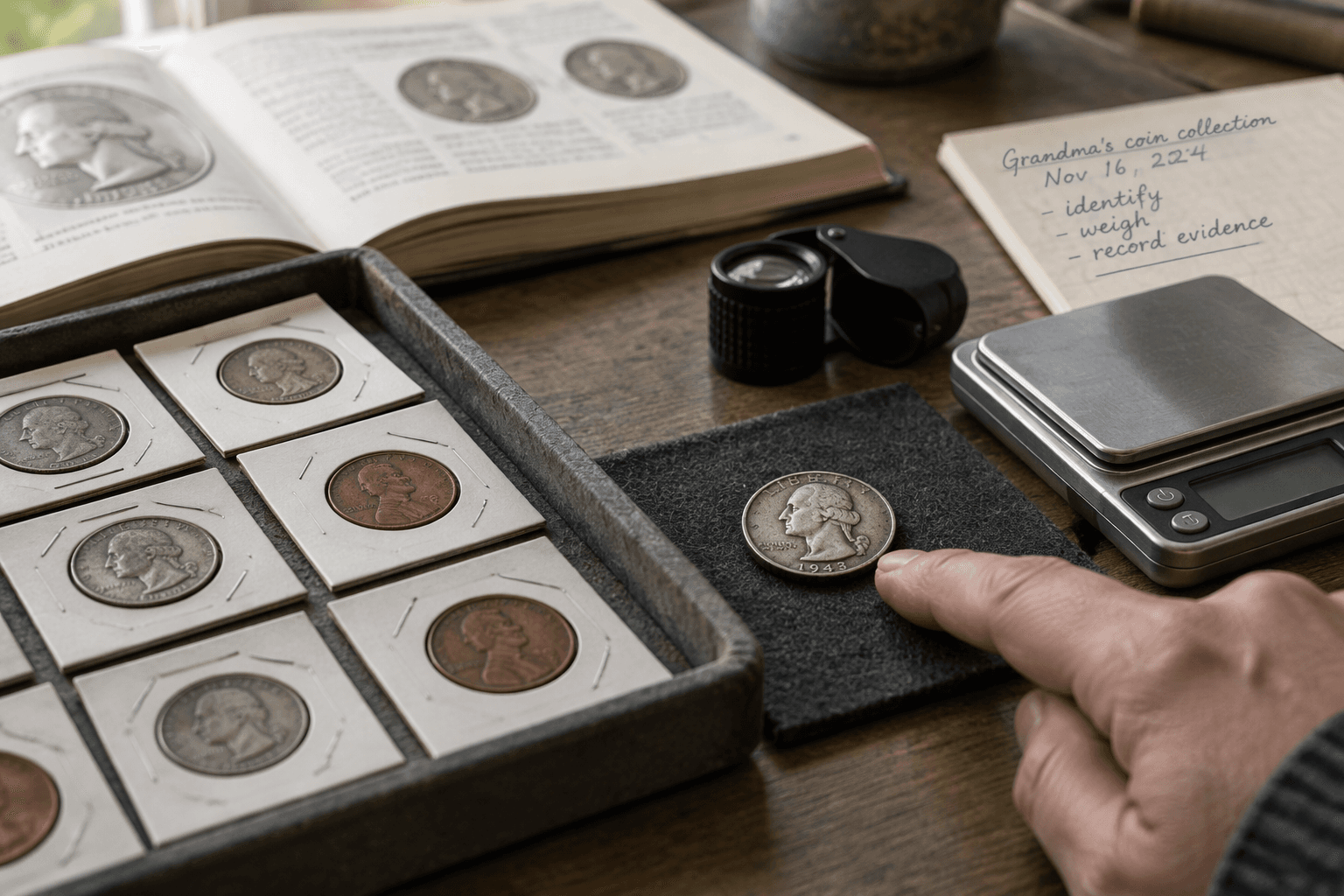
A display answers "what does this look like," but a collection record answers "what is this and where did it come from." When you pull a coin from a frame to show a friend or to sell, you will want its year, mint mark, purchase source, and reference value notes within reach. Our coin identification guide covers naming an unknown coin, and our how-much-are-my-coins-worth guide covers reading a reference range without turning it into a valuation promise.
The habit that ties display and records together: whenever a coin moves into a display, add one line to its record noting where it now lives. That single line keeps the collection searchable when the display changes again.
FAQ
What is the best way to display coins? For a wall, a deep frame with acid-free mat slots and UV-filtering glazing. For a themed group, a shadow box with friction slots. For coins you handle often, a shelf with acrylic stands. All three keep coin faces from touching anything, which is the shared principle behind every safe coin display idea.
Can displayed coins tarnish? Yes. Tarnish is a chemical reaction with sulfur compounds and moisture in the air, and an open display exposes coins to both. Slowing it means controlling the room (no humid bathrooms or kitchens), using UV-filtering glazing, and sealing the frame back with foam strips. Valuable coins should not be exposed at all; keep them in sealed storage.
How to display coins on a wall without nails? Use rated adhesive hooks or heavy-duty removable wall strips to carry the frame's weight, and check the rated load against the frame plus glass. A second option is a shadow-box frame hung from a single adhesive hook, or leaning a small framed display on a shelf rail. Avoid adhesives that pull paint; test the strip on an inconspicuous spot first.
Sources
- U.S. Mint, "Caring for Your Coin Collection": handling and storage principles cited for the untouched-coin and environment rules. https://www.usmint.gov/learn/collecting-basics/caring-for-your-coin-collection (accessed October 2026; SERP-verified 2026-10-03)
- Numis Forums, "Coin display inspiration: share your best and worst ideas": community consensus on frame, shadow box, and shelf forms. https://www.numisforums.com/topic/7596-coin-display-inspiration-share-your-best-and-worst-ideas/page/2/ (live US SERP result, 2026-10-03)
- PinProsPlus, display case idea article: commercial guide confirming the mainstream display categories. https://www.pinprosplus.com/post/display-case-idea-coin (live US SERP result, 2026-10-03)
- The Handyman's Daughter, DIY coin holder display: example of the mat-slot wall approach referenced for the frame section. https://www.thehandymansdaughter.com/diy-coin-holder-display/ (SERP Images module citation, 2026-10-03)
- Royal Canadian Mint blog, "How to safely store and display your collection": independent confirmation of frames, presentation cases, and digital display categories. https://www.mint.ca/en-us/blog/2018-09-got-coins-how-to-safely-store-and-display-your-collection (accessed during this run's SERP refresh)
- SERP refresh for "coin display ideas" (US / en), 2026-10-07 run: frames, capsules, shadow boxes, presentation cases, and digital display dominate organic and community results; product listings occupy separate commercial slots.
SEO title: Coin Display Ideas That Keep Your Collection Safe and Visible Meta description: Coin display ideas that protect what you show: frames, shadow boxes, shelves, and digital share pages, with materials and handling notes for each. Slug: coin-display-ideas Canonical URL: https://www.folidx.com/blog/coin-display-ideas Author: Orion Wells, Founder of Aurcue