Pokémon Scarlet & Violet 151 Card Checklist: Track the Cards You’re Missing
Find the official English Pokémon Scarlet & Violet 151 card list, check collector numbers in order, and track owned cards, missing entries, and foil variants.
By Folidx Team
Start with the official English Scarlet & Violet 151 checklist PDF. Use it to tick off the cards you own, working by collector number rather than card name alone. Keep the official 151 card gallery alongside it for visual reference.
The PDF is the Pokémon 151 Scarlet and Violet card list used in this guide. It runs from 001 Bulbasaur to 207 Basic Energy, with separate numbered entries for some of the same Pokémon. Those entries and the checklist's finish boxes are different things to track. Source: official English checklist.
You can do the comparison with the PDF and a sheet of paper. An app is optional.
Check that you have the English 151 list
Check the heading on the PDF: Pokémon TCG: Scarlet & Violet 151 Card List. This guide follows that English expansion checklist. Do not mix a different language's list into the same sheet without checking its entries against your cards.
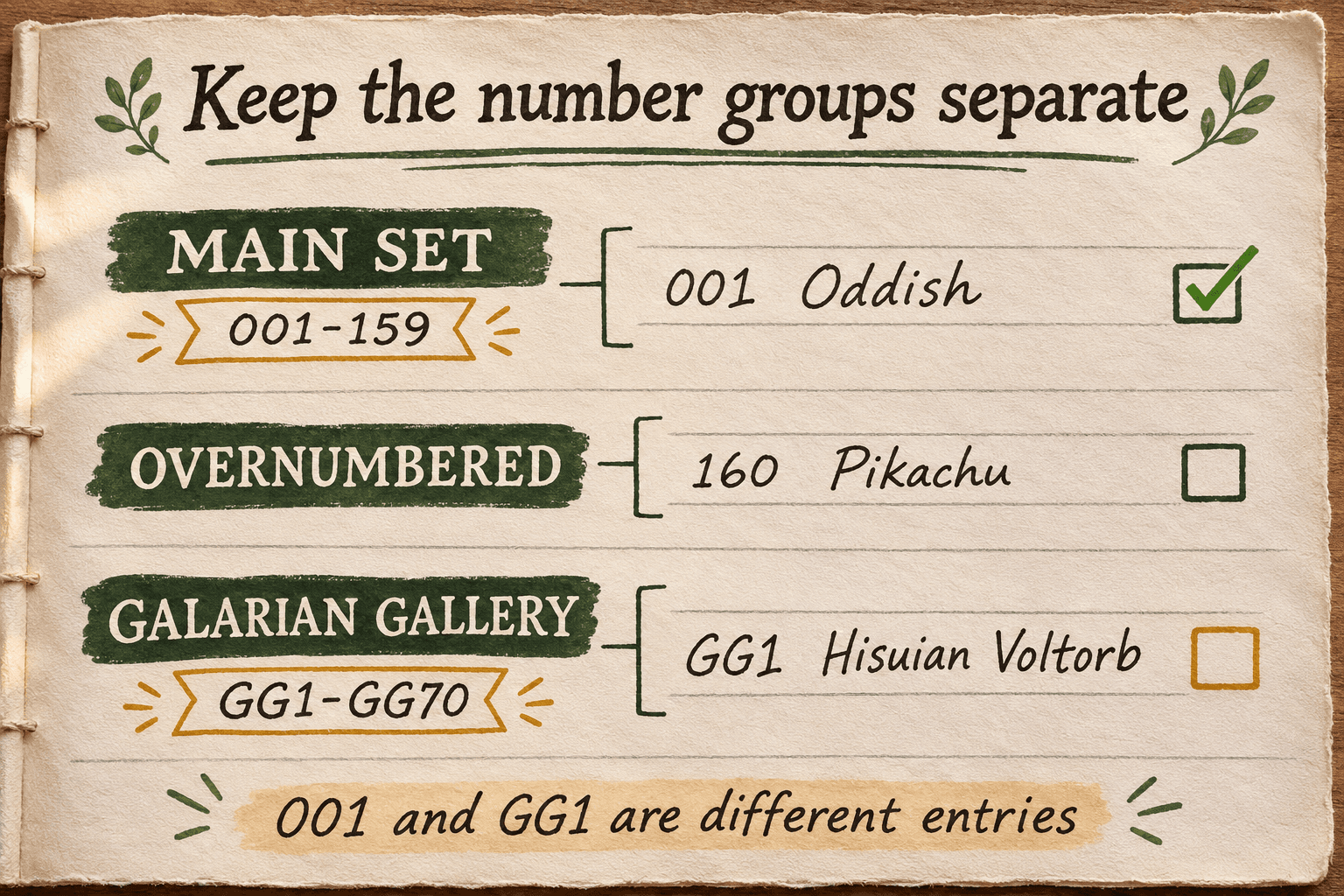
For each card, read its printed collector number and confirm its expansion before marking a row. A familiar Pokémon name is not enough: the official list includes Bulbasaur at both 001 and 166. Owning one does not fill the other entry. Check both rows in the official PDF.
The collector number identifies a card entry within the expansion; it is not the Pokémon's Pokédex number. The two Bulbasaur entries make the distinction useful in practice: record the number from the card, even when you already have a record with that Pokémon's name.
Work through the Pokémon 151 card list in order
- Open or print the official English PDF. Put cards from other expansions aside.
- Start at 001 and compare each numbered row with the cards in front of you.
- Record the exact name and number together. For example, the opening rows are 001 Bulbasaur, 002 Ivysaur, and 003 Venusaur ex.
- Continue through the end of the list. Do not stop at 151 or at a row whose Pokémon you already own.
- Leave an uncertain card unmarked until you can match its number and finish.
Those names, numbers, and the entries beyond 151 come from the official English checklist. Checking by number keeps two entries with the same name from sharing one tick.
Track finishes without changing the card number
The official PDF's legend distinguishes standard set and standard set foil, and the available boxes differ by row. Follow the boxes on the actual checklist rather than assuming every numbered card has the same finishes. Source: checklist legend and numbered rows.
Choose your goal before counting missing cards:
- One copy per collector number: tick a number when you own a matching card, regardless of which finish you choose to keep.
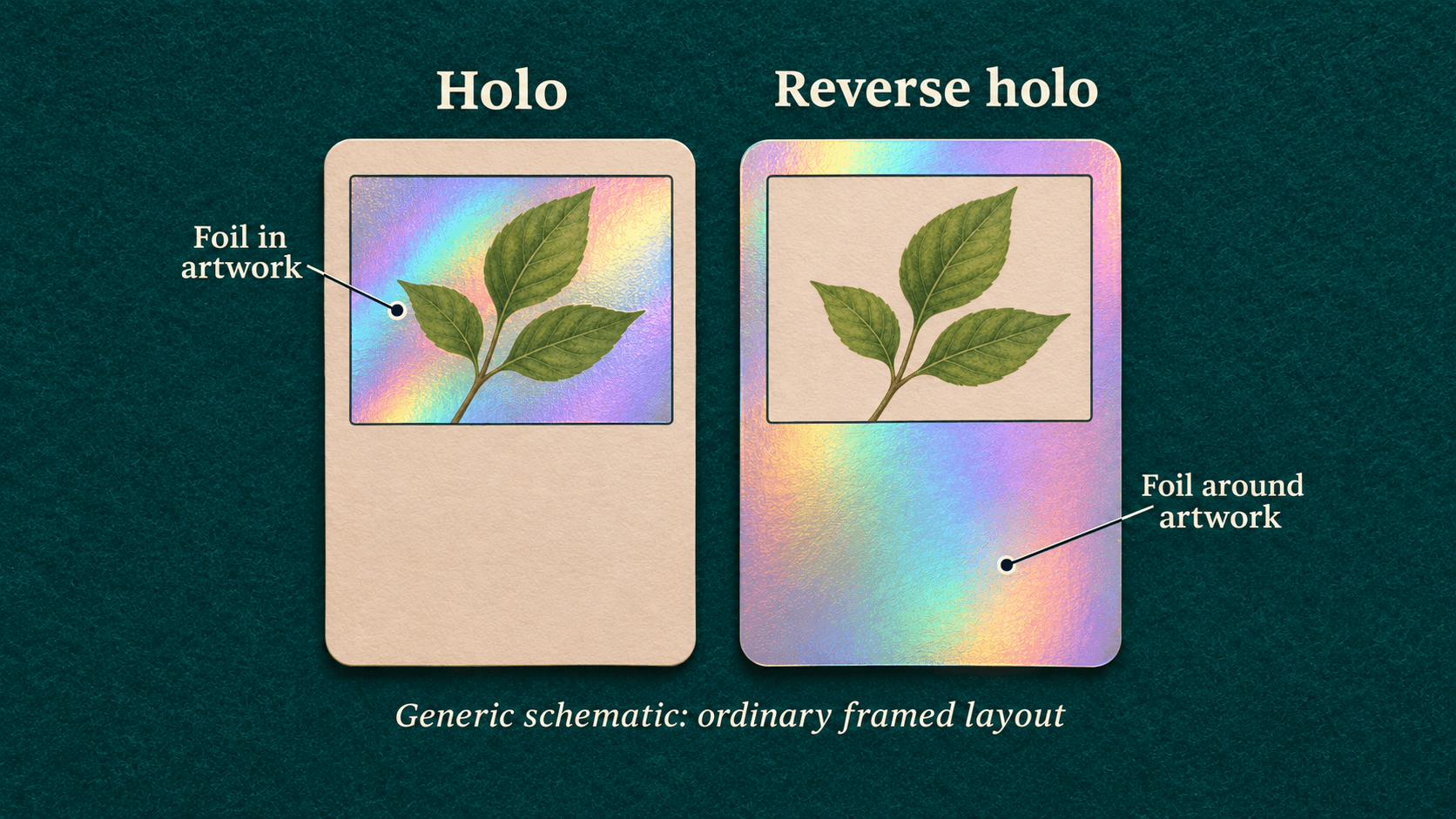
- Specific finishes: add separate columns for the finishes you want, such as regular and reverse holo. Confirm that a finish belongs to that entry before treating a blank as a gap.
Use “not applicable” for a finish outside your goal or one that does not apply to the entry. An empty box should not send you shopping for an unverified variant.
If you collect promotional cards too, keep a separate section with each card's own printed identifier and source. This guide does not add promos to the numbered expansion list or claim that one “master set” definition fits every collector. Write your completion rule at the top of your sheet so you know what your total means.
Compare owned and missing cards with a three-column sheet
Here is a small example collection, not a report of anyone's real cards. Its goal is one copy per collector number, with finishes left out of the count.
| Card entry | Copies owned | Copies missing toward this goal |
|---|---|---|
| 001 Bulbasaur | 2 | 0 |
| 002 Ivysaur | 0 | 1 |
| 166 Bulbasaur | 1 | 0 |
The card names and numbers are verified against the official PDF; the quantities are invented solely for this worked example.
This collector has three physical cards covering two numbered entries. The spare 001 does not fill the gap at 002. The 166 stays on its own row even though its name matches 001. For this goal, a missing count is 1 when you own no matching copy and 0 when you own at least one.
Copy the table into your own sheet, or print the example worksheet below and use its blank rows for a short want list. For the whole expansion, keep the official PDF beside it so you do not omit entries.
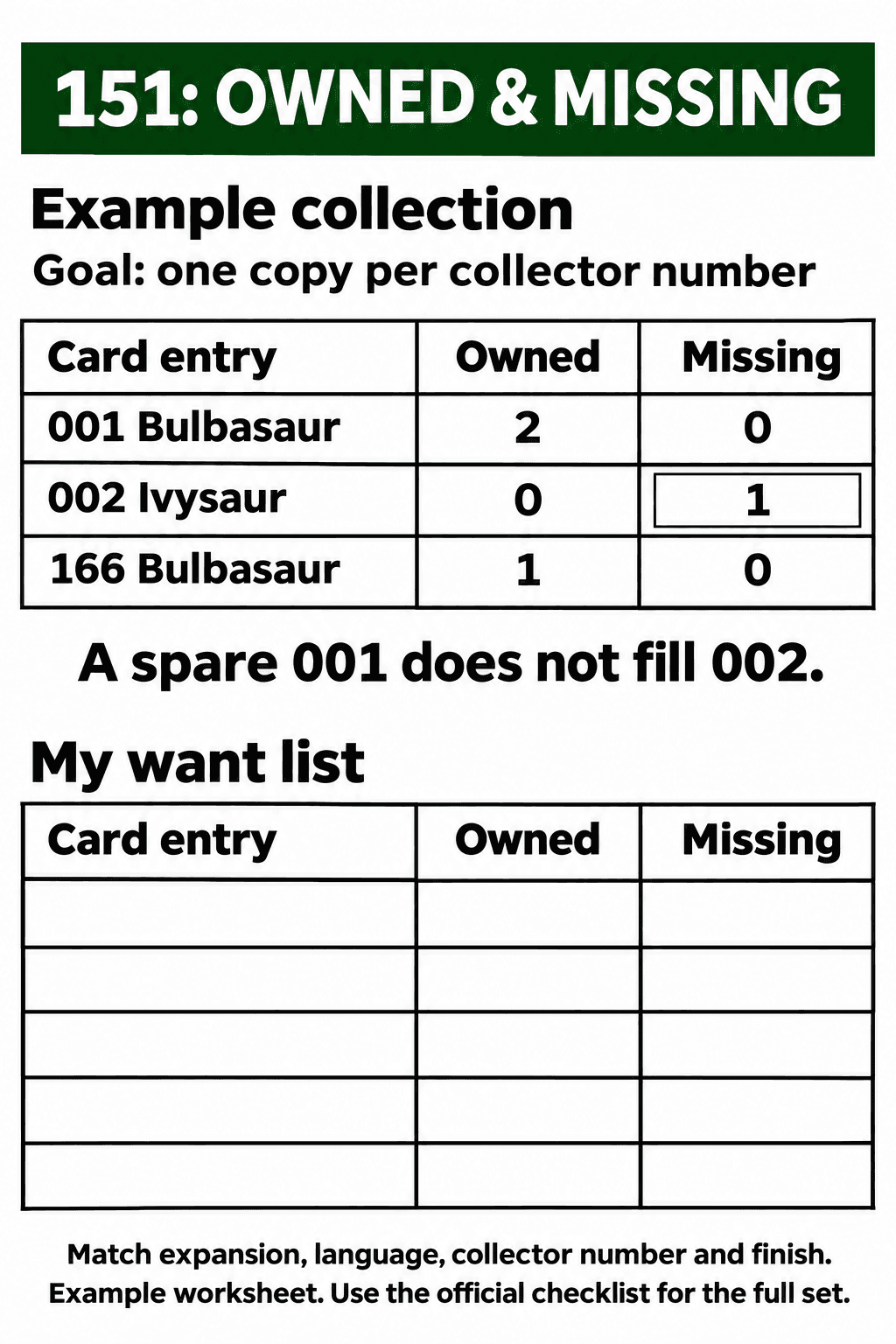
Open the printable example worksheet. The quantities are a worked example; the blank rows are for your own notes.
Check duplicates before buying
Before buying from a want list, compare the seller's card with your row: expansion, language, collector number, and the finish you are seeking. If you already own the exact version, another copy increases quantity; it does not fill a different number or finish.
Record a pending purchase separately from “owned” until you receive it. That keeps the same gap from appearing on two shopping lists without overstating what is in your binder.
For arranging the physical cards, see How to Organize Pokémon Cards. That guide covers binder order and locations; use the official 151 checklist for this expansion's membership.
Keep an owned-card record alongside your checklist in Folidx
Folidx's TCG card binder is an option for keeping editable collection records organized into books and pages. Use that owned-card archive alongside your missing-card sheet.
Give your 151 records a consistent name, such as “English 151, 001 Bulbasaur,” and keep 166 Bulbasaur distinct. When reviewing a record, compare its identification with the physical card and the official checklist. Keep your finish and binder-location notes consistent with the sheet you use to track gaps.
For the example above, keep the two copies of 001 accounted for without marking 002 as owned. Add 002 to your owned records when you obtain it, then update your separate checklist. This is a recordkeeping method, not an automatic comparison with the official set list.
Catalog the cards you own with Folidx, and use the official PDF or your own sheet to track what is missing. This guide does not assume that Folidx imports the Pokémon checklist or supplies a dedicated 151 completion tracker.
Quick answers
Where is the official Pokémon SV 151 card list?
Use the English checklist PDF from Pokémon. The official gallery is a companion visual reference. Match the English list to the cards you are recording.
Why does Bulbasaur appear twice?
The checklist has a Bulbasaur entry at 001 and another at 166. They are separate numbered entries, so owning 001 does not mark 166 complete. Source: official checklist.
Should a reverse holo count as owned?
For a one-copy-per-number goal, count a matching version according to your stated rule. For a finish-specific goal, mark only that finish's column. Keep the rule visible rather than changing it midway through the count.
Sources
- Pokémon: official English Scarlet & Violet 151 card checklist, numbered entries and finish legend.
- Pokémon: official 151 card gallery, companion visual reference.
- Folidx: TCG card binder, owned-card catalog and binder organization.
- Folidx: How to Organize Pokémon Cards, general physical and digital organization.