Shield Nickel Value: Check the Date and With-Rays Type First
Learn how to check Shield nickel value by matching the issue and condition, comparing sourced references, and saving a dated collection record.
By Folidx Team
A useful Shield nickel value starts with the exact date, reverse type, strike and condition. A date alone is not enough: 1867 has both with-rays and no-rays issues, and a proof belongs in a different reference branch from a regular strike. Start by selecting the right issue in the PCGS Shield nickel guide, then check what the reference price represents.
There is no single reliable amount for an unidentified Shield nickel. This guide does not establish a price range for your coin; it shows how to choose comparisons and keep the unresolved details visible.
| What you can establish | Reference branch to open | What still needs checking |
|---|---|---|
| 1866, rays visible between the reverse stars | Type 1, With Rays, exact year | Regular strike or proof; condition |
| 1867, rays visible | 1867 With Rays | Do not use the 1867 No Rays row |
| 1867, clear spaces between the stars | 1867 No Rays | Confirm the spaces are readable, not obscured |
| A later date within the series | Type 2, No Rays, exact year | Check the issue and strike listing, not a generic type row |
| Date or reverse detail remains uncertain | Keep candidate identifications open | Do not attach one issue's price yet |
| A certified coin with a readable label | Matching issue, service, grade and designation | Read the listing's price basis and date |
The date/type branches and separate MS and PR listings above follow PCGS CoinFacts and its price guide. The table selects a reference; it does not authenticate a coin.
Confirm the Shield nickel design
Look for the shield on the obverse and a large numeral 5 surrounded by stars on the reverse. Read the date from the coin itself, and save photographs of both sides before narrowing the identification. The PCGS With Rays catalogue provides obverse and reverse reference images.
Keep the silver half dime separate. It had the same five-cent face value and circulated alongside the copper-nickel coin, but it is a different series. A half-dime price row is not a Shield nickel comparison. PCGS records the Shield nickel's introduction in 1866 and this overlap in its series history.
If the design does not match, return to identification before checking prices. Check the coin against the catalogue photographs even when a search result seems convincing.
Check with rays versus no rays, especially for 1867
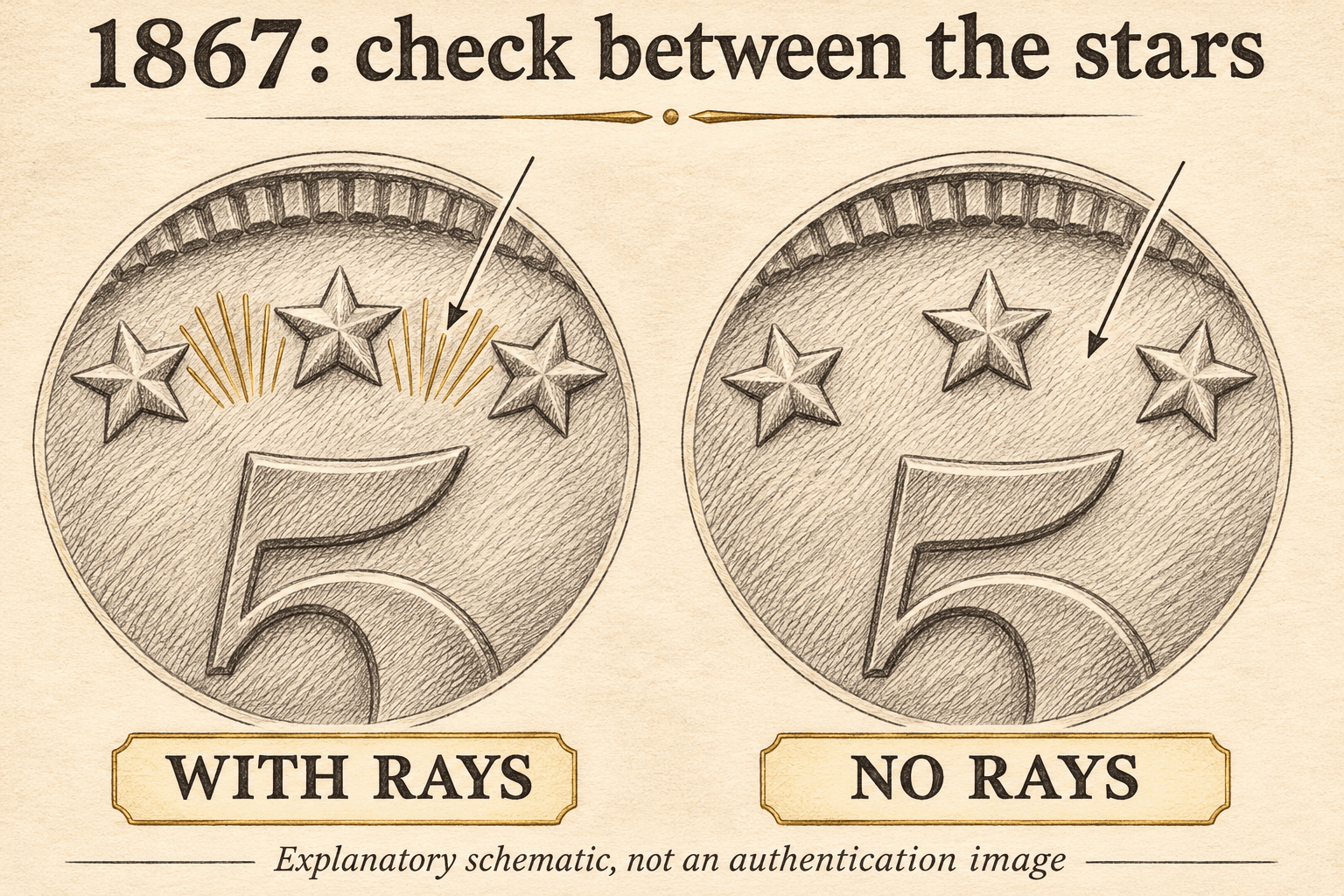
Explanatory schematic of selected reverse details, not a complete coin or authentication image. The type distinction follows PCGS CoinFacts. Use catalogue photographs to examine an actual coin.
Turn the coin over and look between the stars around the 5. The with-rays design has rays in those spaces; the no-rays design omits them. PCGS separates Type 1, With Rays, 1866-1867 from Type 2, No Rays, 1867-1883. Its series overview explains that the change occurred during 1867.
For 1867, include the reverse type in your reference label. Write “1867 With Rays” or “1867 No Rays” only when the reverse supports it. If wear, glare or a poor photograph hides the spaces, record “1867, rays type uncertain.” Try another photograph with a different light angle, retaining the original image.
Do not let a photo enhancer supply the missing detail. If the original surface cannot settle the question, leave both candidates open for review against catalogue photographs or by a qualified numismatist.
Compare the exact issue and strike
After choosing the rays type, check the strike branch. The PCGS guide separates regular-strike MS listings from PR proof listings. A bright surface alone is not sufficient grounds to select a proof row. PCGS notes that some prooflike circulation strikes and true proofs can be difficult to distinguish in its Shield nickel discussion.
Use a specific dated row rather than the guide's general “Type” row. Keep any variety attribution separate, too. For example, the guide lists an 1883/2 overdate separately from the ordinary 1883 Shield issue. A suspected underlying digit needs independent attribution before its reference becomes a valid comparison. Save the unaltered close-up and the question you need answered.
For condition, describe what you can see: which details remain readable, where marks appear, and which areas the photograph does not show clearly. Keep your observations separate from a certified grade. The grading vocabulary guide explains the terms without turning a photograph into a grading opinion.
Compare references without turning them into an offer
When you search for Shield nickel values, check the basis of each number before comparing it. PCGS describes its guide as average dealer asking prices for PCGS-graded coins. NGC describes its guide as average dealer retail prices for NGC-certified coins, excluding sales tax, and warns that updates do not capture every short-term change. Those explanations concern the guides' methodology; the linked NGC page's Jefferson nickel rows do not price Shield nickels.
Keep these sources distinct in your notes:
| Price basis | What to record | Comparison limit |
|---|---|---|
| Guide retail or average dealer asking price | Exact issue, grade, certification basis, currency, URL and observation date | A guide entry is not an offer for your coin |
| Individual seller's asking price | Listing details, condition description and asking date | An unsold listing does not establish a completed sale |
| Realised auction price | Exact lot, sale date, certification, grade and any variety attribution | Check whether the reported total includes buyer's premium; note taxes and shipping separately |
For a sold comparison, open the auction house's original lot page. Read its description and photographs rather than relying on a search thumbnail. As an exclusion example, Heritage lot 21117, sold July 2, 2024, is an 1867 No Rays coin certified PCGS AU53 with an FS-1101 doubled-die attribution. It should not stand in for an unattributed raw 1867 coin merely because the date matches. This guide does not use that lot to set a range.
If you cannot verify a suitable issue-and-condition match, write “no reliable range established” and save the next lookup needed. A record sale and a spot-metal calculation cannot answer what someone would pay for your particular coin. Avoid multiplying guide entries into a collection total. For the wider workflow, see how to check a coin reference value.
Save an editable record and a next review step
Photograph both sides, then add a close-up of the date and the spaces between the reverse stars. Transcribe only what you can read. Keep “rays uncertain” or “possible variety” as an open question until you have evidence to change it.
Use this fictional blank worksheet to keep the evidence beside the reference. It is an editorial template, not a customer record or a Folidx screen. The rejection examples illustrate mismatches; all money fields remain blank.
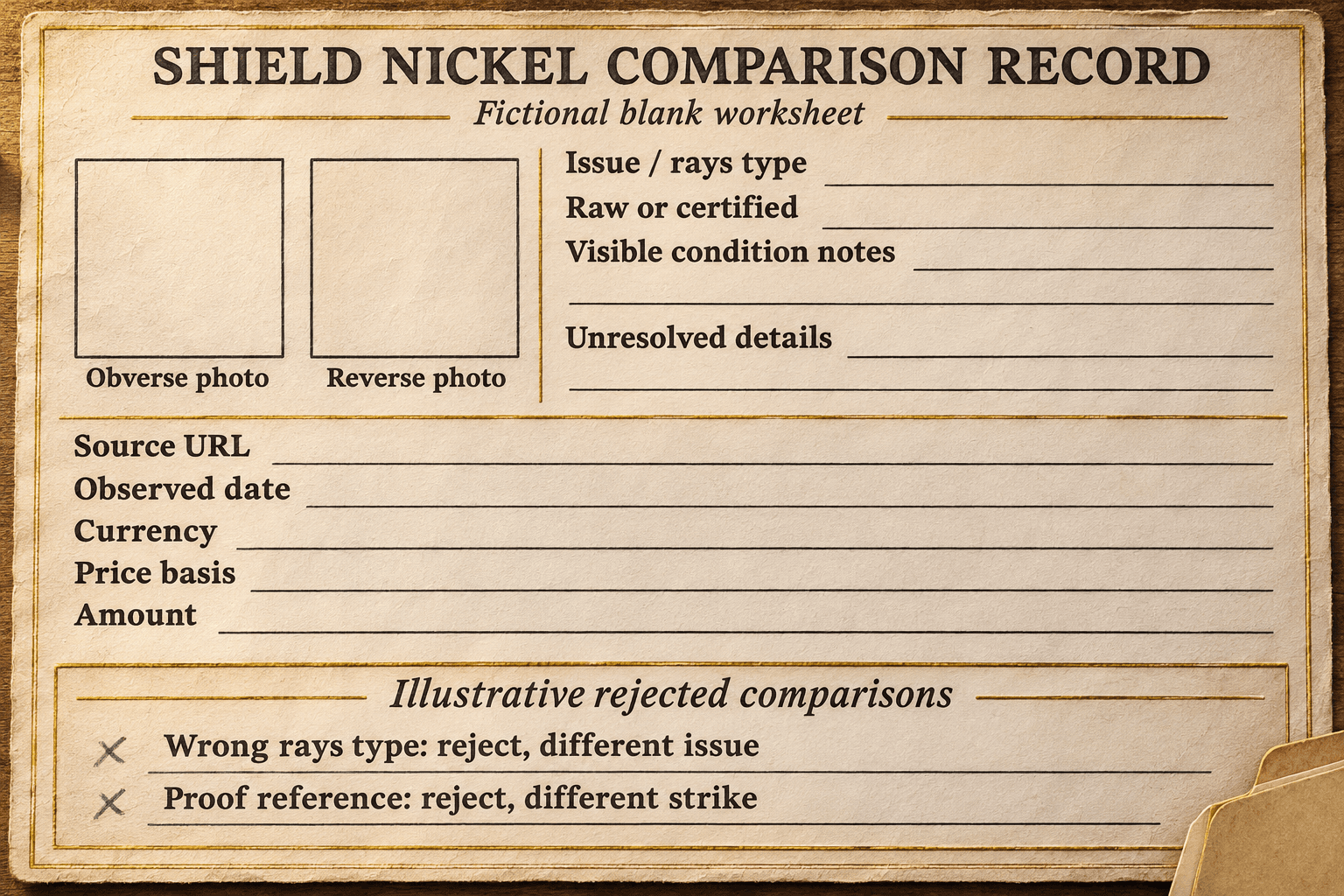
Illustrative worksheet. Fill it with your own observations and sources; the rejected comparisons show why a reference may not fit.
| Item photos | Exact issue / unresolved fields | Raw or certified; visible surface notes | Reference URL / date / currency / price basis | Amount | Decision |
|---|---|---|---|---|---|
| [Obverse, reverse, detail] | [Date, rays type, strike; open questions] | [Holder label if present; observations] | [Source; observed date; currency; guide, ask or sale; premium basis] | [Accept, reject or investigate] | |
| [Same item] | Illustrative comparison: wrong rays type | [Not assessed] | [Rejected source and date] | Reject: different issue | |
| [Same item] | Illustrative comparison: proof for a regular-strike candidate | [Not assessed] | [Rejected source and date] | Reject: different strike |
Add a next action such as “take a clearer reverse photo” or “confirm the variety attribution.” Retain the earlier uncertainty when you update the conclusion, so you can see why the comparison changed.
Folidx is an optional place to continue this work. Coin photos can become editable identification reports with reference ranges and visible condition clues, organised into archive books and pages. Review and edit the suggested identification and notes before relying on them. Folidx does not provide professional grading, authentication or an appraisal. The worksheet above does not imply a matching set of built-in fields.
Short reader questions
Can I compare a raw coin with a certified guide row?
Use it as background, with its certification basis recorded. A raw coin has not acquired the guide row's certified grade just because it looks similar. Leave the condition question open rather than copying the certified value into your record as an established amount.
What should I do if the date or mint is unreadable?
Save the original photographs and transcribe readable details, using a question mark for uncertain digits. If you think you see a mint mark, recheck the series against catalogue photographs before assigning a mint. Do not infer a scarce issue from a blur. If identification remains unresolved, defer the issue-specific value lookup.
Does a reference price mean someone will pay it?
No. A guide, an asking listing and a completed sale describe different evidence. Record which one you used; an actual offer requires a buyer to assess your coin and agree to terms.
Can I choose an 1867 price row from the date alone?
No. Check the reverse for rays between the stars, then select the matching strike and condition reference. If the rays type is unreadable, keep both 1867 candidates open.
Keep the photos, source links and uncertain details together in an editable Folidx record.
Sources
- PCGS CoinFacts: Shield nickel series and type split
- PCGS CoinFacts: With Rays catalogue and reference photographs
- PCGS Shield nickel price-guide branches and guide methodology
- NGC price-guide methodology, used for its explanation of guide prices only
- Heritage Auctions lot 21117, an excluded variety comparison
- Folidx product workflow and limits
Sources checked November 7, 2026. No individual coin's reference range is established here.
About the author: The Folidx team writes guides to documenting collections and using Folidx.