How Much Are My Coins Worth? A Careful Way to Check
Check what your coins are worth with a careful process: date, mint mark, metal, and condition, then compare sourced reference ranges, never a promise.
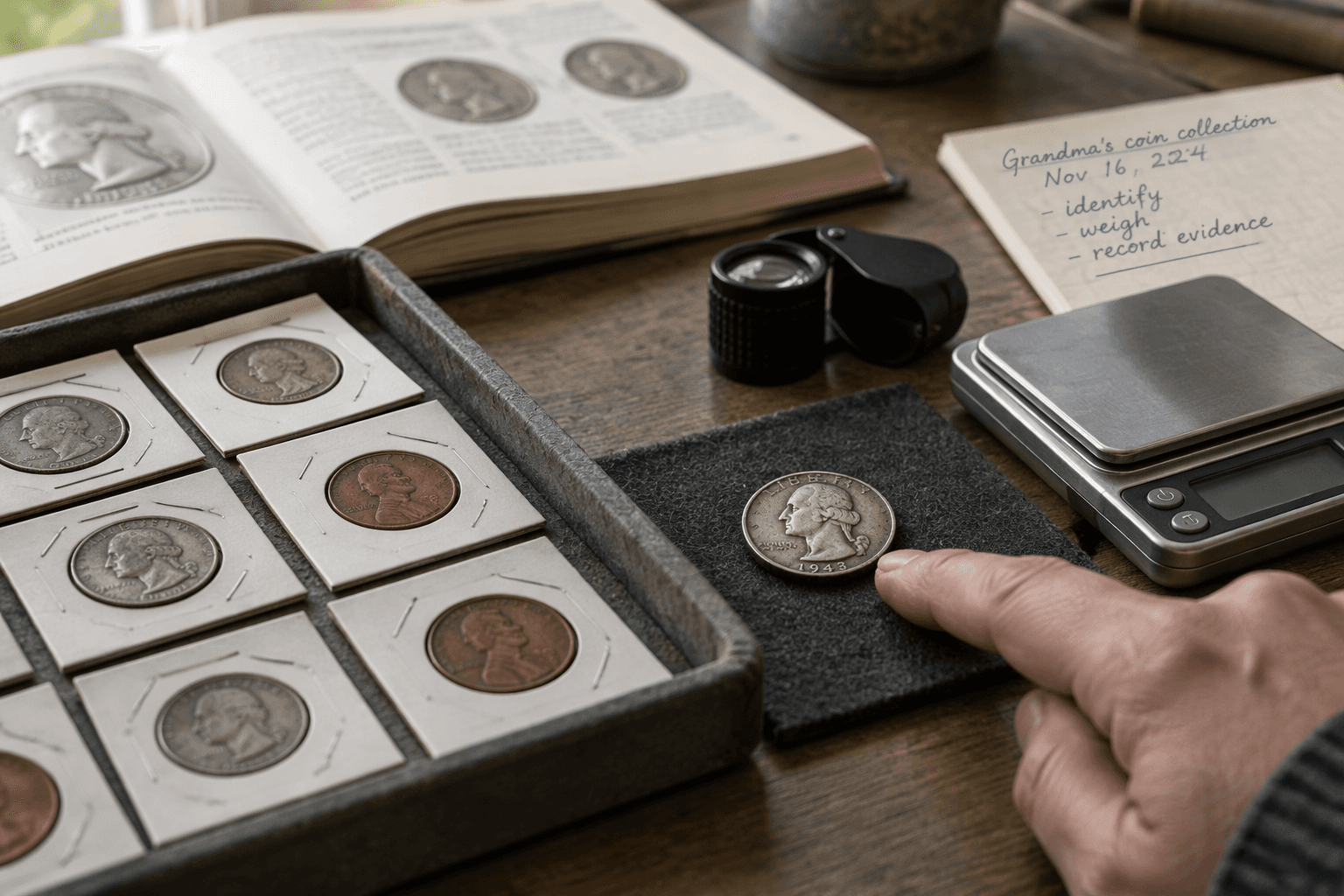
AI-generated editorial illustration. A small inherited coin group being compared with recorded observations and reference material. · Source: GPT Image 2.5 · article-specific editorial illustration
How Much Are My Coins Worth? A Careful Way to Check
If you found a jar of coins or inherited a collection, the honest starting point is this: most circulated coins are worth their face value, and a small share are worth more. The reason is not luck. A coin's reference value comes from four things you can read yourself: its date, its mint mark, its metal content, and its visible condition. Once you record those four facts, you can look up a sourced reference range instead of guessing.
This guide walks through that process. It shows which coins deserve a close look first, how to find the value of old coins without mixing up different kinds of prices, and when a professional appraisal actually makes sense. One boundary up front: nothing here is an appraisal, a grading opinion, or a promise about what any coin will sell for.
The short answer: most coins are worth face value
A pocket coin from the last few decades is usually worth exactly what its denomination says. Dimes, quarters, and halves made after 1965 contain no silver, so a common circulated example has no premium to look up. The same is true for most modern pennies, nickels, and dollar coins, even ones that look old to a first-time holder.
What makes the search worthwhile is the minority case. A coin becomes interesting when at least one of these is true:
- It was made before a key metal change, such as the 1965 switch away from silver in US dimes and quarters.
- It carries a low-production date or mint mark combination.
- It survived in unusually clean, original condition.
- It has a documented error or an unusual variety.
Because these cases are exceptions, the right method is a filter, not a jackpot hunt: sort quickly for the four value factors, then research only the coins that pass.
Four factors that decide whether a coin is worth more
Search engines and appraisal services ask for the same information for a reason. When you look up "how much are my coins worth," the answer depends on details only you can see. Record these four for every coin you set aside.
Date. The year stamped on the coin. Wear can erase it, so check under good light rather than assuming it is missing. A date plus a mint mark defines the exact issue, and some dates are far scarcer than others.
Mint mark. The small letter (P, D, S, O, CC, or others on US coins) that names the mint facility. Its position varies by denomination and era; see US coin mint marks: what they mean and where to find them for a per-coin lookup guide. Two coins with the same date but different mint marks can sit in completely different reference-value tiers.
Metal content. This is the one factor you can verify from the date alone for US coins. Dimes, quarters, and half dollars dated 1964 or earlier are 90 percent silver, so their reference value rests on metal content before rarity even enters the picture. After 1964 the same denominations moved to copper-nickel clad, which is why a worn 1967 quarter is a spending coin and a worn 1964 quarter is not.
Visible condition. You are not grading here; you are noting what a photo would show: how much detail remains on the design, whether the surfaces are original or cleaned, and whether there is obvious damage such as corrosion, bent rims, or scratches. Write down what you see. Condition drives a large share of the spread between a coin's low and high reference numbers.
Old coins worth money: which ones to look at first
If you are sorting a box and asking which of these old coins are worth money, start with the categories that pay off most often. This is a triage table, not a price list; every category still needs its own dated lookup before you treat any number as real.
| Category | Why it is a first-priority check | What to record |
|---|---|---|
| US dimes, quarters, half dollars dated 1964 or earlier | 90 percent silver, so metal content alone sets a reference floor | Date, mint mark, and how worn the design is |
| Silver dollars (Morgan, Peace) | Silver content plus collector demand; common dates still need a condition note | Date, mint mark, and surface state |
| Wheat cents and Indian Head cents | High-volume finds where key dates are the exceptions | Full date, mint mark position, and detail level |
| Error or unusual coins | Documented errors can carry premiums far above the base issue | A photo of the error and a note of what looks abnormal |
| Foreign or unidentified coins | Metal and demand vary; identify before valuing | Country, denomination, and any visible date or script |
Two cautions keep this triage honest. First, "old" is not the same as "valuable": a coin from 1968 is newer than a 1964 quarter but has no silver premium. Second, rare dates are rare, which means most coins in each category will still land near the bottom of the table. Checking is cheap, though, so check rather than assume.
How to find the value of old coins in three steps
Once a coin passes the triage step, use this repeatable process. It answers "how to find the value of old coins" the same way a careful dealer would: establish identity first, then price, then context.
Step 1: Fix the identity. Write down denomination, date, mint mark, metal (use the date rule above for US coins), and your condition notes. If you cannot read the date, photograph both sides instead of guessing. An unidentified coin has no usable reference value, only an identification problem, which is a separate task from pricing.
Step 2: Look up a sourced reference range. Use a published price guide and note where the number came from. The PCGS Price Guide is a widely used reference for US coins, and auction houses such as Heritage maintain beginner guides to coin value basics for a second perspective. A single number from a random webpage is not a reference; a range tied to a named source and a date is.
Step 3: Record the coin, the source, and the time. A value you cannot reproduce later is not research. Keep, at minimum: the coin's identity notes, the guide or source consulted, the date of the lookup, and your confidence in it. Prices move and guides update, so a note without a timestamp goes stale silently.
Face value, book price, realized prices, and estimate ranges: do not mix them
This is the part most quick answers skip, and it is where careful readers gain the most. "Worth" means four different things depending on which market you are quoting:
| Price type | What it answers | Where it comes from |
|---|---|---|
| Face value | What the coin spends for | The denomination stamped on it |
| Book or list price | What a published guide estimates for the issue in a stated condition | Catalogs and price guides, such as PCGS |
| Realized price | What a specific coin actually sold for at a specific sale | Auction results, such as Heritage's price guide archives |
| Estimate range | A bracketed personal reference that combines the above with your own condition notes | Your own records, with sources attached |
The mistakes almost always come from treating one column as another. A book price is not a guaranteed sale price; guides themselves frame their figures as marketplace estimates rather than buy or sell commitments. A realized price for one graded example does not transfer to a worn, raw coin of the same date. And a rough personal estimate is not either of the above until you have attached a source.
Folidx keeps this separation in its product design as well: a reference value snapshot stores the price, its currency, the source, and the time it was taken, and it marks low-evidence results as needing review. That is the same discipline you can keep in any notebook.
When a professional appraisal is worth your time
The DIY process has a ceiling, and it is worth knowing where that ceiling sits. Consider paying for a professional appraisal when:
- Several coins look genuinely scarce by date and mint mark, and a guide lookup puts them in a high tier.
- You are making a decision with real money attached: selling, insuring, or dividing an estate.
- A coin might be a rare variety that you cannot confirm from published references.
- Condition questions matter, meaning the coin could plausibly be near the top of its reference range where small grade differences move the number a lot.
Do not bother paying for an appraisal of a shoebox of common circulated coins; the triage table above already tells you their story. When you do seek one, choose an established dealer, auction house, or numismatic service, and treat the appraiser's figure the same way you treat a guide: a sourced opinion with a date, not a promise.
Keep your findings in a private archive: source, coin, time, confidence
One lookup is easy to lose. A collection of findings, kept together, turns into something genuinely useful: a private record you can re-check, share with family, or hand to an appraiser without repeating the work.
For each coin you researched, keep five fields:
- Identity: denomination, date, mint mark, metal, and condition notes.
- Source: the guide or auction reference you consulted, with the URL.
- Time: when you took the reading.
- Result: the reference range or single value the source gave for that condition tier.
- Confidence: high, medium, or needs review, based on how well the source matched your coin.
This is the workflow Folidx is built around: photograph a coin, get an editable identification report with reference price ranges and visible condition notes, and let the result drop into an archive book with its sources and timestamps attached. The value snapshot remains your own record, reviewable and correctable, rather than an authority's verdict. If you have just inherited coins and are working through the first week, start with what to do with an inherited coin collection: a first-week checklist.
A single, restrained next step: put your pricing conclusion into a private archive with its source, coin, and time attached. Folidx's reference value snapshots are one optional way to do that. No price promise, no selling pressure, just a record you can trust later.
FAQ
How do I find out what coins are worth money?
Read the four value factors first: date, mint mark, metal content, and visible condition. Then triage: US dimes, quarters, and halves from 1964 or earlier are 90 percent silver and always deserve a lookup, as do key dates and documented errors in any series. For everything that passes the filter, use a published guide like the PCGS Price Guide, and record the source and date with the result.
Do cleaned coins lose value?
Coins are generally priced in their original, unaltered state. Scrubbing a coin leaves marks and removes the original surface, and altered surfaces are recognized and typically priced lower than original ones. The safe move is to do nothing: photograph the coin, note the surface as you found it, and let the pricing reflect what is actually there. The cleaning decision has its own rules; see should you clean old coins? before touching anything.
Is a price guide a guarantee?
No. A price guide is a market estimate for an issue in a stated condition at the time it was published. It is not an appraisal, not a buy or sell commitment, and not a promise that any specific coin will bring that figure. That is why the process in this article pairs every number with its source and date, and why an estimate range you assemble yourself, with sources attached, is often the most honest output of all.
Sources
- APMEX: Coin Values - basis for the 90 percent silver composition of US dimes, quarters, and half dollars dated 1964 or earlier; retrieved from the live US SERP on 2026-10-03.
- PCGS Price Guide, US Coins - referenced as a published book-price source for US coins; retrieved from the live US SERP on 2026-10-03.
- Heritage Auctions: Beginner's Guide to Coin Prices - basis for the framing of guide prices as marketplace estimates rather than buy/sell commitments; retrieved from the live US SERP on 2026-10-03. (Direct page fetch returned HTTP 403 during drafting; the citation follows the approved outline's source map.)
- Live US SERP for "how much are my coins worth", locale US/en, read 2026-10-04T14:33:51Z (DataForSEO task 10041433-2633-0139-0000-2ebd1aeaa85e), confirming the informational, process-guide shape of the results.