Should You Clean Old Coins? The Rule Most Collectors Learn Late
Should you clean old coins? Usually no. Learn why cleaning hurts collector value, safe steps for common low-value coins, and what never to do.
Should You Clean Old Coins? The Rule Most Collectors Learn Late
Short answer: for any coin that might be worth something to a collector, do not clean it. Cleaning damage is permanent, and graders detect it. If you have confirmed the coin is a common, low-value piece, the safest option is a gentle soak in mild soap and distilled water, then air dry. Nothing more.
That is the whole article in two sentences. Everything below explains why the rule exists, how to tell which case your coin falls into, and what the lowest-risk steps look like when you do decide to clean.
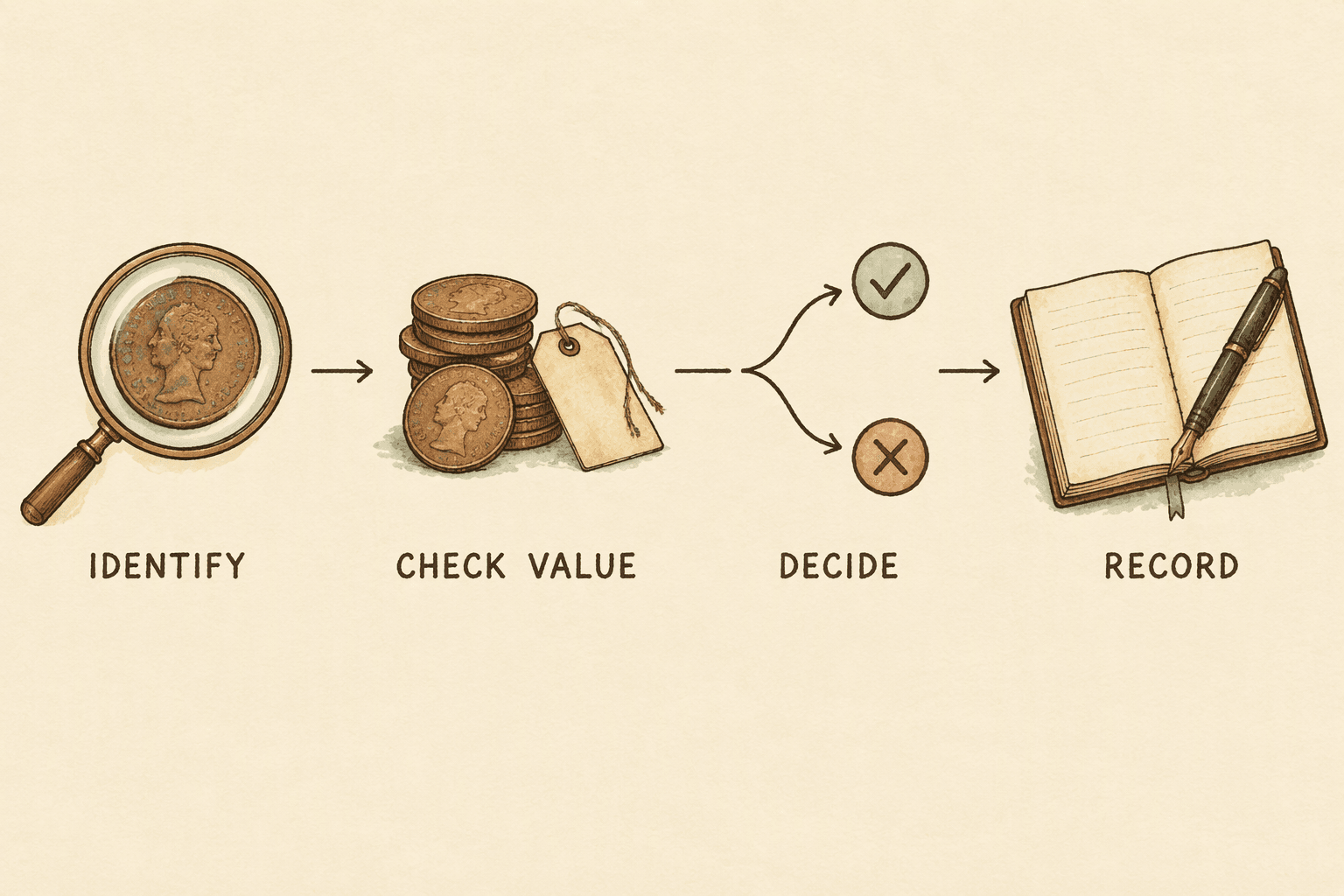
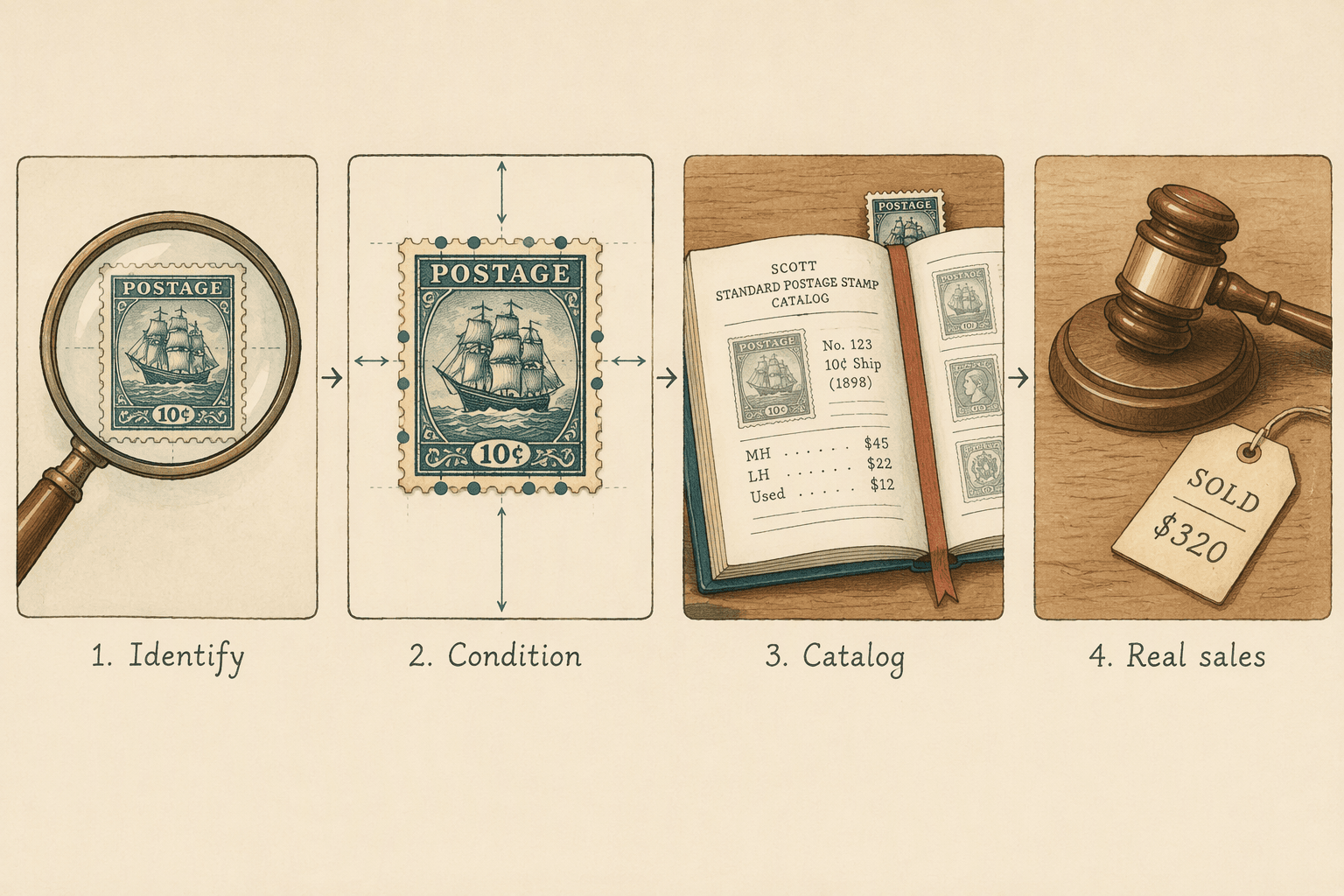
Illustration: the decision this article walks through. Self-made editorial diagram, not a product screenshot.
The rule first: if a coin might be worth something, do not clean it
Collectors and dealers repeat this rule because the downside is one-directional. JM Bullion's numismatic guide puts it bluntly: even well-intentioned cleaning can permanently reduce a coin's value, strip away historical patina, and leave damage that is invisible to the naked eye (JM Bullion, checked 2026-10-06).
Two facts make the rule hard to undo:
- Cleaning is detectable. Residue, pitting, and wiped surfaces remain after cleaning. Professional graders and dealers recognize cleaned coins and discount them.
- A cleaned coin loses its numeric grade. NGC returns cleaned coins with a "Details" grade that names the problem on the label, and the discount that follows is permanent (JM Bullion).
If a coin looks dirty and you are not sure what it is, the correct move is to do nothing: put it in a safe place and get a trained eye on it first. The same rule applies to anything inherited. Our first-week checklist for an inherited coin collection covers this in more detail.
This article is about the cleaning decision. The long-term side of coin care (storage environments, holders, and how to avoid slow damage over years) is a different job, covered separately in how to preserve old coins without damaging them.
Why cleaning costs you: patina and hairline marks
The dark or colorful surface on an old coin is called patina or toning. It forms slowly as the metal reacts with its environment, and it is part of the coin's history. JM Bullion notes that what looks like grime is often a sign of authenticity and age, because coins tone differently over time (JM Bullion). Stripping that surface removes evidence, not dirt.
The second cost is mechanical. Rubbing or polishing a coin acts like fine sandpaper and leaves microscopic scratches across the surface, known as hairlines. JM Bullion describes the same mechanism: new nicks in the metal, even ones you cannot see, dramatically reduce value (JM Bullion).
The Edmonton Numismatic Society quantifies the risk for everyday collectors: destructive cleaning with abrasives or acids can reduce collector value by half or more, and their guide tells the story of a collector who scrubbed thousands of silver dollars with a harsh abrasive until the only value left in each coin was its metal content (Edmonton Numismatic Society, checked 2026-10-06).
This is why "cleaning coins without losing value" is mostly a question of which coins you clean, not how you clean them. No home method makes a collector-grade coin worth more.
Step one: figure out what the coin is
Before you pick up any liquid, answer three questions about the coin:
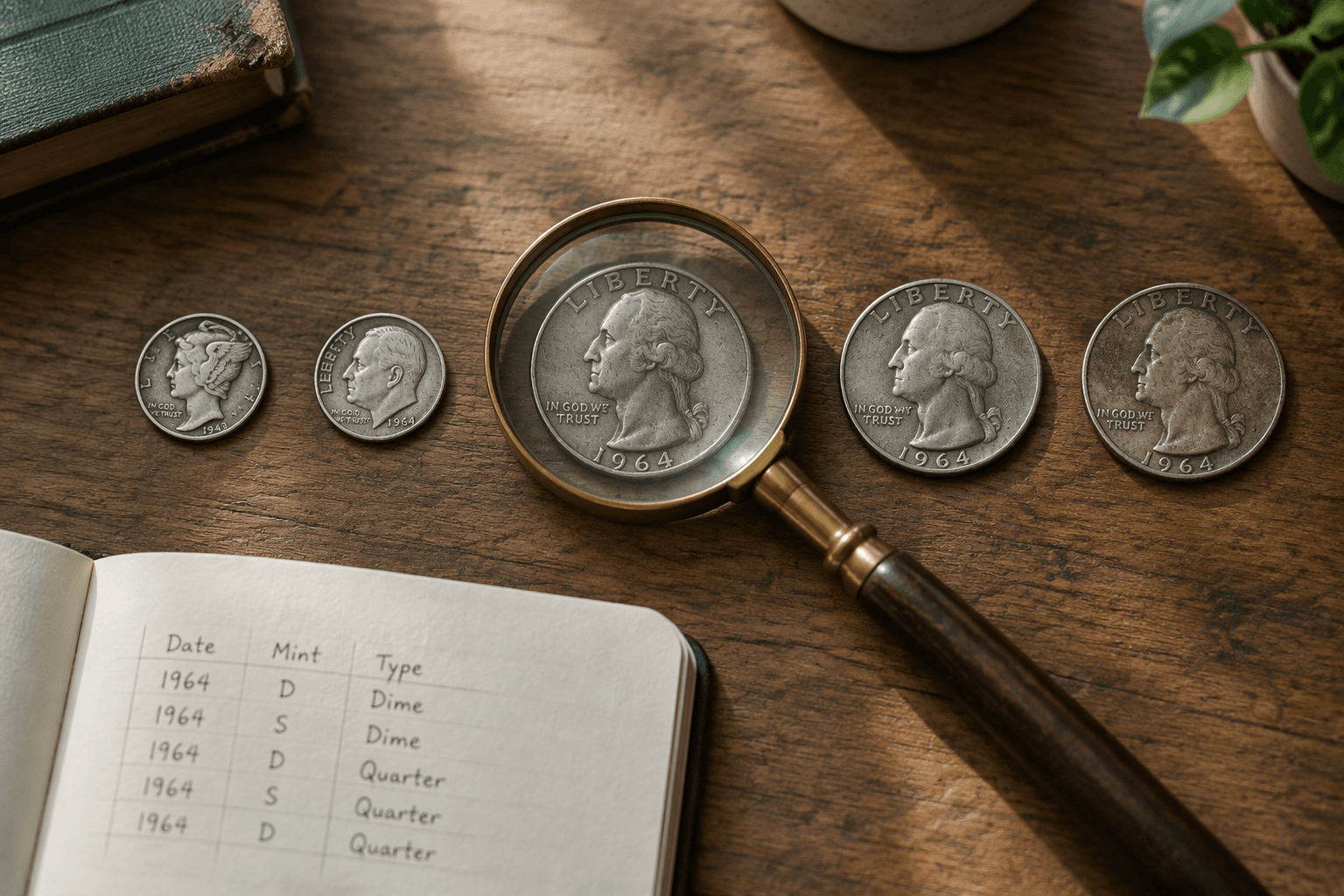
- Country, date, and mint mark. These identify the coin and hint at rarity.
- Metal. Copper, copper-nickel, and silver behave differently in water and solvents.
- Rarity and value cues. Key dates, low mintages, and precious-metal content are the signals that a coin should never be washed.
Our step-by-step guide to coin identification walks through this process, and how much are my coins worth covers how to check value cues with sources you can verify. If you finish that check and the coin might be valuable, stop here and leave it as it is.
If you finish the check and the coin is a genuinely common piece (a worn modern cent, a heavily circulated clad coin, a beaten-up world coin with no collector market), the gentle methods below are appropriate. That is the whole point of the decision: the same cleaning step is harmless for one coin and destructive for another.
Once you know the coin is common: safe cleaning by metal
The Edmonton Numismatic Society's guide separates cleaning into two kinds: destructive cleaning (abrasives and acids, which alter the surface) and non-destructive cleaning (solvents that are harmless to the metal). Their recommended non-destructive baseline is simple (Edmonton Numismatic Society):
- Use distilled water, not tap water. Chlorine in city tap water can discolor the coin.
- Add weak soap, not detergent. A weak soap solution in distilled water lifts dirt and grease from a grimy coin without damaging the metal.
- Rinse with distilled water, then let the coin air dry or pat it dry. Never rub, even with the softest cloth.
- For sticky residue or tape adhesive, pure acetone is the commonly used solvent. Note the fire hazard, and avoid fingernail polish remover, which contains acetone plus other chemicals that can damage higher-grade coins.
How far you can go depends on the metal:
| Metal | Lowest-risk approach | Where to stop |
|---|---|---|
| Copper (common modern cents) | Mild soap soak in distilled water, rinse, air dry | This is the limit. The Edmonton guide states there is no safe home method for copper alloy coins beyond this; anything above collector-uncirculated grade goes to a professional |
| Copper-nickel / clad | Mild soap soak in distilled water; pure acetone for adhesive residue | Same rule: rinse in distilled water, air dry, never rub |
| Silver (common, heavily circulated) | Mild soap soak in distilled water | Do not chase bright surfaces or toning with solvents. If the silver might be collectible, stop |
For collectible coins, the answer stays the same regardless of metal: leave them alone, or hand them to a professional conservator. Active corrosion, verdigris, and PVC residue are ongoing damage that gets worse if ignored, but treating them is conservation work for a professional, not a cleaning chore (JM Bullion).
Copper coins: verdigris and hard crust
Copper is the most common material in low-value old coins, which is why "how to clean copper coins without damaging them" is its own question. The honest answer has three parts:
- Ordinary grime on a common cent: the mild-soap-and-distilled-water soak above is as far as a home cleaning should go. No vinegar, no salt, no scrubbing.
- Verdigris (the green crust) and other active corrosion: this is decay, not dirt. The Edmonton guide warns that restoring badly corroded coins is usually a waste of time, because permanent damage usually sits underneath the crust even if you remove it (Edmonton Numismatic Society). This is professional conservation territory.
- Hard mineral crust on heavily encrusted coins: the Edmonton guide's one approved slow method is a long soak in pure olive oil, over days to months, which softens the crust without further damaging the coin. Patience, not chemistry, is the tool (Edmonton Numismatic Society).
If the copper coin turns out to be a collectible key date or an uncirculated piece, skip all of the above. The Edmonton guide is explicit that there is no safe method for upper-grade uncirculated or proof coins, or for copper alloy coins of value, and to always seek professional advice (Edmonton Numismatic Society).
What never to do
However common the coin is, these methods are off the list:
- Toothpaste, baking soda, steel wool, or any abrasive. The Edmonton guide defines destructive cleaning as the use of abrasives or acids, and every one of these is an abrasive on soft metal.
- Acid washes and commercial dips. The metal cleaners sold on TV and elsewhere are acid-based: they remove some of the surface metal along with the tarnish, and even a modern clad coin loses value from them (Edmonton Numismatic Society). Household acids (vinegar, lemon, cola) belong to the same category.
- Rubbing back and forth, even with a soft cloth. The Edmonton guide's line is absolute: pat dry, never rub (Edmonton Numismatic Society).
- Cleaning a coin whose value you have not checked. If the pro you eventually consult would have said "do not clean that," you have already taken the loss.
One more rule from JM Bullion worth keeping: if you bring a coin to a professional and the professional hesitates about cleaning it, read the hesitation as a no (JM Bullion).
How to handle and dry a coin
The U.S. Mint's care guidance, as cited in the current search results for this topic, holds a coin by its edges between thumb and forefinger, over a soft towel or surface, ideally wearing soft cotton gloves so skin oils stay off the surface (U.S. Mint, Caring for Your Coin Collection, retrieved via live SERP 2026-10-06).
After a soak, the Edmonton guide's method applies to every metal: rinse with distilled water, then let the coin air dry or press it gently against a soft cloth. Blotting removes moisture; rubbing removes surface metal (Edmonton Numismatic Society).
Record what you did
Most guides stop at the rinse. But a cleaning decision, like every other decision about a collectible, deserves a record. Note for each coin:
- What you did (soak, acetone, or decided not to touch it)
- What you used (distilled water, weak soap, pure acetone, olive oil)
- When, and ideally a before photo
This matters for two reasons. First, if you or a future owner ever sends the coin for grading or appraisal, a written record of what touched the coin is the only way to explain its surface. Second, a pattern across a batch of coins is easier to audit when each decision sits on a timeline.
This is the workflow Folidx's collection records are built around: every item has an event timeline, and a cleaning is recorded like any other event, with date and notes attached to the item's record. It is an optional step; a notebook or spreadsheet works too. What does not work is making the decision and leaving no trace of it.
FAQ
Can you clean coins without losing value? Only the coins that had no collector value to begin with. For a common, low-value coin, a mild soap soak in distilled water with an air dry is the lowest-risk cleaning there is. For any coin with collector value, JM Bullion and grading-industry practice agree that cleaning almost always lowers value, and the loss is permanent because graders return cleaned coins with a "Details" designation (JM Bullion).
Is Coke safe for cleaning old coins? No. Cola works on coins for the same reason acid cleaners are destructive: acidity dissolves oxidation together with a small amount of the surface metal. The Edmonton Numismatic Society warns against acid-based cleaners for exactly this reason, whether sold in a bottle or poured from a can (Edmonton Numismatic Society).
Will a patina wipe hurt? Yes. Removing toning with a cloth or chemical wipe is cleaning by another name. It strips the surface layer that documents the coin's age and leaves hairline scratches; a grader will see both and return a "Details" grade instead of a numeric one, and the discount that follows is permanent (JM Bullion).
Sources
- JM Bullion, "Should You Clean Your Old Coins," https://www.jmbullion.com/investing-guide/numismatics/should-you-clean-your-coins/ (full text fetched and checked 2026-10-06)
- Edmonton Numismatic Society, "Cleaning Your Coins," Guide to Coin Collecting, https://edmontoncoinclub.com/resources/guide-to-coin-collecting/cleaning-your-coins/ (full text fetched and checked 2026-10-06)
- U.S. Mint, "Caring for Your Coin Collection," https://www.usmint.gov/learn/collecting-basics/caring-for-your-coin-collection (handling guidance; retrieved and attributed via live US SERP 2026-10-06, task 10060102-2633-0139-0000-ad790e8e0f2d)
Boundary note: this article explains cleaning decisions and risks. It does not grade coins, estimate what any specific coin is worth, or promise a value outcome after cleaning.
SEO title: Should You Clean Old Coins? The Rule Most Collectors Learn Late Meta description: Should you clean old coins? Usually no. Learn why cleaning hurts collector value, safe steps for common low-value coins, and what never to do. Slug: how-to-clean-old-coins Structured data: Article + FAQPage (the three FAQ questions above). No Review or AggregateRating markup, no rating claims.