Coin Identification: How to Name an Unknown Coin, Step by Step
Name any unknown coin step by step: inscriptions, denomination, year, mint mark, and edge, then verify with free catalogs before trusting a photo tool.
Coin Identification: How to Name an Unknown Coin, Step by Step
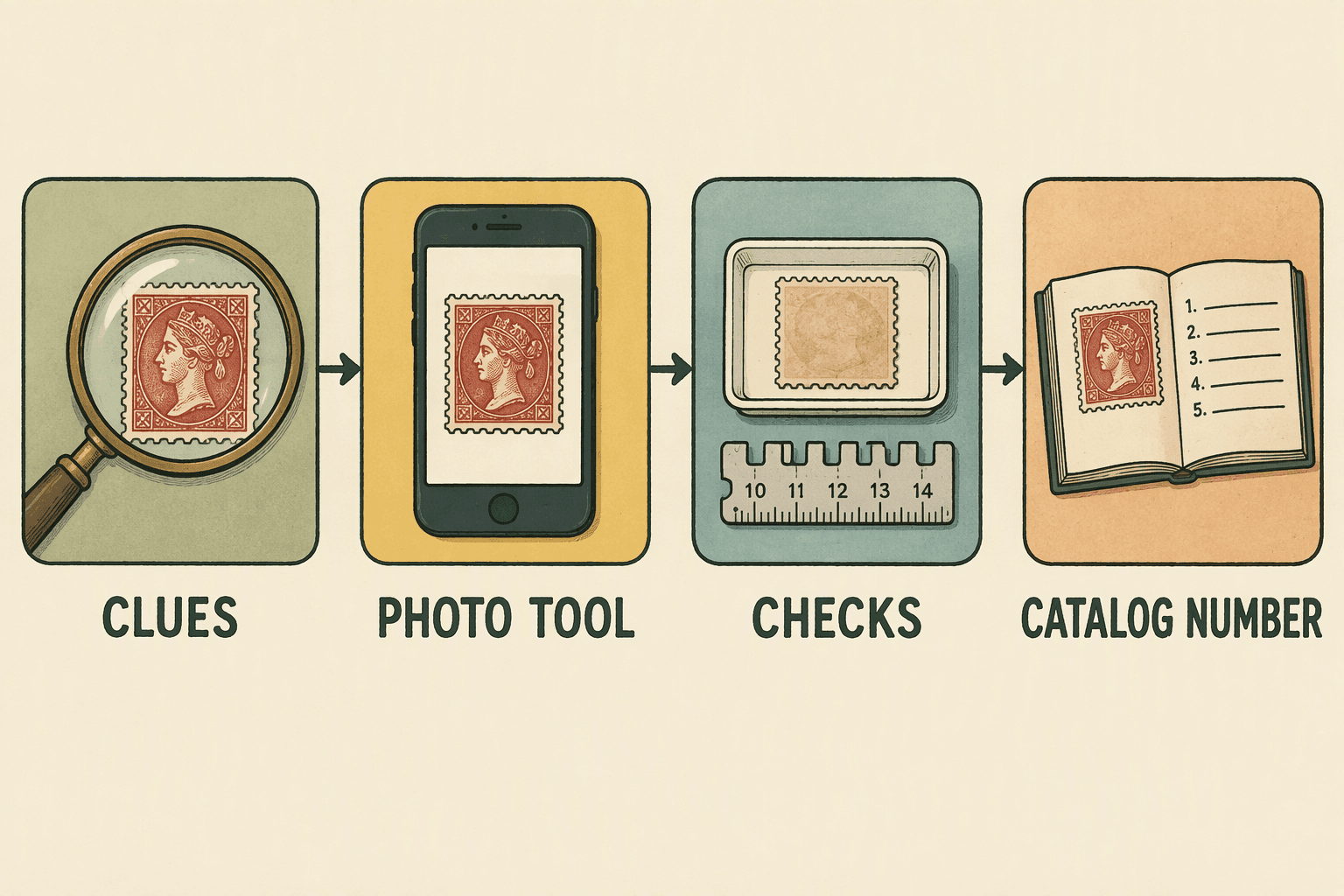
You can name most unknown coins in one pass if you read five things in order: the inscription, the denomination, the year, the mint mark, and the edge. A photo tool can speed this up, but it should confirm what you read, not replace it. Google's own summary of the topic points to the same sequence, and the tools it cites describe themselves as starting points rather than final answers.
This guide walks through the manual order first, then shows how to use photo identification without getting fooled, and finishes with free catalogs you can trust and a simple way to record what you concluded.
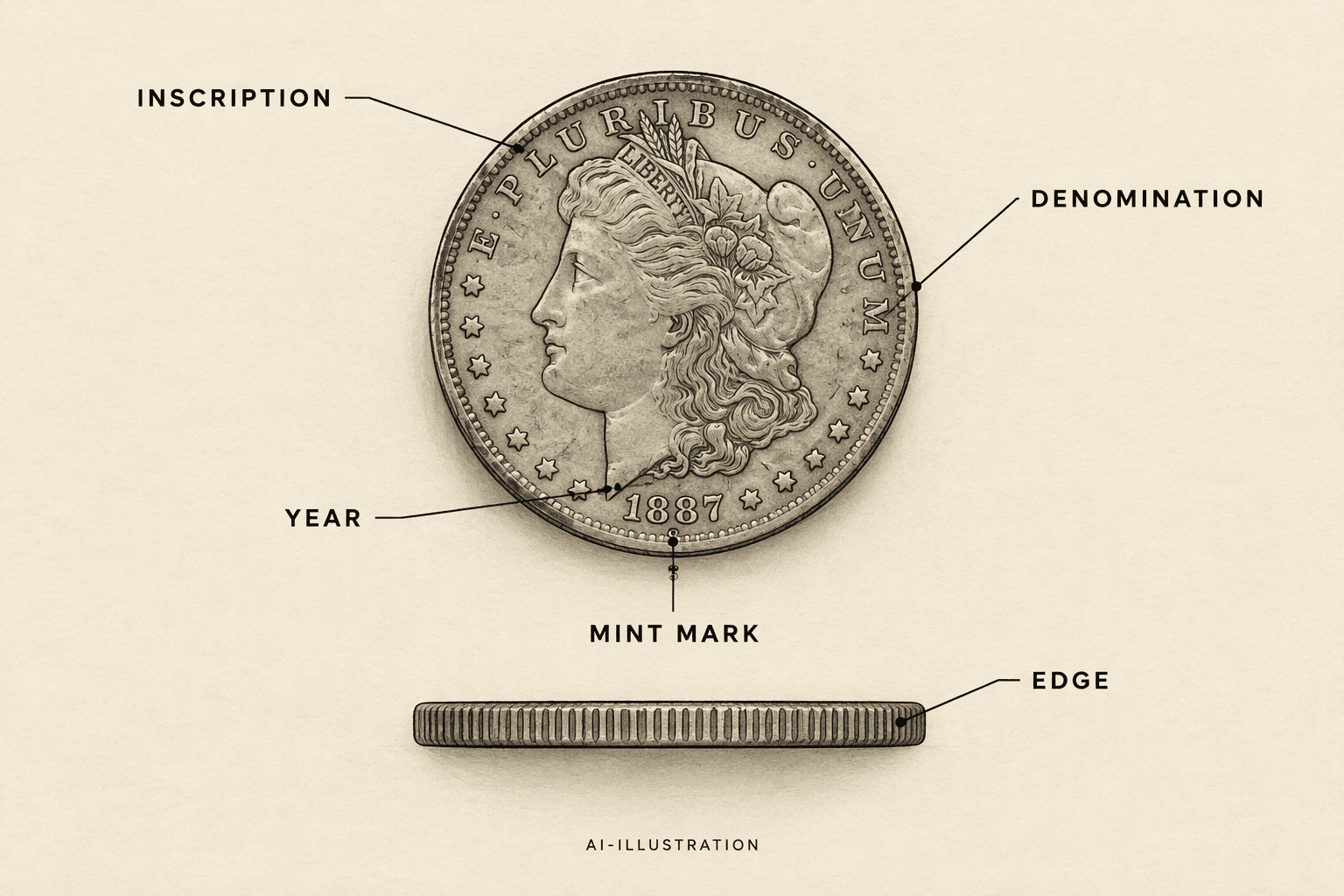
Illustration for this article, generated for editorial use. It shows the five identification elements, not a specific coin or an appraisal.
First, Sort Your Coin in 30 Seconds
Before any detail work, put the coin into one of four buckets. This answers the common question of how to identify a coin when you know nothing about it yet:
| Bucket | Quick signs | What changes |
|---|---|---|
| Modern coin from your own country | Familiar language, current ruler or design style | Easy: read it directly, then verify in a catalog |
| Older or worn coin | Soft lettering, heavy wear, unfamiliar portrait | Expect catalog work; handle with extra care |
| Foreign coin | Unfamiliar script, symbols, or metric units | Start with the inscription to find the country |
| Commemorative or proof-like piece | Special designs, mirror surfaces, unusual packaging | Check whether it is a standard issue or a special strike |
Sorting first keeps you from chasing rare-coin scenarios when the answer is a common circulation piece. Most unknown coins turn out to be ordinary; the five-step read below will show that quickly.
Step 1: Read the Inscriptions
Inscriptions are the fastest route to a country. Look for:
- A country name, such as "UNITED STATES OF AMERICA" or "CANADA".
- A ruler's name or portrait style, common on Commonwealth and European coins.
- Mottos, such as "E PLURIBUS UNUM", which narrow the issuing authority.
- A language script. Arabic, Chinese, Japanese, or Cyrillic lettering points to a specific region and tells you which translation aid to open.
If the legend is worn, read the clearest fragment and search that fragment plus the word "coin". Even two or three readable letters often identify the series. If both faces confuse you, our guide to the obverse and reverse of a coin explains which side carries which details on most world coins.
Step 2: Find the Denomination and Unit
The denomination is written either as a number with a unit, like "50p" or "¥100", or spelled out, like "ONE CENT" or "QUARTER DOLLAR". Pair the unit with the country you found in Step 1 and you have the coin's basic identity: country plus value.
Watch for two traps:
- Old or pre-decimal systems. A "shilling" or "gulden" dates the coin to a specific monetary era and rules out modern issues.
- Two countries using the same unit. "Penny" fits both the UK and former British territories, so the inscription, not the unit, settles the country.
If the denomination is missing from the design, measure the diameter with a ruler to the nearest millimeter. Diameter plus metal color usually leaves only one or two candidate denominations within a country's series.
Step 3: Read the Year and Mint Mark
The year is usually on one face near the portrait or the design. Read it carefully: a smudged "8" and "3" send you to different decades, and some series reuse designs across long spans.
Then look for the mint mark, a small letter or symbol showing where the coin was struck. On many US coins it sits under the motto or near the date; a "D" and an "S" can mean different mintages for the same design. Mint marks matter because some years and mints produced far fewer coins, which is exactly what catalogs index.
For a full walkthrough of US letters and their locations, see our guide to US coin mint marks. If the surface is too worn to read the date, skip to the edge and the measurements below; catalogs often list diameter and weight per issue, which can still narrow the series.
Step 4: Check the Edge
The edge is the third side most people forget, and it carries real information:
- Plain edge: common on lower denominations and older issues.
- Reeded edge: fine parallel lines, standard on many US dimes, quarters, and halves.
- Lettered or incuse edge: text or symbols struck into the rim, used on some dollars, coins from specific periods, and many modern commemoratives.
Run a fingertip around the rim and note what you feel. Then compare it with the catalog entry for your candidate series. A mismatch here, for example a plain edge where the catalog says reeded, often means you are looking at a different denomination, a different country, or a copy. Treat any mismatch as a reason to recheck Steps 1 through 3, not as a conclusion about authenticity.
Step 5: Photo Identification: How to Use It Without Getting Fooled
A photo tool fits naturally here. You have read the inscriptions and now want a shortlist of matching series to verify. Tools such as Coinoscope describe their own job this way: snap a picture, and the app "will show you a list of similar coins". That is the right mental model. A photo match is a shortlist, not a name.
Three things most often cause a photo tool to mislead you, and each has a simple fix:
- Glare and reflections. A shiny surface reflects the room, and the model reads the reflection instead of the design. Shoot in soft, indirect light and tilt the coin so light falls across it, not into the lens. The photo guides on Coins Identification make the same point: natural light, no shadows, no strong filters.
- No sense of scale. Two designs that differ only in diameter look identical in a cropped photo. Place a ruler or a standard object beside the coin, or record the diameter separately, so the result can be checked against catalog specifications.
- Near-identical varieties. Different years, mint marks, and small design changes can look the same to an image model. If two candidates look plausible, go back to the year and mint mark you read in Step 3 and let those details decide.
Photograph both sides, keep the text in focus, and take a second, angled shot of the edge. If you want a fuller shooting setup, our guide on how to photograph coins covers lighting and angles for reference images.
One caution from the same sources: do not clean the coin first. Cleaning is listed as a mistake to avoid before photographing, and it can lower a coin's value if it turns out to be collectible.
Verify With an Authoritative Catalog
After the photo tool gives you a shortlist, verify in a catalog before you write the name down. This step is what separates a guess from a usable identification, and it matters most when you identify old coins, where wear hides exactly the details that distinguish one issue from the next.
- The NGC Coin Explorer is a free online catalog for United States coins. It is organized by denomination and series, and each entry lists dates, specifications, and design details you can match against your coin.
- The guides on Coins Identification walk through country, date, denomination, symbols, and edge step by step, and they state plainly that a photo result should be treated as "a shortlist rather than a final identification".
- For any coin that may be silver, gold, ancient, or valuable, the same sources recommend a qualified expert before selling or relying on the result.
Check these points against the catalog entry: country and denomination agree, the year exists in that series, the mint mark matches the entry, the edge type matches, and the diameter and weight are in range. If all five agree, you have a defensible identification. If one disagrees, you are in the wrong row of the catalog.
Identification is not grading and not authentication. A catalog confirms what the design is; it does not tell you the condition grade or whether the coin is genuine.
After You Name It: Record the Conclusion, the Source, and Your Confidence
An identification you cannot reconstruct later is worth little. Write down, for each coin:
- The conclusion: country, denomination, year, mint mark, and edge type.
- The evidence: which catalog entry, which photo-tool match, and which details you compared.
- The confidence level: confirmed where everything matched, tentative where the coin is worn or a detail is unreadable.
This is where a private archive beats a spreadsheet or a camera roll. Folidx turns a coin photo into an editable identification report that keeps the original image, the visible condition clues, and source evidence separate from the conclusion, and every field stays editable so your review can change the record. Results enter Archive Books and Archive Pages, where photo search and duplicate checks help you find the coin again or confirm you do not already own it.
Folidx positions these reports as reviewable references, not appraisals. It does not grade coins, authenticate them, or promise a price, and neither should any conclusion you record from this process. If you want the next step after naming a coin, our guide on how much your coins are worth covers a careful, source-based way to look at value without appraisal claims.
FAQ
How can I identify my coins for free?
Do the manual read first: inscription, denomination, year, mint mark, edge. Then use free resources to verify. The NGC Coin Explorer is free to browse for US coins, photo tools such as Coinoscope offer a free basic tier, and the Coins Identification site lets you upload a photo without an account. Everything above costs nothing; the paid versions of tools add convenience, not authority.
Is a photo tool always right?
No. The tools' own guidance says a photo result is a shortlist, not a final identification. Accuracy depends on photo quality, visible text, and coin condition, and glare, missing scale, and near-identical varieties are the three most common causes of a wrong match. Use the tool to generate candidates, then verify each candidate against a catalog entry before you accept it.
What if the coin is worn?
Worn coins hide dates and legends first, so shift to the details that survive wear: edge type, diameter, weight, and metal color. Search for the readable fragments of lettering instead of the full legend. Photo tools struggle more with worn surfaces, so expect a weaker match and lean on catalog specifications. If the coin may be silver, gold, or ancient, ask a professional before assuming anything, and leave the surface untouched; cleaning a worn coin can remove the very evidence you need.
Sources
- Coinoscope: Identify coins by image, product page describing photo matches as a list of similar coins, accessed 2026-10-04.
- Coins Identification: Free Coin Identifier by Photo, guidance on photo quality, shortlist framing, and avoiding cleaning, accessed 2026-10-04.
- NGC Coin Explorer: United States, free US coin catalog, accessed 2026-10-04.
- Google search results and AI Overview for "coin identification", US locale, collected 2026-10-04 via DataForSEO organic SERP, task 10041421-2633-0139-0000-0a2e3083fcf5.