Coin Grading Explained: What the Sheldon Scale Actually Means
A plain-language guide to the Sheldon 1-70 coin grading scale: what MS, AU, VG and PF labels mean, how condition bands differ, and how to record what you see.
Coin Grading Explained: What the Sheldon Scale Actually Means
If you have ever picked up a coin and seen a label like "MS-63" or "AU-58," you were looking at a coin grade. Coin grading is the practice of describing a coin's condition on a standard scale so that two people, anywhere, can talk about the same worn surface the same way. The scale most grading services use runs from 1 to 70 and is called the Sheldon scale. This article explains how to read it: what each band of the coin grading scale looks like in hand, what the prefixes MS, AU, VG, and PF mean, and how to write down what you observe so your notes stay useful later.
One boundary up front: a grade is an opinion about condition. It is not a certificate of authenticity, a valuation, or a promise of any future price. Folidx keeps original photos and visible condition clues in your private archive; it does not assign grades.
What coin grading actually measures
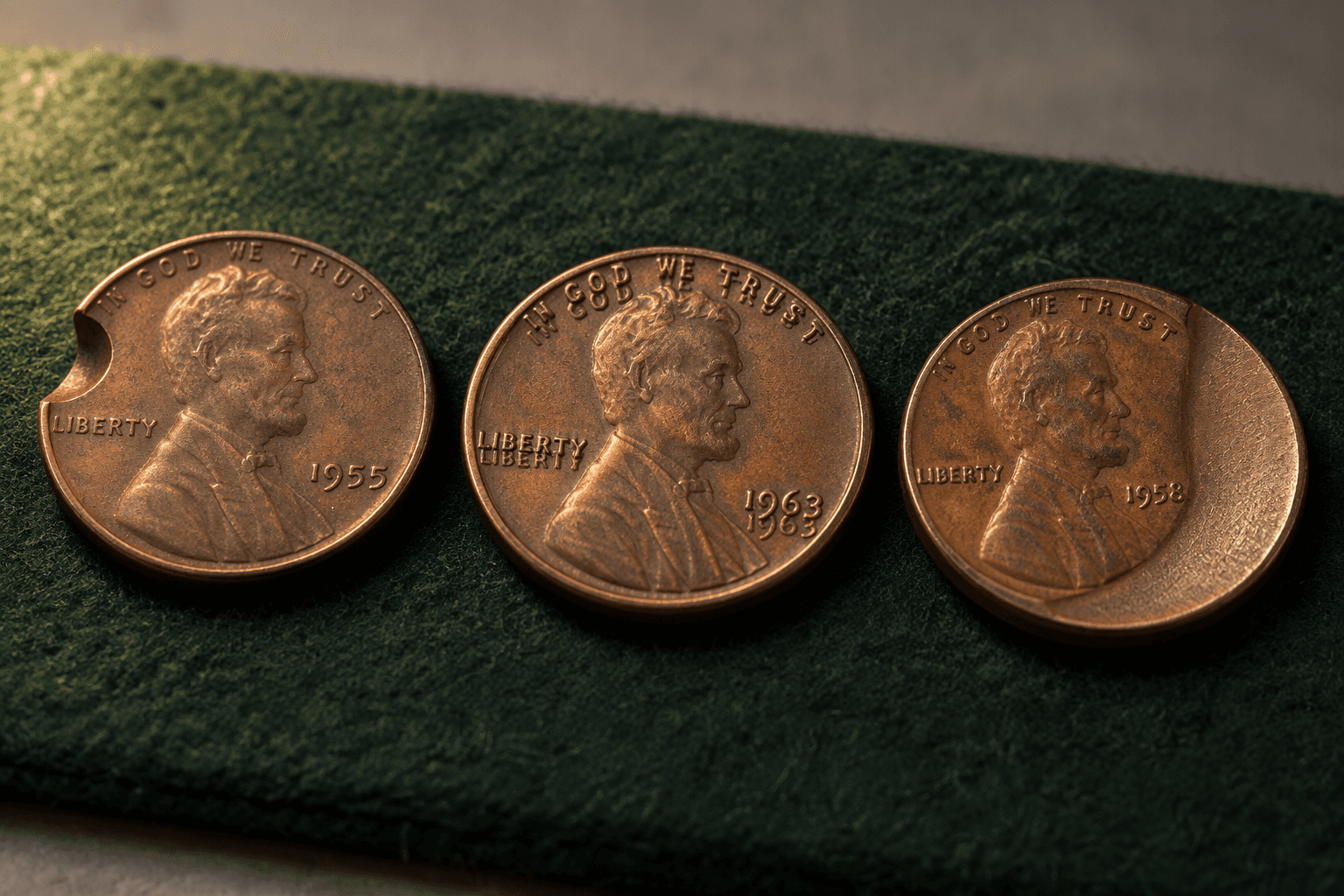
A grade answers one question: how much of the original strike has survived handling? Wear is not random. It starts on the highest points of the design, such as a cheek, a wreath detail, or the top of a letter, and spreads outward as handling continues. The 1 to 70 scale compresses that story into a number: the higher the number, the less wear and surface damage, with 60 and above reserved for coins that show no trace of circulation at all.
The scale grew out of work by Dr. William Sheldon in the 1940s and is now published in detail by the major grading services. NGC's grading scale page and PCGS's grading standards both describe condition using the same numeric bands, and the American Numismatic Association's official grading standards provide written descriptions for each step. Two labels attached to the same coin from different services can differ by a point; that is normal, because grading involves judgment at the boundaries.
The Sheldon scale, band by band
Rather than memorizing 70 numbers, it helps to read the scale as six bands. Each band has a signature you can check without magnification.
| Band | Grades | What you see on the coin |
|---|---|---|
| Poor to Fair | 1 to 2 | Enough detail to identify the type and date, at best. Rims are flat or nearly gone. |
| About Good to Good | 3 to 6 | Most letters and digits worn smooth or faint. The date is barely readable at AG-3; rims merge into the fields. |
| Good to Very Good | 8 to 15 | Major design elements appear in outline. Letters and digits exist but show softness. |
| Fine to Extremely Fine | 20 to 45 | Moderate wear on the high points, full design detail, and the first traces of original luster in protected areas at the top of the band. |
| About Uncirculated | 50 to 58 | Only slight wear on the highest points, full details, and most of the original mint luster. AU-58 is famous for looking uncirculated at a glance. |
| Mint State | 60 to 70 | No wear anywhere. The differences within the band come from contact marks, hairlines, strike, and luster, not from handling. |
Within the Mint State band, the definitions are about surface quality rather than wear. NGC describes MS-63 as an average strike with moderate abrasions and hairlines, MS-65 as well struck with minimal marks, and MS-70 as a coin with no post-production imperfections at 5x magnification. The ANA's written standard for AU-58 notes the barest trace of wear on one or more high points with nearly full luster, which is why 58 sits so close to the uncirculated line.
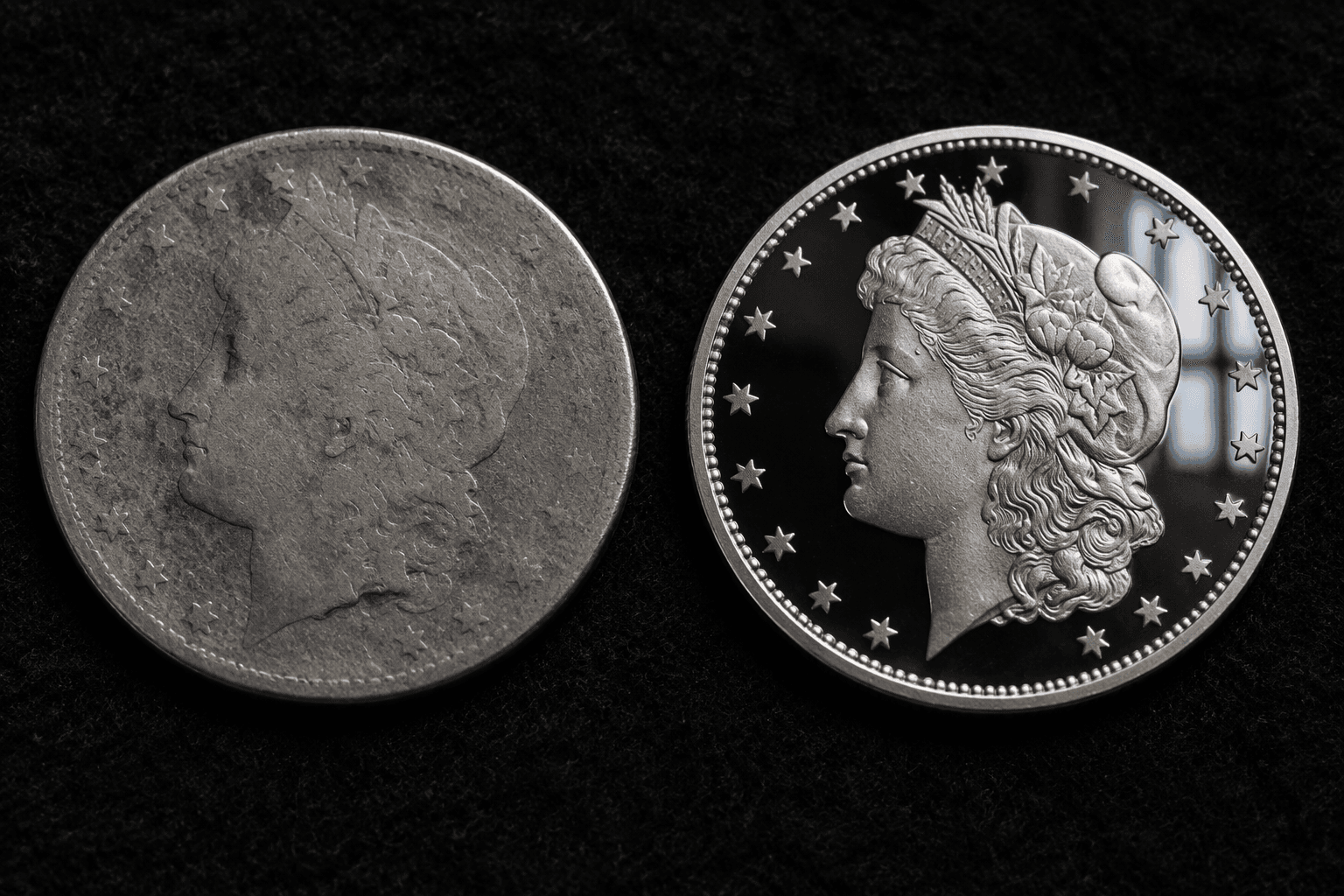
What MS, AU, VG, and PF mean on a label
A full label has two parts, and answering "what does MS mean in coin grading" is where most confusion starts. The letters describe the strike type or condition family; the number positions the coin inside that family. They are two separate pieces of information.
- MS (Mint State). A coin struck in the normal format for circulation that never actually circulated. Per NGC, MS applies to grades 60 through 70. An MS-63 can look better than an AU-58 in a photo, but the AU coin has been handled; the MS coin has not.
- PF (Proof). A coin struck in a special format for collectors, usually with mirrored fields and frosted raised details. Proof describes how the coin was made, not how much it was used. A worn proof still carries the PF prefix.
- SP (Specimen). A hybrid between Mint State and Proof: better than ordinary currency strikes but not meeting the definition of a true Proof.
- AU (About Uncirculated) and VG (Very Good) are condition names inside the circulated range, mapped to 50 to 58 and 8 to 10 respectively.
So MS-63 and PF-63 are not rivals on the same ladder. The first is a circulation strike with some bag marks; the second is a collector strike, made differently from the start. Reading the prefix first, then the number, prevents most misreadings.
Coin condition grades you'll see in practice
When you handle a coin yourself, the numeric labels translate into a short list of observable features. These are the everyday coin condition grades to check:
- Wear on high points. Flatten a cheek, a wreath leaf, or a letter top and you are below Mint State.
- Contact marks. Small nicks from the coin touching other coins in bags or rolls. Their size, number, and location drive most of the difference between MS-60 and MS-65.
- Hairlines. Fine, usually straight lines from wiping or old cleaning. Visible hairlines pull a Mint State coin down the band.
- Luster. The cartwheel sheen from the original strike. It survives in protected areas longest, and its presence or absence is the fastest wear test.
- Toning. Surface color change over time. Toning is part of the surface condition, not a defect by definition, and NGC notes that eye appeal from toning can earn special designations.
- Cleaning marks and rim damage. Abrasive cleaning leaves swirls that grading services treat as surface damage, which is why our cleaning decision guide recommends leaving surfaces alone in most cases.
Note the difference between what is visible and what is not. Everything above can be checked by eye or with a loupe. Hidden issues, such as corrosion under dark toning or a repaired surface, are not part of a visual assessment, and no photo-based process can confirm them.
Why two coins in the same band can look different
Two coins labeled MS-63 can look quite different side by side. The number compresses several attributes, including strike, marks, luster, and eye appeal, into one figure, and services weigh those attributes differently at the margins. Collectors use auction catalogs like Heritage's grading tutorial to compare photos with assigned grades and calibrate their own eye.
This is also why your own record should stay layered. Note what you can verify (wear on specific high points, visible marks and where they sit, luster in protected areas) separately from any label printed by someone else, and mark which observations are confident and which need a second look. If the label and your observation disagree, the useful move is not to overwrite one with the other; it is to keep both with dates and sources so the record can be rechecked.
How to record what you observe
A grade you cannot trace back to evidence is just a number in a notebook. The practical routine is simple:
- Photograph the coin from both faces under even light, keeping the original image.
- Note the visible clues: wear locations, marks, luster, toning, rim condition.
- Attach the source of any grade or description you copied, including the label's service and certification number if there is one.
- Mark anything uncertain for review instead of forcing a decision.
Folidx is built for this recording role. Each entry keeps the original photo, surfaces the visible condition clues it finds, links each claim to its source, and flags low-confidence fields so you know what to recheck. A condition review can be logged as an event on the item's timeline, so the record grows with the coin instead of replacing itself. If you are sorting out a whole coin box, the check-value workflow explains where condition fits among the inputs that matter, and the obverse and reverse guide covers the terms you will use to describe where wear sits.
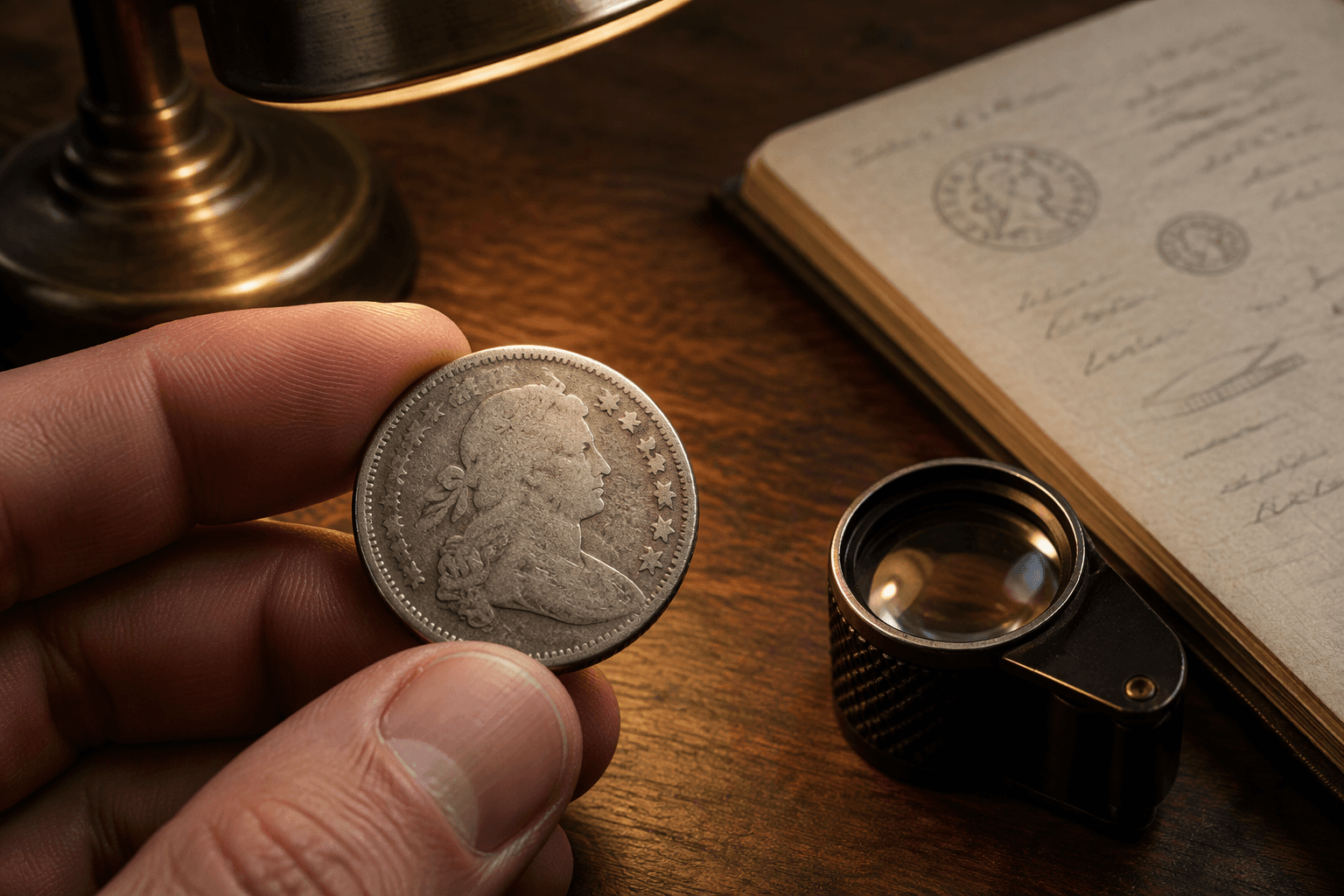
If you want to try this on one coin tonight: hold it under a single light source, tilt it slowly, and watch where the light breaks. Luster that rotates smoothly with the tilt means an unhandled surface. Flattened highlights that stay dull mean wear. That single observation is the core of the whole 1 to 70 scale.
FAQ
How do you find out the grade of a coin?
If the coin is in a sealed holder, the label shows the grade assigned by the grading service, usually with a certification number you can verify on that service's website. For a raw coin, you have two paths: compare what you can see against the published standards from NGC and the ANA to form your own estimate, or submit the coin to a third-party grading service, which assigns its own opinion for a fee. This article covers the first path: recording your own observations with evidence.
Is coin grading the same as authentication?
No. A grade describes condition; authentication is a judgment that a coin is genuine. Grading services typically perform both, but a number on a label by itself is not proof of authenticity, and a genuine coin can carry any grade from 1 to 70. Keep the two questions separate in your records.
Sources
- NGC Coin Grading Scale - strike types (MS, PF, SP) and numeric grade descriptions
- ANA Official Grading Standards - written descriptions for MS, AU, EF, VF, F, VG, G, AG, Fair, and Poor
- PCGS Grading Standards - Sheldon scale adoption and service standards
- Heritage Auctions coin grading tutorial - numeric and adjectival grading practice
Folidx records condition observations, original photos, and sources in your private collection archive. It does not grade, authenticate, or appraise coins, and nothing in this article should be read as a valuation or a grading conclusion.