Coin Errors: How to Tell a Mint Error From Post-Mint Damage
The three mint error families, the famous doubled die penny, a four-question test to separate real mint errors from damage, and how to record findings.
Pick up an odd-looking cent and one question comes before every other: did the mint make it this way, or did the world damage it afterward? A mint error is created while the coin is manufactured. Post-mint damage happens later, in pockets, drawers, machines, or hands. The distinction matters because the two are judged differently, and mistaking one for the other is the most common mistake new collectors of coin errors make.
This guide walks through the three families of mint errors, the doubled die penny that starts most searches, a four-question test you can apply at a kitchen table, a checklist of penny errors and other coin errors to look for in everyday change, and a simple way to photograph and record what you find. It describes what to observe. It does not estimate what any coin is worth.
What a mint error is (and what it is not)
A mint-made error occurs when a coin is made incorrectly at the mint, and the definition covers everything that happens to the blank or coin up until the minting process is complete. Errors can come from a defective planchet, a defective die, or a mistake made during striking. Mints inspect coins during production and catch most mistakes, but some escape into circulation.
What a mint error is not:
- Post-mint damage (PMD). Scratches, dents, corrosion, bending, and flattening that happen after the final strike are damage, even if the damage occurred inside the mint during later automated handling.
- Intentional design features. A mint mark, a proof finish, or a special commemorative design is deliberate. A mint mark tells you which facility struck the coin; if you need that background, see what US coin mint marks mean. A proof coin's mirror fields and frosted devices come from a special striking process, not a mistake; the difference is covered in what a proof coin is.
The boundary line is the same one dealers and graders use: did the anomaly exist when the coin left the coining press, or did it happen afterward? Every check below is a way of answering that question from the coin itself.
The three error families: planchet, die, strike
Error classification follows the three things that can go wrong in making a coin: the blank (planchet), the stamping tool (die), and the moment of pressing (strike). Collectors shorthand this as the planchet, die, and striking system. Some errors span categories, for example a grease-filled die is a die problem that shows up at strike, but the three families cover most of what you will meet.
| Family | What goes wrong | Examples you may hear about |
|---|---|---|
| Planchet | The blank is wrong before it is struck: wrong size, wrong metal, incomplete, or defective | Clipped planchet, wrong planchet, missing clad layer, lamination flaw |
| Die | The stamping tool is wrong or damaged, and it repeats its flaw on every coin it strikes | Doubled die, die crack, die clash, cud |
| Strike | The pressing itself misfires: misalignment, missing collar, repeated blows, or mismatched dies | Off-center strike, broadstrike, multiple strike, mule |
The families matter because the verdict follows the family. A die error will repeat on every coin that die produced, in the same place. A strike error is usually a one-off accident. A planchet error shows up in the metal itself before any design was applied. Naming the family is the step that makes the error-versus-damage question answerable.
The doubled die penny: the error everyone should recognize
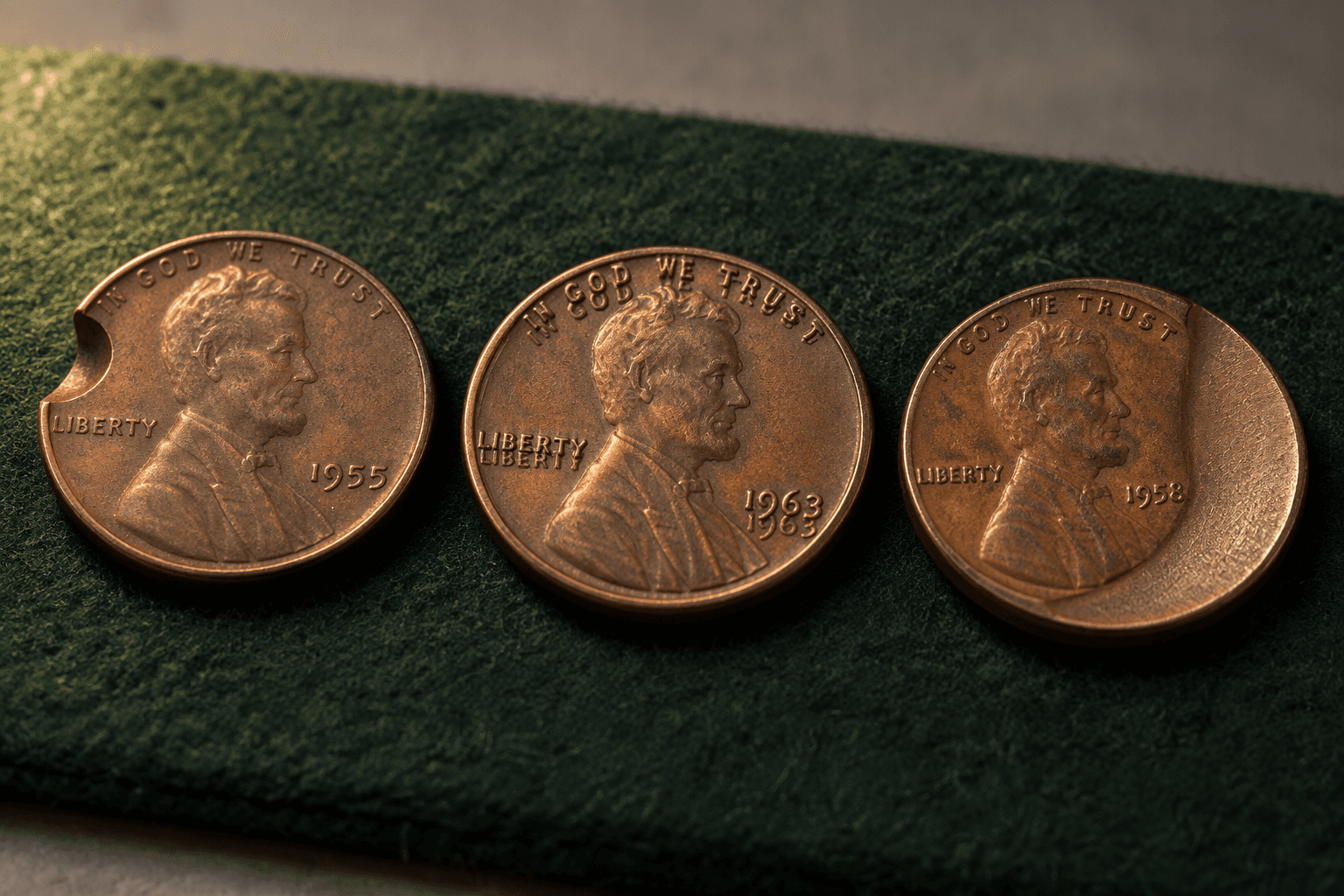
Searches for "double die penny" almost always mean a doubled die cent, and it is the classic entry point into penny errors. A doubled die happens when a working die receives an additional, misaligned impression from the hub during die production. Because the flaw lives in the die, every coin that die strikes shows the same doubled features in the same position. The most famous example, the 1955 doubled die obverse cent, was produced despite an obvious flaw and is a standard reference point for the type.
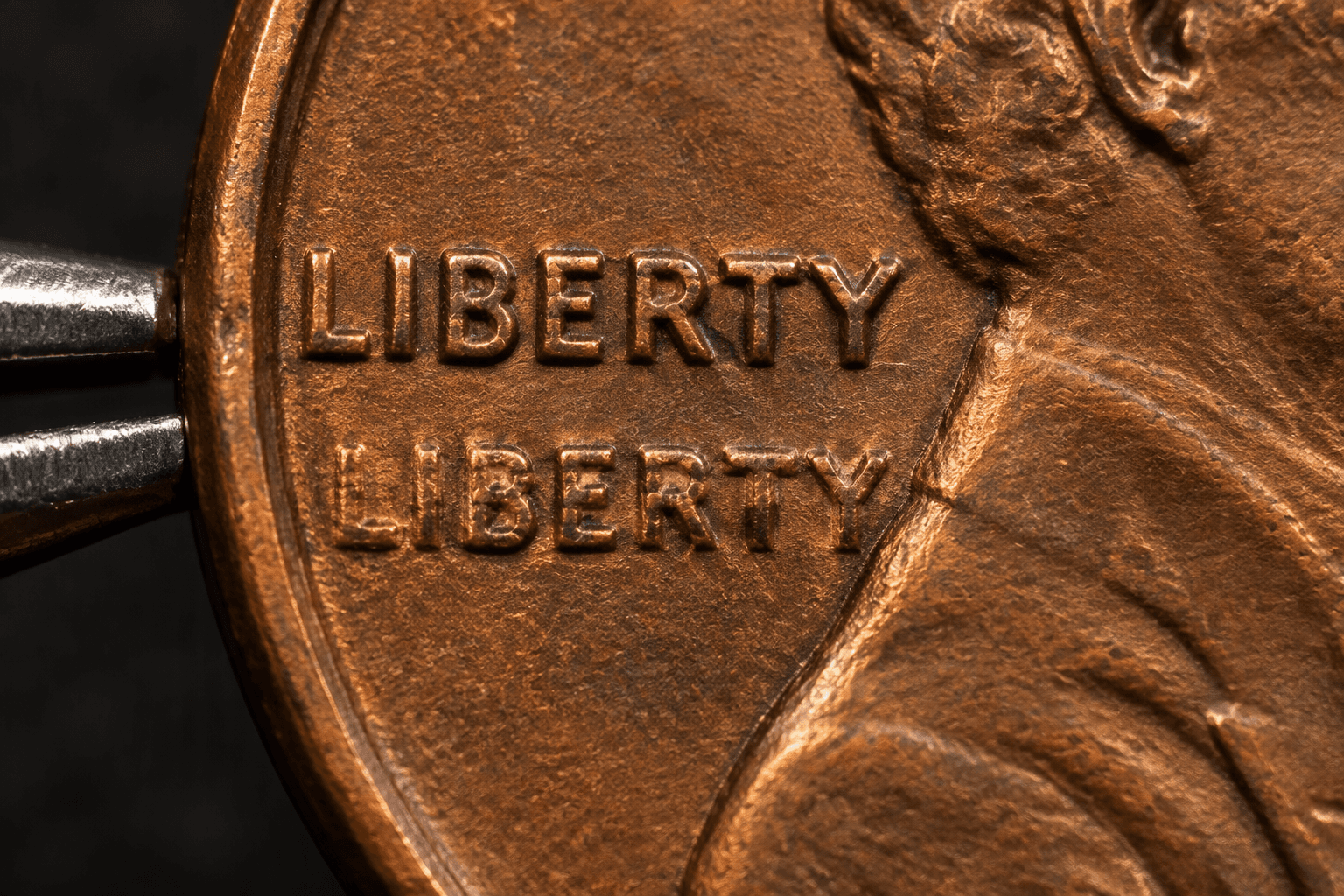
Doubling shows best on lettering and dates because those are crisp, repeated shapes. On a true doubled die the second impression is a complete, well-defined copy of the letterform: look at LIBERTY or IN GOD WE TRUST and you should be able to trace two distinct sets of serifs and edges.
Two look-alikes cause most false positives:
- Machine doubling (also called strike doubling) happens at the moment of strike, when the die shifts or bounces against the coin. It produces flat, shelf-like smeared doubling rather than a second complete letter.
- Die deterioration doubling appears late in a die's life as soft, rounded doubling from a worn die surface.
The practical test: on a doubled die, both impressions look like the design. On machine doubling, one impression is the design and the other is a smeared shelf of pushed metal. If you hold a doubled die suspect next to a normal coin of the same date and the extra letters repeat crisply and identically on both faces, you are looking at a die characteristic.
Four questions to separate a mint error from post-mint damage
You do not need special equipment to run this test, only good light, a steady hand, and patience. Work through four questions in order.
1. Does the anomaly follow the design? A genuine die error repeats the shapes of the design: doubled letters, a design element missing everywhere it should appear, a clash mark that echoes the other side's motifs. Damage does not follow the design; it lands where the coin met a hard edge, at random angles and depths.
2. Is the metal disturbed? Mint errors leave the struck surface intact. The anomaly is part of the strike: raised metal that flowed from the die, or a smooth blank crescent where the die never touched. Post-mint damage leaves evidence of force after the strike: scratches that cut through luster, gouges with sharp entry points, tool marks, or metal smeared or carved. If you can see fresh-looking gouges crossing over the raised design, the strike is no longer the question.
3. Does the rim tell a story? The rim is the most honest witness on the coin. An off-center strike leaves a smooth blank crescent and often a missing rim on one side. A broadstrike spreads past the retaining collar and loses its reeded or plain edge profile. A clipped planchet shows a smooth curved bite, sometimes with a matching weak spot on the opposite rim. Damage at the rim, by contrast, is irregular: coin-counter nicks, file marks, or a squeezed edge that does not match any mint process.
4. Would every coin from that die show it? A die variety is not a one-coin event. Every coin struck from that damaged or doubled die carries the same anomaly in the same spot, which is why error catalogs list them by date, mint, and die pairing. Damage happens once. If your anomaly looks like a repeatable feature of a whole die run rather than an accident on one coin, that supports the error side of the ledger. If the anomaly is unique and shapeless, damage is the better description.
Two honest limits apply. First, describing what you see is not authentication: conclusive attribution of a specific error variety belongs to recognized expert services. Second, condition interacts with everything above, and grading is its own discipline; the framework is introduced in coin grading explained. If the stakes are high, the coin should be examined by a professional before any conclusion is acted on.
Coin errors to look for in pocket change
The terms "penny errors" and "coin errors to look for" describe the same activity: scanning everyday change for the handful of anomalies that appear often enough to be realistic finds. These five cover most first discoveries.
| What to look for | Family | What you will see |
|---|---|---|
| Doubled lettering or dates | Die | Two crisp impressions of the same letters, identical on both copies, in the same place as on other coins of that die |
| Off-center strike | Strike | Part of the design missing, a blank crescent, and often a flat or absent rim on one side |
| Clipped planchet | Planchet | A smooth curved bite out of the edge, with the rim opposite the clip showing weak or missing detail |
| Die crack | Die | A thin raised line of metal crossing part of the design, following the same path on every coin from that die |
| Missing clad layer | Planchet | On a modern cent, quarter, or dime, one face showing the silvery core metal where the outer clad layer should be |
A scanning habit that works: go through change slowly once, checking dates and lettering rather than overall shine, then check edges and both faces of anything that pauses your eye. Compare a suspect against a normal coin of the same date and denomination, since many "weird" features turn out to be ordinary wear.
How to photograph and record an unusual coin
Whatever the verdict, the evidence is the part you keep. Photograph before you touch, research, or clean anything.
- Photograph both faces and the edge. The edge and rim answer question three, so give them their own frame.
- Add a close-up of the anomaly. Fill the frame with the doubled letters, the clip, or the crack.
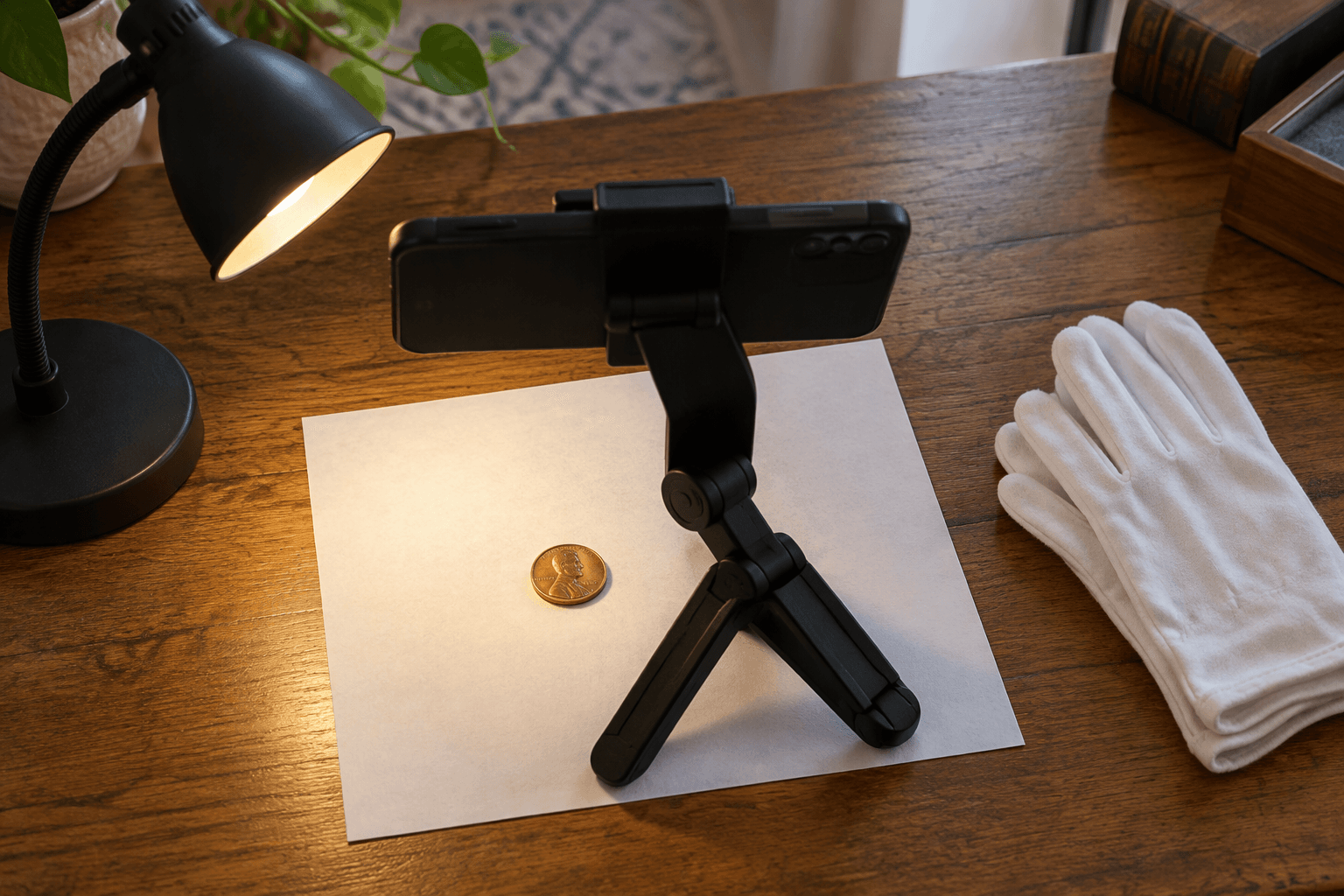
- Use raking light. A desk lamp at a low angle throws small shadows off raised metal and makes doubled edges readable. Direct flash flattens everything and hides the differences you are testing for.
- Include a scale reference. A ruler, or a common coin of known size, gives the photo context.
- Handle the coin by its edge, ideally over a soft surface, and never clean a coin you suspect of being an error.
- Write down the four answers before you give the coin any name. Does the anomaly follow the design? Is the metal disturbed? What does the rim show? Does the feature look repeatable across a die run? Those notes are worth more later than any first impression.
Once you have the photos and the four answers, the remaining task is keeping them together. Folidx turns a coin photo into an editable record where the original images, your condition notes, and your own observations stay attached to the coin in a private archive you can revisit later. It is a reference and organization tool, not a grading or authentication service, and it makes no value promises; its role is to keep your evidence intact while you decide whether the coin deserves an expert's attention.
Frequently asked questions
What are common types of coin errors?
The three families cover them: planchet errors such as clipped planchets, wrong planchets, and missing clad layers; die errors such as doubled dies, die cracks, and die clashes; and strike errors such as off-center strikes, broadstrikes, multiple strikes, and mules. Within each family, specific varieties are cataloged by date, mint, and die pairing.
How do I know if my coin is a mint error or just damaged?
Run the four questions: does the anomaly follow the design, is the metal disturbed, does the rim tell a mint-made story, and would every coin from that die show the same feature. Error answers point toward the design and repeat; damage is random, disturbs the struck surface, and happens once. Describing the coin is as far as a home examination should go; final attribution is an expert's job.
Why are error coins expensive?
When error coins carry premiums, the reason is the same as for any collectible: scarcity plus collector demand. Some error types are caught and destroyed at the mint, so the pieces that escape are few relative to the collectors who want them. That is a description of how the market works, not a promise about any particular coin, and this article makes no value claims. For a careful way to research what a specific coin may be worth, see how much are my coins worth.
How do I identify a rare coin?
Rarity identification is a research process, not a glance. Describe exactly what you see, use the error-versus-damage test to make sure the feature is original to the strike, then compare the coin's date, mint mark, and features against reference catalogs and reputable error references. Unusual appearance alone does not make a coin rare, and many dramatic-looking anomalies are common damage. When a genuine variety is suspected, professional authentication is the step that settles it.
Sources
- Wikipedia, "Mint-made errors": definition, planchet/die/striking classification, doubled die mechanics, post-mint damage distinction, and notable U.S. error varieties. https://en.wikipedia.org/wiki/Mint-made_errors
- Stack's Bowers, Error Coin Guide: error family taxonomy for collectors. https://stacksbowers.com/coin-resource-center/coin-collectors-guide/error-coin-guide/
- Stack's Bowers, Error Coins resource page: error versus post-mint damage framing. https://stacksbowers.com/coin-resource-center/error-coins/
- Bullion Exchanges, "Top Coin Error Types Every Collector Should Know": doubled die examples and error-type overview. https://bullionexchanges.com/learn/top-coin-error-types-every-collector-should-know
- Folidx product overview, section 2.2 (product boundary): Folidx provides reference and archive capability and does not offer appraisal, grading, or authentication.