State Quarters: How the 50-State Program Works and How to Collect the Set
How the 50 State Quarters program worked from 1999 to 2008, the issue-order list by state and year, the 2009 territory extension, and how to track your set.
State quarters are the quarters the United States Mint issued from 1999 through 2008, each carrying a different reverse design for one of the 50 states. Five designs came out each year, about one every ten weeks, in the order the states joined the Union: Delaware first in January 1999, Hawaii last in November 2008. In 2009 the Mint extended the format with six more designs for the District of Columbia and the US territories, which is why many collector folders show 56 slots instead of 50. The coins still turn up in change today, and a complete set is trackable with a simple state, year, and mint-mark record.
This guide covers the program rules, why the issue order follows the states, what the 2009 extension added, a full issue-order reference table, and a workflow for recording what you already own.
What the 50 State Quarters program was
Congress authorized the series in the 50 States Commemorative Coin Program Act, signed on December 1, 1997. From 1999 to 2008 the Mint released a circulating quarter with a unique reverse design for each state, roughly every ten weeks. The obverse kept the George Washington portrait used since 1932, so in any handful of change you can spot a state quarter by flipping the coin over.
The design rule was simple: one state per design, five designs per year, no state appearing twice. Each state picked its own theme through its governor, who sent finalist concepts to the Treasury Secretary for approval, and in 17 of the 50 states the public voted on the final design. (US Mint, Wikipedia)
Scale matters for anyone hunting the set today. Across the program the Mint struck 34,797,600,000 state quarters, an average of about 696 million coins per state, from Virginia at roughly 1.59 billion down to Oklahoma at about 416.6 million. The Mint estimated that 147 million Americans collected the coins during the run. Those numbers explain why a pocketful of change still yields several state designs on a regular afternoon, and why an ordinary circulated example is not, by mintage alone, unusual. (Wikipedia)
If you find a quarter you cannot place, the first step is naming it. The same steps used to identify any coin work here: read the date, check the reverse scene, then confirm the state. See our guide to coin identification for that process.
How the issue order works: why Delaware came first
The Mint released the quarters in the same order the states ratified the Constitution or were admitted to the Union. Delaware ratified first on December 7, 1787, so it took the first release on January 1, 1999. Hawaii became the fiftieth state on August 21, 1959, and closed the series on November 3, 2008. Between those two points, each new release moved to the next state in admission order, so within each year the release dates follow the states' admission order rather than alphabetical order by state name. (Wikipedia)
The practical result: you can predict roughly when a given state quarter entered circulation before you ever find it. New Jersey followed Pennsylvania in 1999, New York opened 2001, and the older the state's admission date, the earlier its coin appeared.
The 2009 extension: districts and territories complete the set
When the state series ended in 2008, a 2007 appropriations act extended the format for one more year. The District of Columbia and United States Territories Program added six quarters in 2009, one each for the District of Columbia, Puerto Rico, Guam, American Samoa, the US Virgin Islands, and the Northern Mariana Islands. The coins reuse the same Washington obverse and the same size and composition as the state quarters. (Wikipedia)
These six coins complete the 56-coin set that collector folders are built around. They also behave differently from the state series in one respect: mintages are far lower. The District of Columbia quarter leads the group at about 172 million coins, while the Northern Mariana Islands closed at about 72.8 million, an order of magnitude below the state-series average. You will still find them in change, but noticeably less often than any state design. (Wikipedia)
State quarters list: the ten-year issue-order table
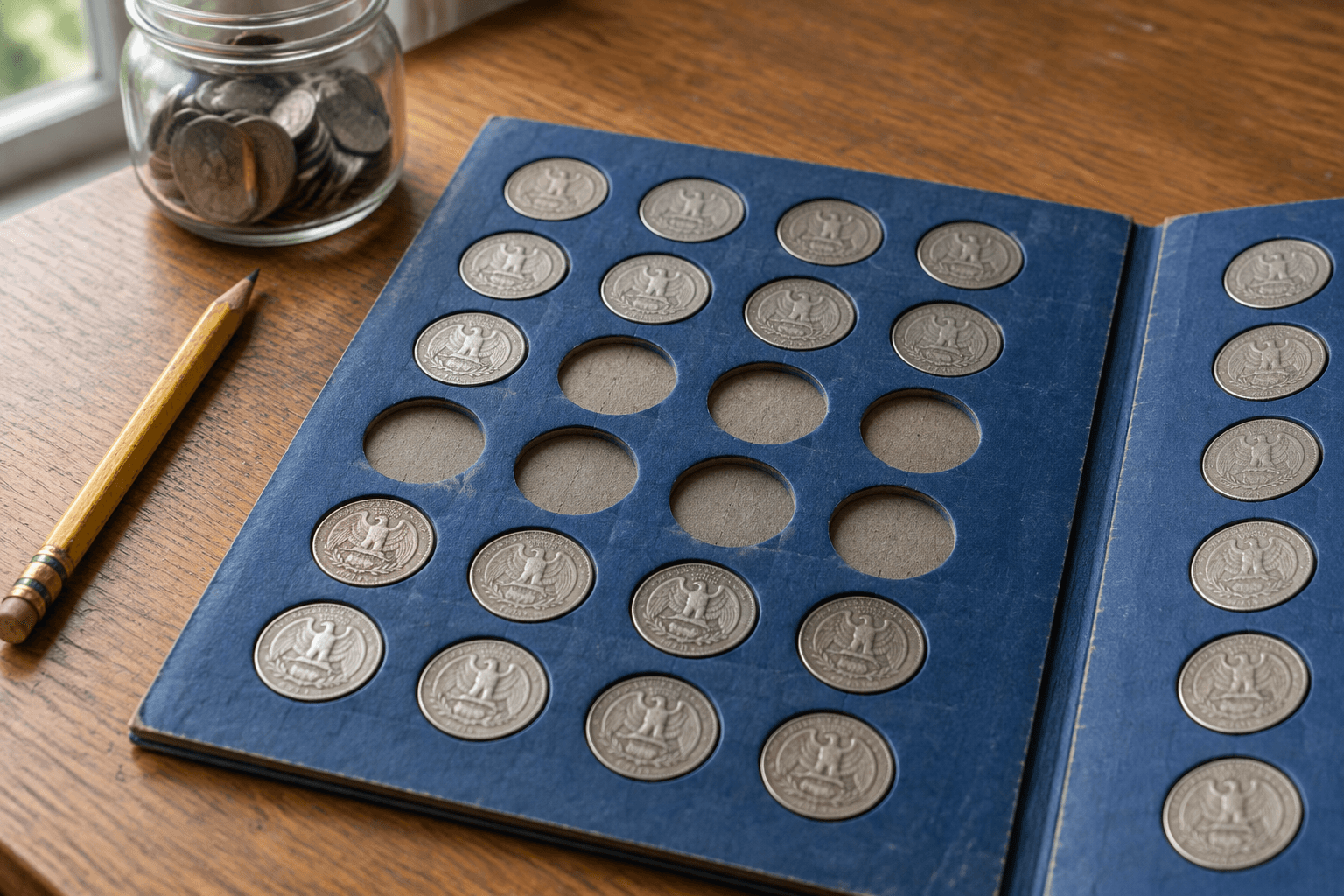
The table below lists every state quarter in issue order, with the reverse theme that identifies it at a glance. Printed checklists and collector folders organize the same list into slots, which is why a half-filled folder reads as a map of what is left to find.
| Year | State | Reverse design |
|---|---|---|
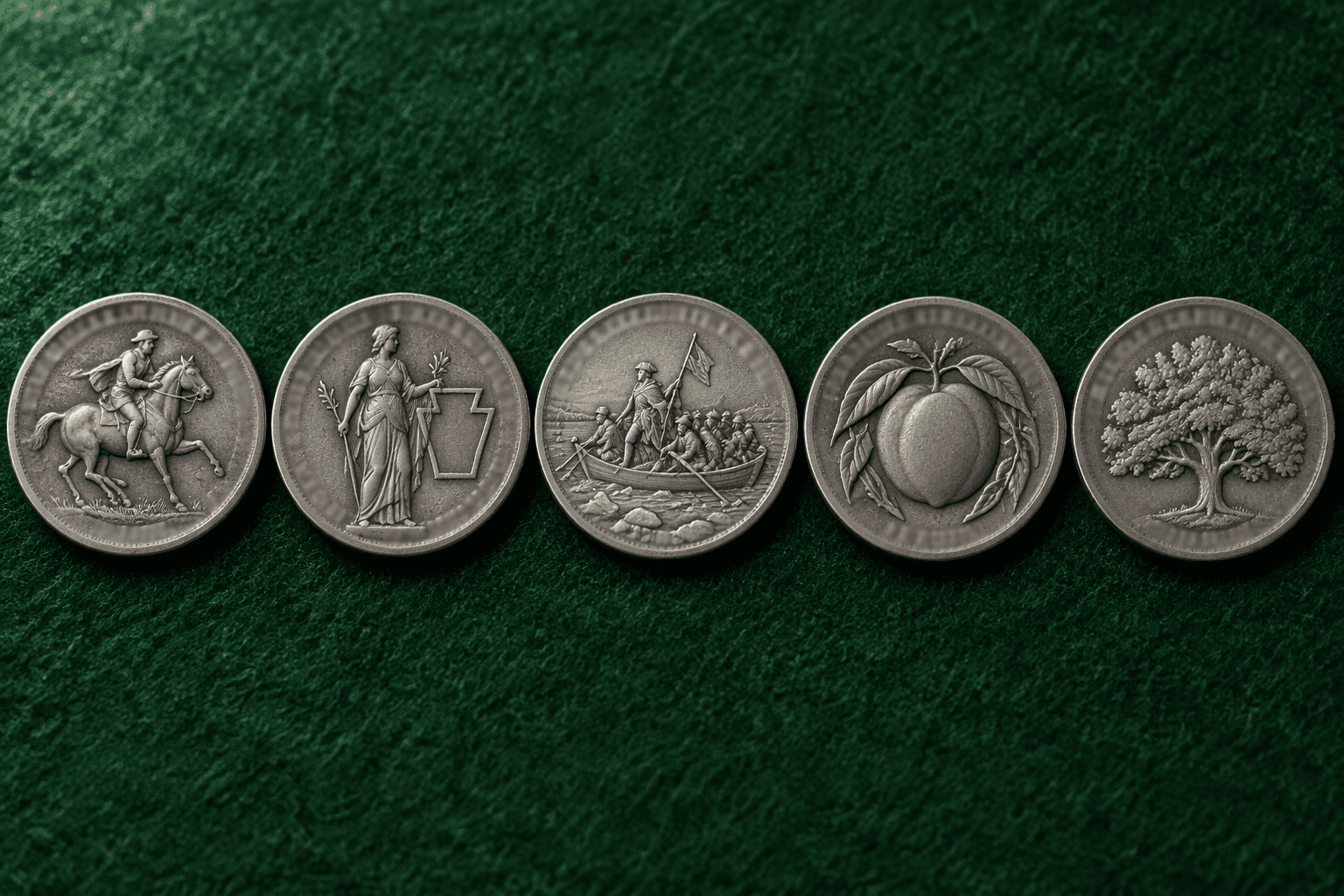
| 1999 | Delaware | Caesar Rodney on horseback, "The First State" |
| 1999 | Pennsylvania | Commonwealth statue, keystone, state outline |
| 1999 | New Jersey | Washington Crossing the Delaware |
| 1999 | Georgia | Peach with live oak sprigs and state outline |
| 1999 | Connecticut | The Charter Oak |
| 2000 | Massachusetts | Minuteman statue and state outline |
| 2000 | Maryland | Dome of the Maryland State House |
| 2000 | South Carolina | Palmetto tree, wren, yellow jessamine |
| 2000 | New Hampshire | Old Man of the Mountain |
| 2000 | Virginia | Jamestown ships, Susan Constant, Godspeed, Discovery |
| 2001 | New York | Statue of Liberty with Hudson River line |
| 2001 | North Carolina | Wright Flyer, "First Flight" |
| 2001 | Rhode Island | Pell Newport Bridge with a racing yacht |
| 2001 | Vermont | Maple trees with sap buckets, Camel's Hump |
| 2001 | Kentucky | Thoroughbred racehorse, "My Old Kentucky Home" |
| 2002 | Tennessee | Fiddle, trumpet, guitar, "Musical Heritage" |
| 2002 | Ohio | Wright Flyer III and an astronaut |
| 2002 | Louisiana | Pelican, trumpet, Louisiana Purchase map |
| 2002 | Indiana | IndyCar with 19 stars |
| 2002 | Mississippi | Magnolia blossoms |
| 2003 | Illinois | Young Lincoln with Chicago skyline |
| 2003 | Alabama | Helen Keller reading braille |
| 2003 | Maine | Pemaquid Point lighthouse with schooner |
| 2003 | Missouri | Gateway Arch with Lewis and Clark |
| 2003 | Arkansas | Diamond, rice stalks, mallard |
| 2004 | Michigan | State and Great Lakes outline |
| 2004 | Florida | Spanish galleon, palmetto, space shuttle |
| 2004 | Texas | Lone Star with lariat |
| 2004 | Iowa | Grant Wood schoolhouse scene |
| 2004 | Wisconsin | Cow, round of cheese, ear of corn |
| 2005 | California | John Muir, condor, Half Dome |
| 2005 | Minnesota | Common loon and state outline |
| 2005 | Oregon | Crater Lake |
| 2005 | Kansas | Bison and sunflowers |
| 2005 | West Virginia | New River Gorge Bridge |
| 2006 | Nevada | Mustangs at dawn, "The Silver State" |
| 2006 | Nebraska | Chimney Rock with Conestoga wagon |
| 2006 | Colorado | Longs Peak, "Colorful Colorado" |
| 2006 | North Dakota | Bison and badlands |
| 2006 | South Dakota | Mount Rushmore with pheasant |
| 2007 | Montana | Bison skull, "Big Sky Country" |
| 2007 | Washington | Leaping salmon before Mount Rainier |
| 2007 | Idaho | Peregrine falcon with state outline |
| 2007 | Wyoming | Bucking horse and rider |
| 2007 | Utah | Golden spike locomotives, "Crossroads of the West" |
| 2008 | Oklahoma | Scissor-tailed flycatcher |
| 2008 | New Mexico | Zia sun symbol with state outline |
| 2008 | Arizona | Grand Canyon and saguaro |
| 2008 | Alaska | Grizzly bear with salmon |
| 2008 | Hawaii | Statue of King Kamehameha I |
The 2009 extension adds the final six slots:
| Year | Jurisdiction | Reverse design |
|---|---|---|
| 2009 | District of Columbia | Duke Ellington at a grand piano |
| 2009 | Puerto Rico | Sentry box at Castillo San Felipe del Morro with maga flower |
| 2009 | Guam | Island outline, proa boat, latte stone |
| 2009 | American Samoa | Ava bowl, fue whisk, and staff with coconut tree |
| 2009 | US Virgin Islands | Three island outlines with bananaquit and yellow cedar |
| 2009 | Northern Mariana Islands | Latte stone, Carolinian canoe, fairy terns |
Designs and issue dates per Wikipedia's program record and the Mint's program page.
1999 state quarters: the first five designs people remember
The first year of the program produced the designs most people associate with the series, partly because the program's novelty peaked while they circulated.
- Delaware, January 1, 1999: Caesar Rodney on horseback, marking the midnight ride that carried his vote for independence. The caption "The First State" also made it the clearest statement of the release-order idea.
- Pennsylvania, March 8, 1999: the Commonwealth statue with the keystone and state outline.
- New Jersey, May 17, 1999: Washington Crossing the Delaware, the only state quarter to place George Washington on the reverse while he also faced the viewer on the obverse.
- Georgia, July 19, 1999: a peach with live oak sprigs.
- Connecticut, October 12, 1999: the Charter Oak.
Anyone who started a childhood folder in 1999 usually filled these five first, and they remain the most frequently pulled state quarters from change. If your set is missing something, the gaps tend to sit in the final-year states rather than here.
How to track your set: states, years, mint marks, and duplicates
A state-quarter set is easy to track because every coin carries three small facts on its face: the state on the reverse, the year on the obverse, and a mint mark. Record all three for each find.
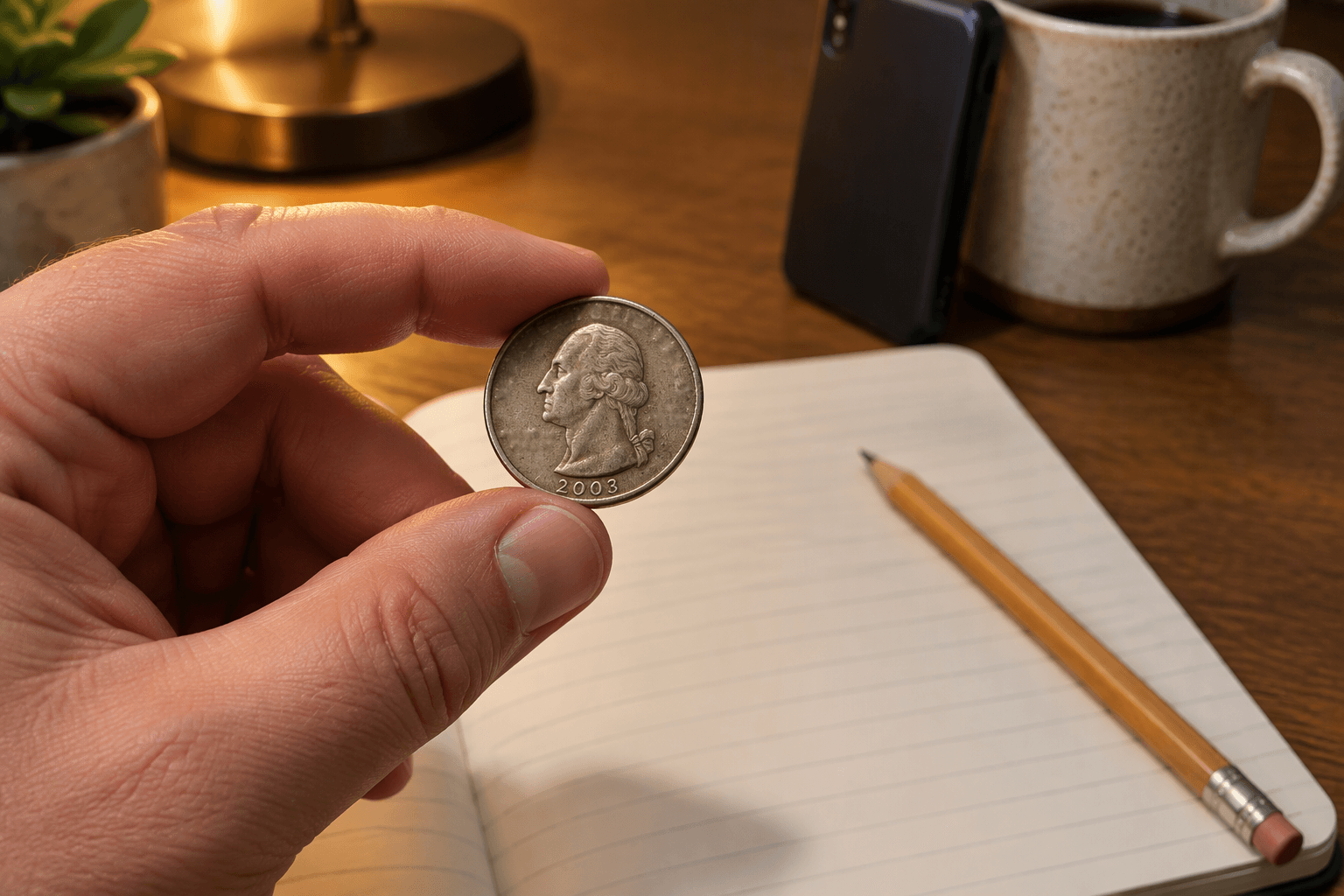
- Identify the state and year. The reverse names the state; the obverse gives the release year, which tells you the release block the coin belongs to.
- Read the mint mark. It sits on the obverse next to Washington's neck: P for Philadelphia, D for Denver, and S on proofs. Our mint-mark guide shows where to look on each series.
- Note visible condition. A few words on wear, scratches, or luster are enough for a personal record; keep the wording consistent so a later find can be compared against an earlier one.
- Flag anything odd. A filled die, an off-center strike, or a die crack is worth a second look and a photo. Our guide to mint error versus damage helps sort real errors from circulation wear.
- Check for duplicates before trading. Compare against what you already own before buying or swapping a missing state. State quarters are common enough that a duplicate purchase is the usual mistake, not a missed rarity.
For value questions, resist jumping from a state name to a price. Condition, mint mark, and documented varieties decide whether a specific coin is worth checking at all, and our coin value checking guide walks through that process without promising an appraisal.
An archive app such as Folidx can carry this same workflow: photograph each find, get an editable record with state, year, and mint mark fields, keep the coins organized in an archive book, and run a duplicate check before you trade for the next missing state. It is an optional tool, not a marketplace, and nothing in your archive leaves your account unless you choose to share it.
FAQ
Which state quarters are worth keeping? Most state quarters pulled from circulation are common by mintage, so state identity alone is not a reason to set a coin aside. What makes any specific example worth a closer look is condition, an unusual mint mark combination, or a documented die variety. If something looks different from a normal strike, photograph it and follow a careful value-checking process before drawing conclusions. See our coin value guide for the method.
What state quarter is worth 10,000 dollars? Headlines about five-figure state quarters usually point to a small number of documented errors, such as the Wisconsin quarter's extra-leaf corn variety, that drew collector attention when discovered. A single dollar figure is not evidence of a value for your coin. Value claims need a confirmed variety, a condition assessment, and current market references, and nothing here constitutes an appraisal. Our error versus damage guide explains how to document a candidate before asking for an expert opinion.
Can you still buy state quarters? The program ended with Hawaii in 2008 and the territory extension in 2009, and the Mint no longer sells program products. The coins themselves still circulate, so change hunting remains the cheapest source, and hobby dealers and auction sites offer individual coins, folders, and certified sets. Folidx is a collection archive, not a marketplace, so we do not sell coins.
What is the hardest state quarter to find? Oklahoma had the lowest mintage in the series at roughly 416.6 million coins against Virginia's 1.59 billion, so the last designs of the run are among the scarcer finds in change. The 2009 territory quarters are scarcer still, with mintages between about 72.8 million and 172.4 million. Scarce relative to other state quarters is still common in absolute terms, so a find is a find, not a windfall. (Wikipedia)
Sources
- US Mint, 50 State Quarters Program page (program definition and timeline)
- Wikipedia, 50 State quarters (issue order, release dates, mintage figures, design selection process)
- Wikipedia, District of Columbia and United States Territories quarters (2009 extension, territory designs, territory mintages)