Stamp Catalogs and Scott Numbers: How to Find the Right Number for Your Stamp
What stamp catalogs are, how Scott, Michel, Gibbons, and Yvert numbering differ, a five-step lookup workflow, and how to record catalog numbers.
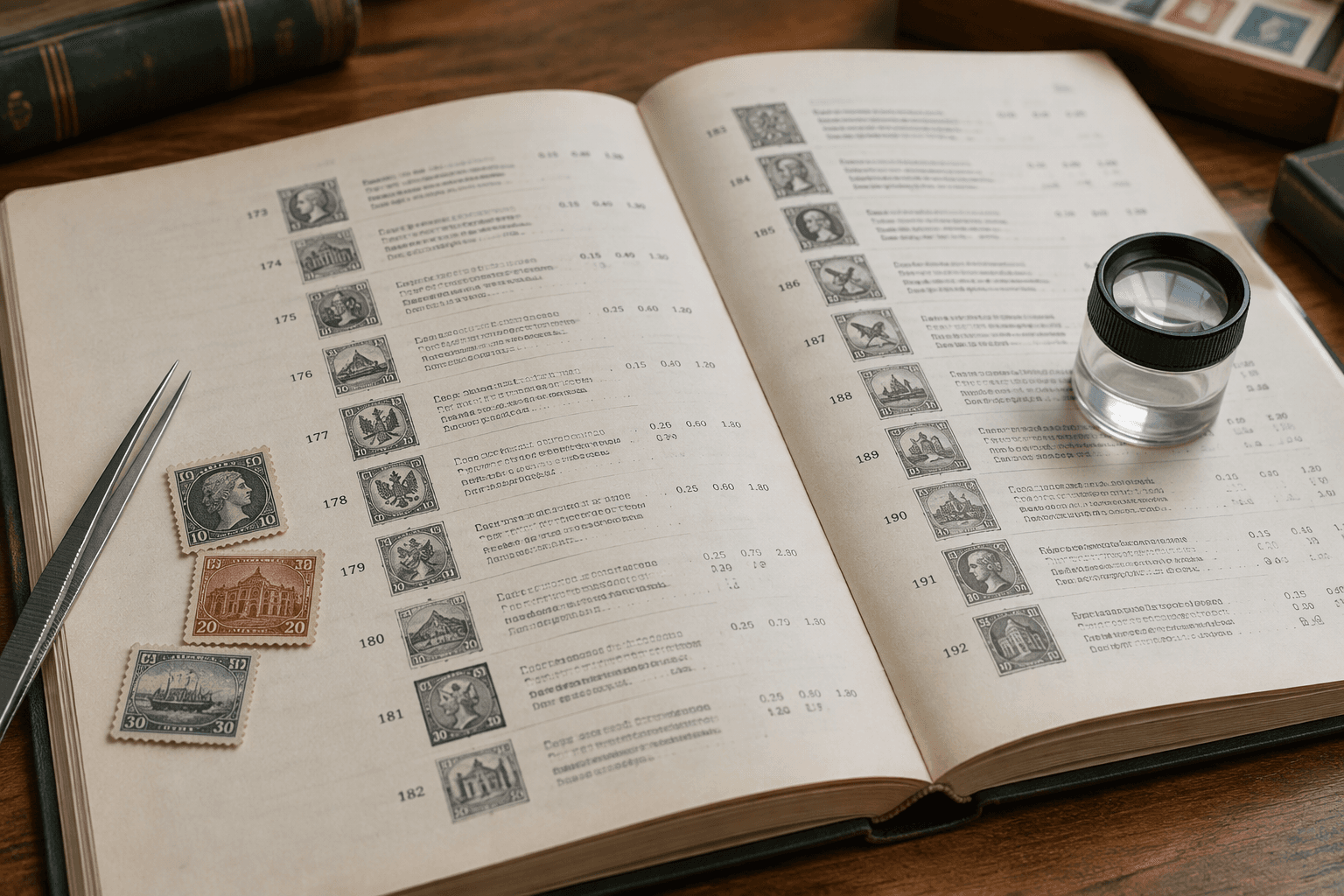
You can already describe your stamp: the country, the rough year, the picture. What you still lack is the shorthand every dealer, price list, and reference book uses for it: the catalog number. For United States stamps, that is usually a Scott number. This guide explains what a stamp catalog actually is, which catalogs matter, how to look up the right number in five steps, and how to record that number so it stays with your stamp.
What a stamp catalog is (and what the numbers are for)
A stamp catalog is a systematic reference that lists the stamps a country has issued and gives each one a number, along with issue dates, design descriptions, color and printing variants, and reference price context. It is one of the core tools of philately, and the format goes back to the first catalogs of 1861 (Wikipedia, "Stamp catalog").
The catalog itself does not grade your stamp or set the market. Its main job is to create a common vocabulary. When a dealer lists "Scott 1147" and a club member asks about "Scott 1147", both of you point to the same stamp without exchanging photos. That is why the number, not the description, is what gets written down: it is short, stable across editions, and reusable in price lists, auction lots, and your own archive.
The major catalogs in one table

Different publishers maintain different catalogs, and each assigns its own numbering sequence. These are the references a US collector runs into most often:
| Catalog | Coverage | Why it matters for US stamps |
|---|---|---|
| Scott Catalogue | United States and worldwide | The default numbering in the US market. Dealers, auction houses, and most US price lists quote Scott numbers (Scott, Mystic Stamp overview). |
| Michel | Worldwide, Germany-based | The standard reference in much of Europe, including a specialized German volume. |
| Stanley Gibbons | UK and Commonwealth emphasis | The standard for British and Commonwealth material; its listed prices are the publisher's own selling-price estimates (Wikipedia). |
| Yvert et Tellier | France and francophone markets | The usual numbering in France and French-speaking collecting circles. |
| H.E. Harris / Whitman US catalog | United States | A long-running, budget-friendly US catalog and price-guide line. The 2026 edition, the 91st, is currently listed with an illustrated stamp identifier (H.E. Harris 2026 US catalog). |
| USA Philatelic (USPS) | Current US issues | The Postal Service's free collector publication, a neutral way to confirm what the US is issuing now (USPS store page). |
| National Postal Museum collection search | US and worldwide holdings | A public catalog of real, photographed examples you can compare against your stamp (Smithsonian search). |
If you are choosing a US stamp catalog as a first stamp collecting catalog, the practical split is this: Scott numbering is what other American collectors will expect you to use, while the H.E. Harris / Whitman volumes offer a lower-cost way to own the same style of reference. One physical stamp can carry a different number in each system, because each publisher builds its own sequence, so collectors always name the catalog along with the number.
How to look up a Scott number in five steps
- Fix the country and the era. Start with the country name and, if you know it, the approximate year or reign. Most catalogs are organized by country first, then chronologically (Stamp identification: how to figure out what stamp you have covers this step in depth).
- Match the picture. Find the entries whose illustrations match your stamp's design, portrait, or subject. This is where the picture you already have does most of the work.
- Check what splits numbers. Look at the denomination, the colors, and the details a catalog uses to separate similar-looking entries: perforation gauge, watermark, printing method. Two entries that look alike in a thumbnail can be different catalog numbers (see the sections below and Stamp perforations: how to measure and record them).
- Confirm against the entry. Read the full entry for your candidate number, not just the thumbnail. The issue date, denomination, and description should all match your stamp. If the entry lists several perforations or shades, confirm which variant you are holding before you commit to one number.
- Save the number with the stamp. Write down the number, the catalog it comes from, and the date you checked it, following the record-keeping method in the last section.
A famous example shows how the code works. The 1918 24-cent airmail stamp with the airplane printed upside down, known as the Inverted Jenny, is cataloged as Scott C3a in the Smithsonian National Postal Museum's catalog record for the error (National Postal Museum, "24c Curtiss Jenny invert single"). The letter C marks the airmail series, and the "a" marks the major variety of the ordinary 24-cent airmail stamp, cataloged as C3. One short code identifies both the stamp and the specific variety, which is exactly what a catalog number is for.
When one stamp has several numbers: varieties, perforations, watermarks
Catalogs split what looks like the same stamp into different numbers based on production details:
- Perforations. The same design printed with different perforation gauges can carry separate numbers, which is why collectors measure the gauge before locking in a number.
- Watermarks. Older issues often exist with and without a paper watermark, and catalogs treat the two as different entries (What is a watermark on a stamp?).
- Shades and printings. Distinct ink shades, paper types, or reprint runs can each get their own number.
- Errors and major varieties. Significant printing errors receive their own codes, as the Inverted Jenny's "a" suffix shows.
This is also why two collectors can describe the same-looking stamp with different numbers: they may be using different catalogs, or they may disagree about which variety they have. The fix is not a better guess but a better record: name the catalog, the edition, and the features you checked.
Free and paid lookup options, described neutrally
You do not need to buy anything to find a number, and no single option is right for everyone:
- Paid print catalogs. The Scott volumes and the H.E. Harris / Whitman US catalogs are the classic home references. Libraries and stamp clubs often keep copies you can consult for free.
- Paid online versions. The major publishers offer digital editions with search and updates; coverage and pricing differ by publisher.
- Free online databases. Community catalogs and museum databases list millions of stamps with images. The Smithsonian's National Postal Museum search is a solid public reference (postalmuseum.si.edu).
- Dealer reference pages. Many dealers publish lookup guides and identifier tools. Treat them as reference reading, and note that commercial pages exist to sell catalogs and services.
Free sources vary widely in how complete and how current they are, so whatever you use, record which source produced the number. This article names catalogs for comparison only and links no offers.
How to record the number with your stamp so it stays findable
A catalog number only helps if you can find it again next to the stamp it describes. Keep three facts together:
- The catalog number, with the catalog name: "Scott 1147", not just "1147".
- The catalog and edition you checked, for example a named catalog and year, so the reference is traceable.
- The date you checked, plus where the number came from, such as a print catalog, a museum database, or a dealer page.
The classic paper version is a glassine envelope with an index card: stamp in the envelope, number, edition, and date on the card. The same fields work in a digital archive, where they keep the number attached to the photo instead of to a folder you will forget (How to store postage stamps: a safe, searchable system).
The habit carries over to related formats without change. If you collect covers, the same record line goes next to the cover: the catalog number of the stamp, the edition, and the date checked, as covered in First Day Covers Explained: what they are and how to keep them.
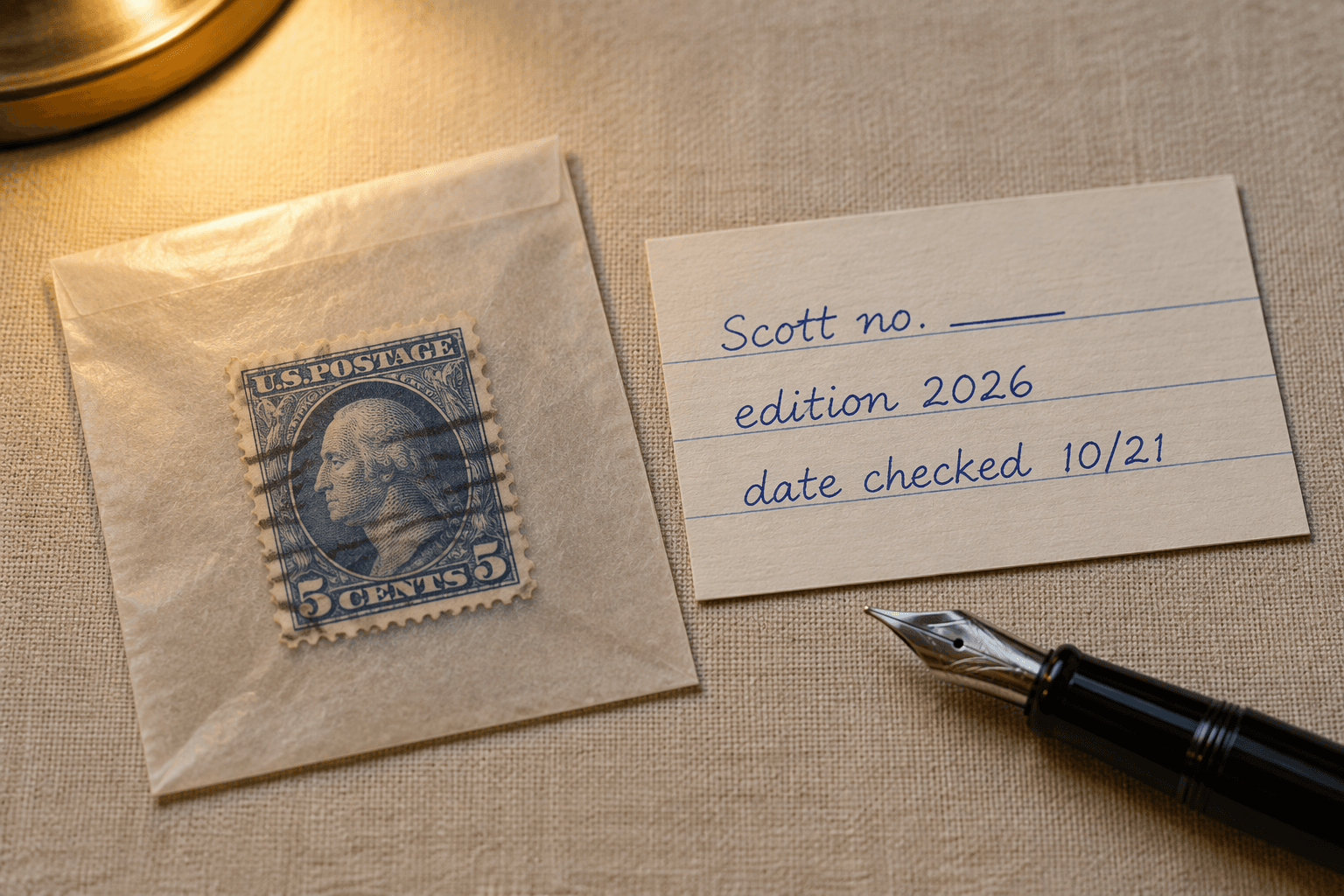
If you keep a private collection archive, Folidx is one option for this: each stamp entry can carry its catalog number, catalog edition, and source notes beside the photo, so the reference stays verifiable instead of becoming a bare claim. Folidx offers reference information, not appraisals or authentication, and every field stays editable so you can correct it against the catalog yourself (folidx.com).
FAQ
What is a stamp catalog? A reference that lists a country's stamps with numbers, issue dates, descriptions, varieties, and reference price context. It creates the shared vocabulary collectors use to talk about specific stamps (Wikipedia).
What is a Scott number? The number a stamp carries in the Scott Catalogue, the standard numbering for United States stamps. Prefixes mark special series, such as C for airmail, and suffix letters mark major varieties.
Do I need to buy a catalog to identify my stamp? No. You can find numbers using library copies, club references, free online databases, and museum collection searches. Buying a print or online catalog is a convenience, not a requirement.
Why do different catalogs give different numbers for the same stamp? Each publisher assigns its own sequence, and some split varieties differently. Always record which catalog a number comes from.
Can a catalog number tell me what my stamp is worth? A catalog gives reference price context for a stamp in a stated condition, not a value for your specific copy. Condition, centering, gum, and faults change what a particular stamp is worth, so treat catalog prices as a starting reference rather than a valuation.
How often do catalog numbers change? Prices are updated with each edition, and newly issued stamps are added each year. Existing numbers are stable, which is what makes them useful as long-term shorthand.
Sources
- Wikipedia, "Stamp catalog" - definition, catalog history, worldwide catalog list
- Scott Publishing, catalog store page and Mystic Stamp, Scott Catalogue overview - Scott as the US standard
- H.E. Harris 2026 United States Postage Stamp Catalog & Price Guide, 91st edition - US price-guide catalog, current edition details
- USPS, USA Philatelic - official current-issue reference
- Smithsonian National Postal Museum, search the collection - public reference examples
- Smithsonian National Postal Museum, "24c Curtiss Jenny invert single" - catalog record titled "Scott Catalogue USA C3a", source for the Inverted Jenny example
- Folidx - product boundary: reference and archive, not appraisal