Stamp Identification: How to Figure Out What Stamp You Have
Identify any postage stamp step by step: country clues, year, design, watermark, and perforation checks, then confirm with catalog references before trusting an app.
Stamp Identification: How to Figure Out What Stamp You Have
You found a stamp in an envelope, a drawer, or an inherited album, and the question is the same one every collector starts with: what is this? The reliable answer comes from a sequence, not a single scan. Read the clues printed and pressed into the stamp, narrow the candidates with a photo search, then confirm the exact identity with a catalog number.
Photo identifier apps sit in the middle of that sequence. They sort a pile of unknown stamps into rough groups fast, but they are a starting point, not a verdict. This guide walks the full sequence so you can check whatever a tool tells you.
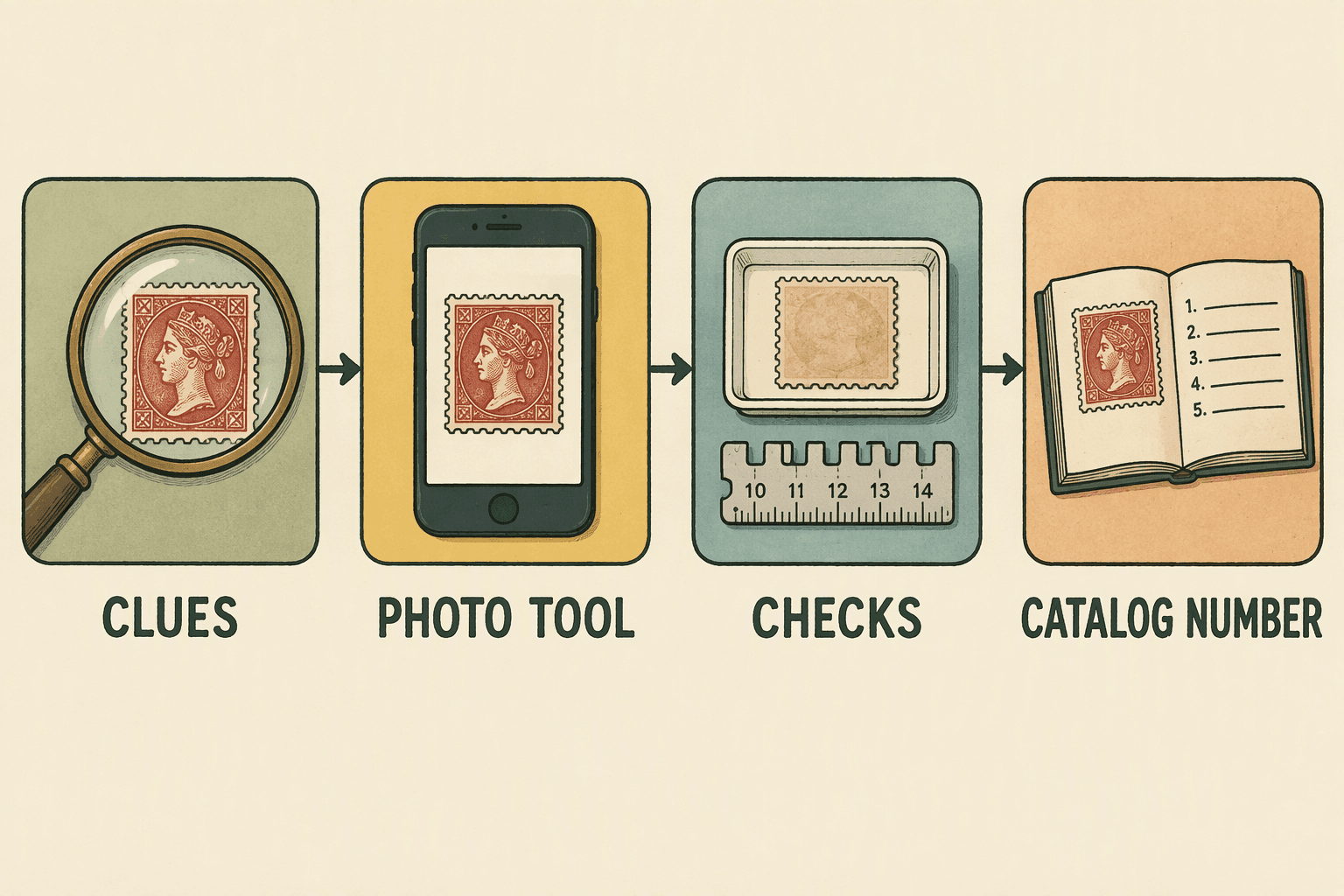
Illustration: the four stages of stamp identification, from the stamp's own clues to a confirmed catalog number. Hand-drawn editorial illustration, made for this article.
Don't Scan Yet: Five Clues the Stamp Itself Gives You
Before any tool sees the stamp, the stamp tells you five things:
- Country name. Most stamps print the issuing country in its own language, which is often the fastest single clue.
- Denomination. The face value and its currency unit narrow the country list and hint at the mail era.
- Year or era. Commemoratives often carry the year in the design. Definitives usually do not, but their style still bounds the century.
- Design theme. Portraits, ships, maps, coronations, expos, and Olympic designs each point to identifiable issues.
- Physical construction. Paper color, watermark, and perforations are invisible in a casual glance but decisive between look-alikes.
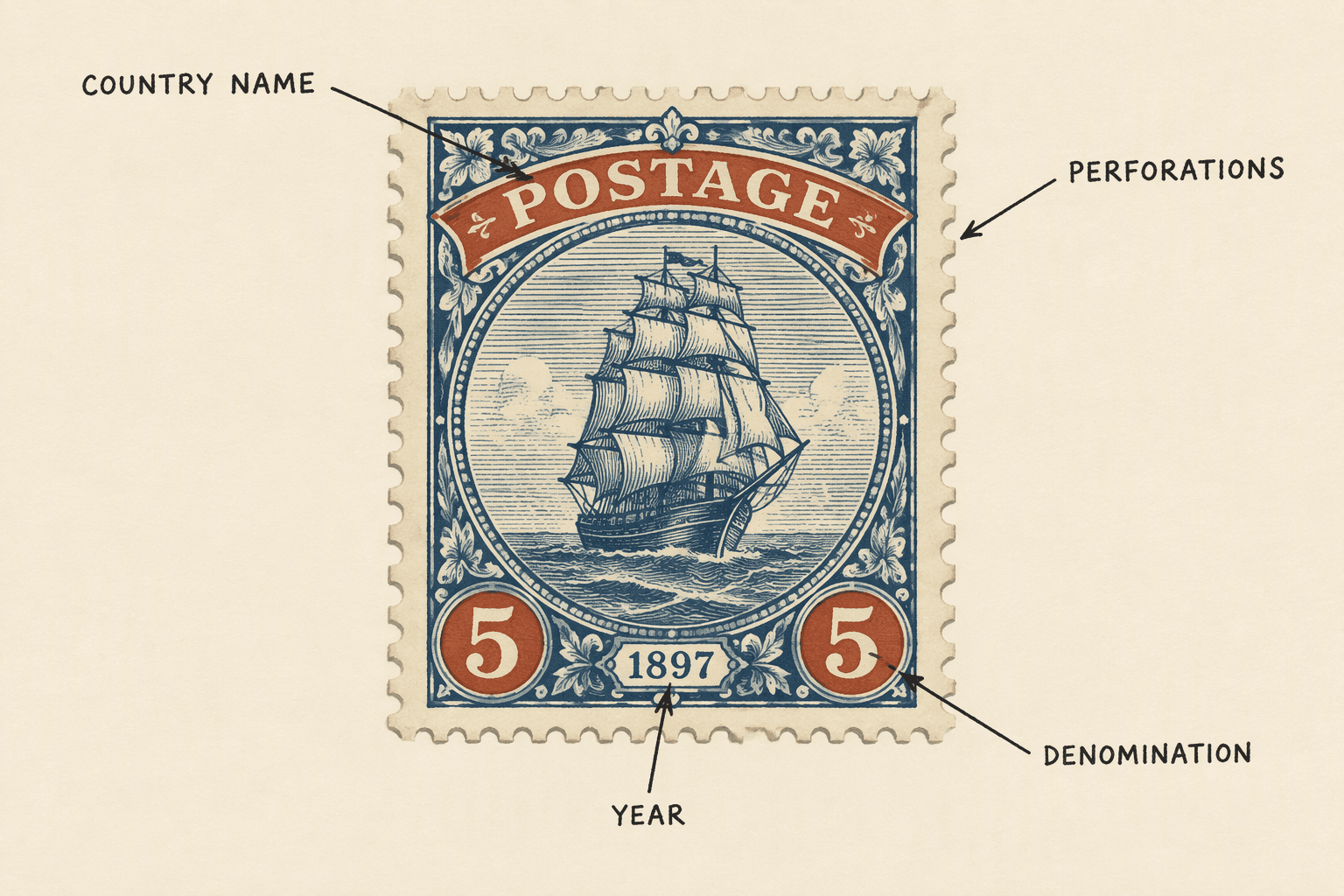
Illustration: where the country name, denomination, issue year, and perforations sit on a generic stamp. Hand-drawn editorial illustration, made for this article.
Why the fifth clue matters: two stamps can share the same design, color, and perforation measurement and still be different catalog entries, because the only visible difference is the watermark Mystic Stamp. Treat every clue as evidence to record, not as a final answer.
Country and Language Clues: Reading Text You Cannot Read
Country names appear in the issuing country's own language, so a stamp that says "Helvetia" is Swiss, "España" is Spanish, "Deutschland" is German, and "Nippon" is Japanese. You do not need to read the language to use it. Type what you see into a search engine, and the country usually falls out in one query.
The currency on the denomination helps when the country name is missing or the stamp is an overprint. Pence and shillings point to the British Empire and its era, centimes to France, pfennig to Germany, kopecks to Russia, cents to the Americas and several other systems. A currency unit rarely names one country on its own, but it shortens the candidate list enough for the next clues to finish the job.
Overprints deserve a note: a new value or name printed over an older stamp usually marks a change of postal administration, a territory transfer, or a provisional issue. Overprinted stamps are a classic identification trap, and they are exactly the category where a photo tool's confidence should be double-checked against a catalog.
Denomination, Year, and Design Theme
Work the printed evidence in this order:
- Face value first. A 3-cent stamp says something about the postal rate period it was made for. Low values usually come from long-running definitive series, which means the year must come from other clues.
- Year next. If the design carries a date, an anniversary, or a jubilee year, you may already have the issue year. Many commemoratives are effectively self-dating.
- Theme last. A recognizable subject, such as a named building, a world's fair, or a specific anniversary, often resolves to a short list of issues that a search confirms in minutes.
When the stamp gives you a country and an approximate era, you have enough to move to the photo step with a real question instead of a blank one.
Use a Photo Tool to Narrow the Range
Take the photo before you reach for an app: stamp flat, camera straight on, even light, the whole stamp in frame. The same lighting discipline that works for coin photography applies here, and our guide on how to photograph coins covers the setup.
With a usable photo, two free approaches work:
- Reverse image search. Google Lens and similar tools match your photo against indexed catalog and marketplace pages and often land directly on the right catalog entry.
- Identifier apps. Stamp identifier apps return a country, year, and sometimes a catalog guess from one photo.
Collector communities treat both as starting points. In a long-running discussion on r/stampcollecting, the working consensus is that identifier apps and reverse image searches are useful for sorting unknown piles, while careful identification still ends at catalogs and reference books Reddit r/stampcollecting. That is the honest division of labor, and it is also where the limits live:
- Paper and watermark. A watermark lives inside the paper. A normal photo cannot see it, and watermark differences can be the whole identity.
- Perforation precision. Perforation counts must be measured with a gauge, not estimated from a photo.
- Near-identical varieties. Design families repeat the same portrait or scene across dozens of issues, and small shade or perf differences separate them.
- Condition. Heavy cancels, stains, and toning erase the printed detail that tools rely on.
- Confident wrong answers. An app that returns "Country, Year, Catalog 123" in one second is returning a hypothesis. Check it the same way you would check a stranger's claim.
Use the tool's output as a candidate list, then take the top candidate into the two physical checks below.
Check 1: The Watermark
A watermark is a pattern or set of letters impressed into the paper during manufacture, originally as an anti-counterfeit measure. Many older stamps carry one, and modern US stamps generally do not Mystic Stamp.
The standard home check is simple. Place the stamp face down in a watermark tray, pour watermark fluid over it until it is covered, never water, and the watermark becomes visible. Let the stamp dry completely before lifting it out Mystic Stamp. You may see only part of a letter rather than a whole design, and that partial view is still usable evidence.
On US stamps the watermarks are letters: a double-line USPS watermark ran on postage stamps from 1895 to 1910, and a single-line USPS watermark ran from 1910 to 1916 American Philatelic Society. Many stamps exist on both watermarked and unwatermarked paper, and the watermark alone can separate a very common stamp from a stamp valued in the hundreds or thousands American Philatelic Society.
Record one of three outcomes: the watermark you saw, "none detected", or "not checked". Any of the three is a real data point. For the full method and how to log what you see, see What Is a Watermark on a Stamp.
Check 2: Perforations
Perforations are the punched holes that separate stamps on a sheet, and their density is measured with a perforation gauge, which counts the number of holes in the space of 2 centimeters Mystic Stamp.
Measure in a fixed order so your notes stay comparable: horizontal perforations first, along the top or bottom edge, then vertical perforations along the sides. Collectors write the result as two numbers, such as 11 x 10.5, and catalogs list these measurements for every issue Mystic Stamp.
This check resolves more look-alikes than any other physical trait. If two stamps share a design, a color, and a perforation measurement and still refuse to match, the watermark check from the previous section is the next difference to test Mystic Stamp. For the gauge method step by step, see Stamp Perforations: How to Measure and Record Them.
Name the Stamp with a Catalog Number: How Scott and Similar Identifier Tools Work
A catalog number is the shared name collectors use for one exact stamp. In the United States, Scott numbers are the standard: the Scott Catalogue assigns a number to every stamp as it is issued, which is what lets collectors, dealers, and albums refer to the same item unambiguously Mystic Stamp.
A catalog entry is also a checklist. Each listing records the date of issue, the printing method, the perforation, and the watermark, and those characteristics apply to following sets until the catalog notes a change Amos Advantage. That makes verification mechanical: take your top candidate number, open the listing, and confirm the year, perforation, and watermark against the stamp in your hand. If one trait disagrees, you are looking at a different listing.
For wordless or hard-to-classify international stamps, identifier references exist precisely for this step. The Scott Stamp Illustrated Identifier groups stamps by visual features instead of by country and series, and similar printed identifier guides serve the same role for specific countries, such as period-by-period US identifier breakdowns Kenmore Stamp. Whatever identifier format you use, finish by writing down three things: the catalog name, the number, and the edition year. Numbers can shift between editions, so the edition is part of the evidence.
After Identification: Save a Verifiable Record
An identification is only as useful as the record behind it. For each stamp, keep together:
- Country and, where known, the issuing entity
- Issue year or era
- Catalog name, number, and edition year
- Denomination and currency
- Watermark finding, including "none detected"
- Perforation measurement
- The photo you identified from
- The source you relied on, and how confident you are
Keep the original photo and the source evidence separate from the editable conclusions, and mark low-confidence fields so future-you knows what to recheck. A screenshot of an app's answer is not a record; the record is what you can re-verify later.
If you also collect coins and cards, Folidx works as an optional photo-based archive for exactly this kind of record. You photograph a stamp, review an editable identification report, and the app keeps the original photo, source references, and confidence separate from the conclusions you can edit, then files the stamp into your private archive books with duplicate checks built in. It is a records tool, not an appraisal service.
One takeaway: record the identification result, country, year, catalog number, watermark, and perforations, together with its sources. Once a stamp is named and recorded, how to store postage stamps is the next decision, and how much are my stamps worth is the one after that.
FAQ
Is there a free website to identify stamps?
Yes, several free routes work. A reverse image search such as Google Lens costs nothing and often surfaces the exact catalog page. Collector communities, including r/stampcollecting, will examine clear photos posted by members. Free identifier sites and apps exist as well. Treat any free answer as a lead and confirm it with a catalog number before you rely on it.
Why do similar-looking stamps differ in value?
Because catalogs give look-alikes separate numbers. Watermark presence and type, perforation gauge, shade, printing method, and minor varieties each create distinct listings, and one such difference can move a stamp from very common to a stamp valued in the hundreds or thousands American Philatelic Society. Condition and collector demand then act on top of identity. Identity first, value second, is the order that keeps both answers honest.
Sources
- Mystic Stamp, "How to Identify U.S. Stamps": perforation gauge method, watermark fluid procedure, watermark-versus-perforation decision order. https://info.mysticstamp.com/learn/how-to-identify-u-s-stamps/
- Mystic Stamp, "Step-by-Step Guide to Identify Your Stamps": Scott numbers as issued identifiers, first US stamp 1847. https://info.mysticstamp.com/learn/stamp-identification-guidelines/
- American Philatelic Society, "Expertizing Basics: Watermarks": double-line USPS 1895 to 1910, single-line USPS 1910 to 1916, watermark as the sole difference between common and high-value listings. https://stamps.org/news/news-archives/c/collecting-insights/cat/exploring-stamps/post/ap-expertizing-basics-watermarks
- Amos Advantage, "Understanding the Scott Catalogue Listings": catalog entry fields for issue date, printing method, perforation, and watermark. https://www.amosadvantage.com/stamp-guides/understanding-the-scott-catalogue-listings
- Linn's Stamp News, "Keys to cataloging a stamp: check watermarks and measure perforations": watermark and perforation checks as the core cataloging keys. https://www.linns.com/news/postal-updates-page/stamp-collecting-basics/2007/september/keys-to-cataloging-a-stamp--check-watermarks-and-measure-perfora.html
- Kenmore Stamp, "U.S. Stamp Identifier": period-by-period US identification reference category. https://www.kenmorestamp.com/us-stamp-identifier
- Reddit r/stampcollecting, "Any apps to identify stamps?": community consensus that apps and reverse image search are a starting point. https://www.reddit.com/r/stampcollecting/comments/1ehfckt/any_apps_to_identify_stamps/