How Much Are My Stamps Worth? A Careful Way to Check
Find out what your stamps are worth with a careful process: exact identification, condition checks, catalog references, and real sales evidence, no promises.
AI-generated editorial illustration. A collector inspecting stamp condition beside an auction catalog and archival record. · Source: GPT Image 2.5 · article-specific editorial illustration
How Much Are My Stamps Worth? A Careful Way to Check
Most stamps are worth their face value or a few cents. A small share are worth real money, and the difference shows up only after you work through four checks: identify the stamp exactly, grade its condition, look up a catalog reference, and verify against real sales. This article walks through that process in order, with the sources you can check yourself. It is a reference method, not an appraisal.
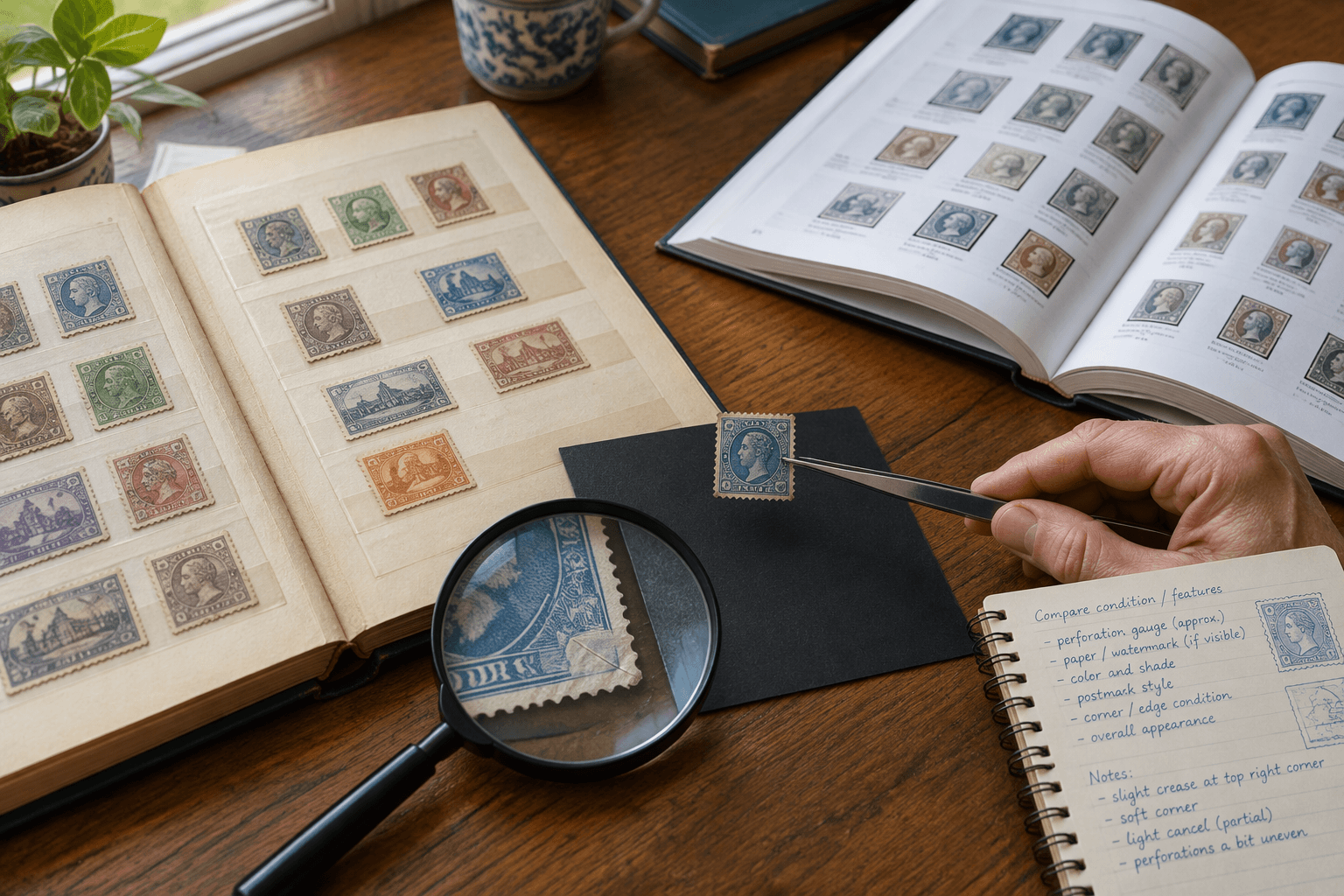
AI-generated editorial illustration; the stamps are illustrative examples, not identification references.
Why most stamps are only worth face value
Post offices printed most stamp designs in enormous quantities, and those stamps stayed in circulation for years. When millions of identical copies exist, supply alone caps the price. StampWorld's value guide puts it bluntly: it estimates that roughly 98 percent of all stamps are worth less than, or about the same as, the cost of handling and shipping them. Of the remaining share, about 1 percent sits in the $10 to $100 range, and the last 1 percent carries the famous high prices (StampWorld, "Stamp Values: How Much are My Stamps Worth?").
That distribution matters for how you spend your time. Checking the value of every stamp in an inherited album one by one is slow and usually unrewarding. A better approach is a quick triage pass first: set aside the stamps that show the features collectors actually pay for, then run the full four-step check on those only.
What the exceptions look like: features worth checking first
When collectors ask which old stamps are worth money, the answer is rarely "because it is old." Age alone does little. The features that make a stamp a candidate for a closer look are:
- Stamps still on the original envelope. A stamp attached to its cover can carry postal-history value that a soaked-off single does not, and used examples are sometimes worth more than mint ones of the same issue (FindYourStampsValue StampWiki).
- Printing errors and varieties. Misprints, inverted designs, and color errors can be scarcer, and often pricier, than the normal stamp in perfect condition. So do not discard a stamp that looks wrong; record what you see (FindYourStampsValue StampWiki).
- Complete sets. A full set of an issue, in matching condition, usually prices better than scattered singles from it.
- Unusual condition for the issue. A common stamp in exceptional grade can outprice a scarcer stamp in poor shape.
- Scarce denominations or special-purpose issues such as high-value definitives, airmail, or early commemoratives from your country's catalog.
If a stamp shows none of these, a catalog lookup will usually confirm a low value quickly, and you can move on.
Step 1: Identify the stamp exactly
Value attaches to a specific catalog entry, not to a general look. Before any price makes sense you need the country, the year or era, the denomination, and the design description, and ideally the catalog number that identifies the exact printing.
To work through identification systematically, follow our step-by-step guide, Stamp Identification: How to Figure Out What Stamp You Have. Two details do most of the discriminating work between similar-looking issues:
- Watermarks. Many classic issues exist in watermarked and unwatermarked printings with very different prices. Learn the method in What Is a Watermark on a Stamp?
- Perforation gauge. The same design was often printed with different perforation counts, and catalogs list each as a separate entry with its own value. See Stamp Perforations: How to Measure and Record Them
Photograph both sides of the stamp in even light before you start, so you can compare against catalog images without handling the stamp again.
Step 2: The five condition checks
Condition is where most value is won or lost. Dealers grade stamps on a small set of visible factors, and you can check each one yourself with a magnifier and good light (FindYourStampsValue StampWiki).
| Check | What to look for | Why it moves the price |
|---|---|---|
| Centering | Is the design balanced between the margins? Hold the stamp upside down and judge with your eyes only. | Centering is the key factor in a stamp's grade. |
| Perforations | Are all teeth complete and holes clean? Measure the gauge. | Missing or shortened teeth lower the grade. |
| Gum (mint stamps) | Is the original gum intact? Collectors classify gum as used, unused, or never hinged. | Never hinged (NH) is the premium state; a hinge mark or gum disturbance reduces it. |
| Cancellation | Is the postmark light (design clearly visible) or heavy (design obscured)? | A light cancel preserves more value than a dark one. |
| Paper and faults | Creases, tears, pinholes, stains, thins, or faded color? | Faults push a stamp from "sound" toward "faulty" or "defective," each step cutting the price. |
Record what you find in writing rather than trusting memory. A one-line note per stamp, such as "VF centered slightly high, NH, no faults," is enough to compare against catalog pricing notes later.
Step 3: Check catalog references
With the stamp identified and condition noted, look up its catalog listing. The standard references are the Scott catalog for United States and North American philately, Stanley Gibbons for Great Britain, and Michel for much of Europe; StampWorld also runs a free online catalog searchable by country, year, and denomination (FindYourStampsValue StampWiki, StampWorld).
Read the catalog number, the condition notes, and the listed value together. Two cautions keep the number honest:
- A catalog value is a retail reference for a stamp in the condition the catalog describes, not a guaranteed price for your copy. StampWorld's own guide stresses that valuation takes research and that catalog figures are only one input (StampWorld).
- A catalog lists values for several condition grades. Match your Step 2 notes to the right grade row before copying a number.
Step 4: Verify with real sales, not asking prices
A listing price is what a seller hopes to get. What your stamp is worth is closer to what similar stamps actually sold for. Before you treat any catalog figure as a conclusion:
- Search completed auctions and sold listings for the same catalog number in the same grade, and note the currency and sale date.
- Compare at least two independent results. One sale can be an outlier.
- Weigh dealer buy prices against retail offers. Dealers who resell buy at a discount to what they ask.
- Note the sample size. A common stamp with hundreds of sales gives a reliable range; a rare one with a single sale in a decade gives a weak one.
Only after this step does a defensible statement exist, and even then it should carry its qualifiers: which catalog number, which grade, which market, which date.
Save the conclusion as a sourced reference record
A value you cannot trace later is worth little. For each stamp you check, keep a small record with:
- the stamp's identification (country, catalog number, condition notes),
- the reference value with its source, currency, and date,
- the real-sale evidence you found, with the same fields,
- a confidence note: strong when catalog and several sales agree, weak when they diverge or evidence is thin.
This is exactly why we record a private reference value rather than a single authoritative number. If you use Folidx, the optional value snapshot flow saves each price with its source, time, and currency so the conclusion stays reviewable; storing the notes in a notebook works the same way. What this method does not do is promise a price, offer an appraisal, or arrange a sale. Those require a professional dealer or appraiser, and the references above explain what such a service should look like.
Frequently asked questions
Can I check the value of my stamps online?
Yes, and it is a reasonable starting point. Free online catalogs such as StampWorld let you look up identified stamps by country and year, and auction sites show real transaction prices. Online value-estimation services also exist, but treat their outputs as estimates to verify, not conclusions, and check any fee-based service carefully before paying (FindYourStampsValue StampWiki, StampWorld).
Does a hinge mark reduce value?
Usually, yes, for mint stamps. A hinge is the small gummed paper collectors once used to mount stamps in albums, and its remnant disturbs the original gum. Collectors price never hinged (NH) mint stamps above hinged ones of the same issue, so a hinge mark moves a mint stamp into a lower value tier. On used stamps, where gum condition matters less, the effect is smaller.
Should I remove stamps from envelopes?
Generally, no, not before you know what you have. Soaking can damage fragile older paper and destroys the postal-history context of the cover, which is sometimes the more valuable part. Check the envelope for interesting postmarks, routes, or dates first; if the stamp appears common and the cover ordinary, soaking later is still possible. When in doubt, photograph and store the envelope intact (see How to Store Postage Stamps: A Safe, Searchable System).
Sources
- StampWorld, "Stamp Values: How Much are My Stamps Worth?" (accessed 2026-10-05)
- FindYourStampsValue StampWiki, "Value of postage stamps" (accessed 2026-10-05)
- StampWorld catalogue (free online catalog, accessed 2026-10-05)
This article is a reference method. It does not constitute an appraisal, a price guarantee, or investment advice, and no figure in it applies to a specific stamp without the verification steps above.