First Day Covers Explained: What They Are and How to Keep Them
What a first day cover is, the stamp, postmark and cachet on one, how covers differ from loose stamps, and how to sort and record an inherited pile.
First Day Covers Explained: What They Are and How to Keep Them
A first day cover is an envelope or card that carries a new postage stamp canceled on the day the stamp was first authorized for use. If you have just inherited a box of old envelopes, each one with a stamp in the corner and a round "FIRST DAY OF ISSUE" cancellation, that is exactly what you are holding. This guide explains what each part of the envelope means, how covers differ from loose stamps, and how to sort, record, and store a pile of them without damaging anything.
What is a first day cover?
A first day of issue cover, usually shortened to first day cover or FDC, is a postage stamp on a cover, postal card, or stamped envelope that was franked on the first day the issue was authorized for use. The postmark usually names the city and date of the first day and often includes the words "first day of issue" (Wikipedia: First day of issue).
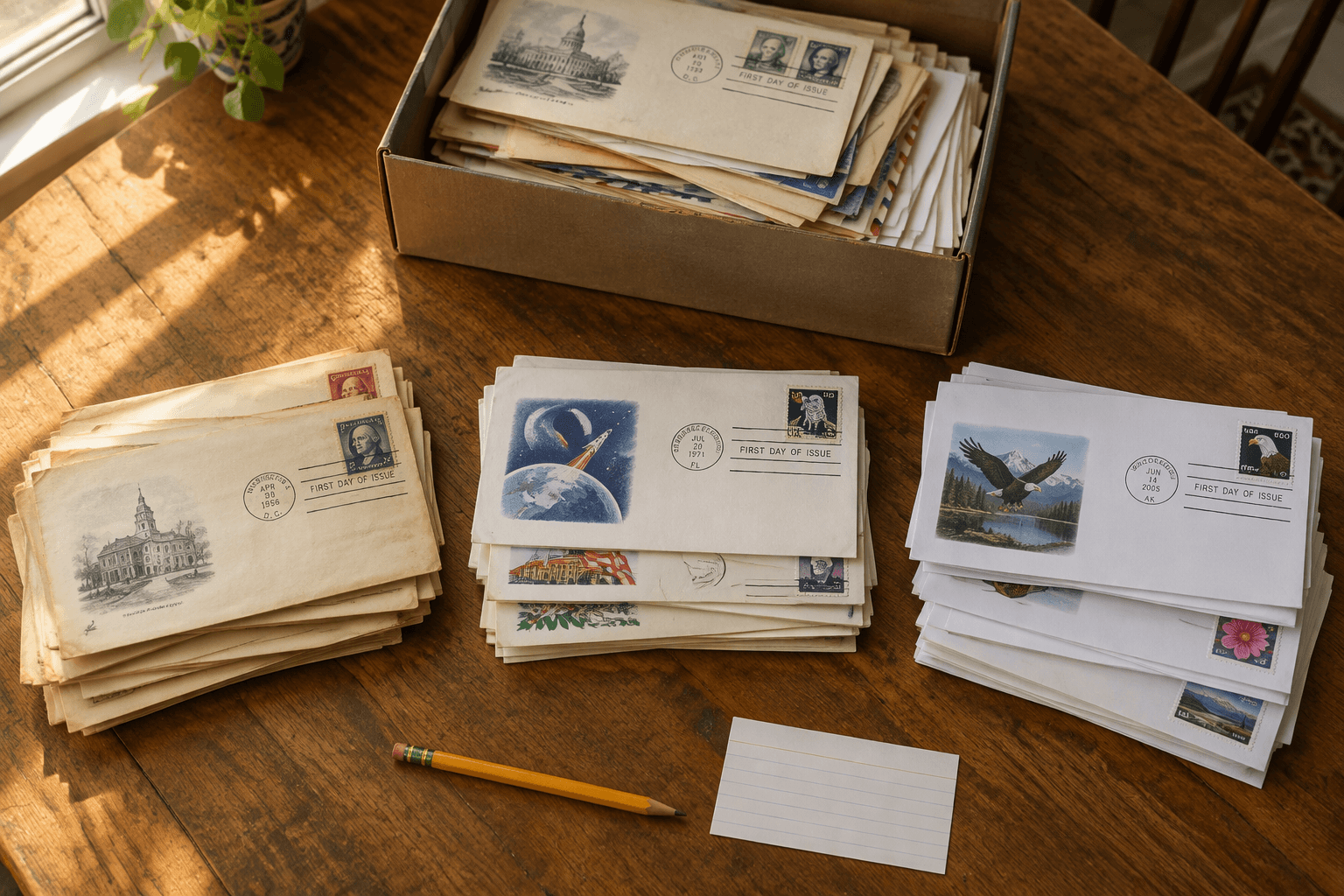
The point of the object is not the letter it once carried. The cover is a dated record of a stamp's release day. That is why collectors filed them away, and why a shoebox of first day covers is really a shoebox of dated events.
The three parts of an FDC
Every first day cover is built from three parts, and each one is a field worth recording:
| Part | What it is | What to record |
|---|---|---|
| The stamp | A new issue affixed on its first day of sale | Which stamp it is (topic, denomination, year) |
| The postmark | An official cancellation, often pictorial, tying the cover to the first-day city and date | Issue date and postmark city |
| The cachet | A printed, drawn, or painted illustration on the envelope, usually related to the stamp's subject | Cachet type (printed, hand-drawn, plain) and the artist or maker if known |
The postmark is the proof part. It should touch the stamp and connect it to the envelope, and in the United States only postmarks from official first-day cities carry the "First Day of Issue" wording (Wikipedia). The cachet is the art part. Postal authorities apply postmarks, but anyone can design a cachet, which is why some collectors follow particular cachetmakers (Stamp News Now).
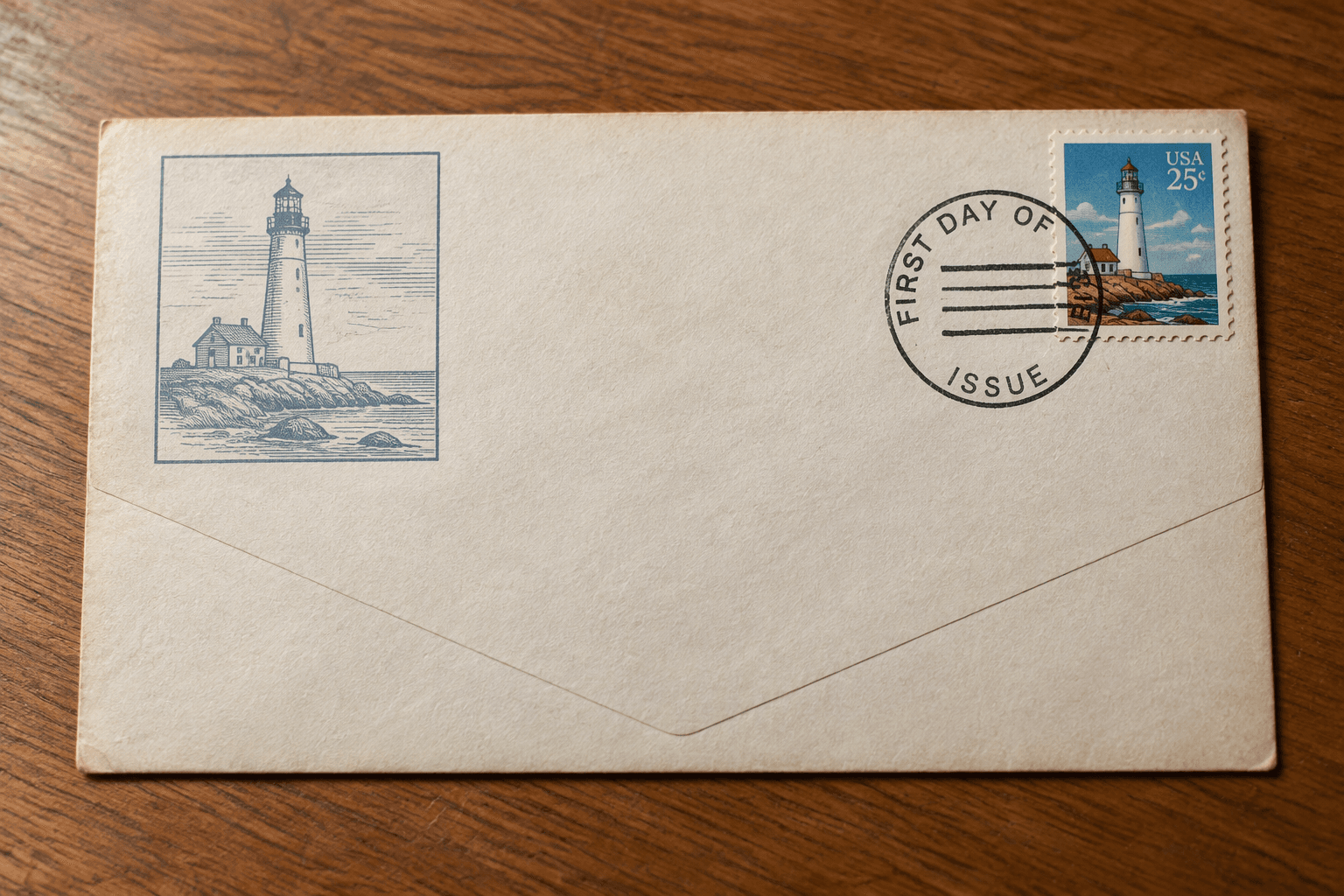
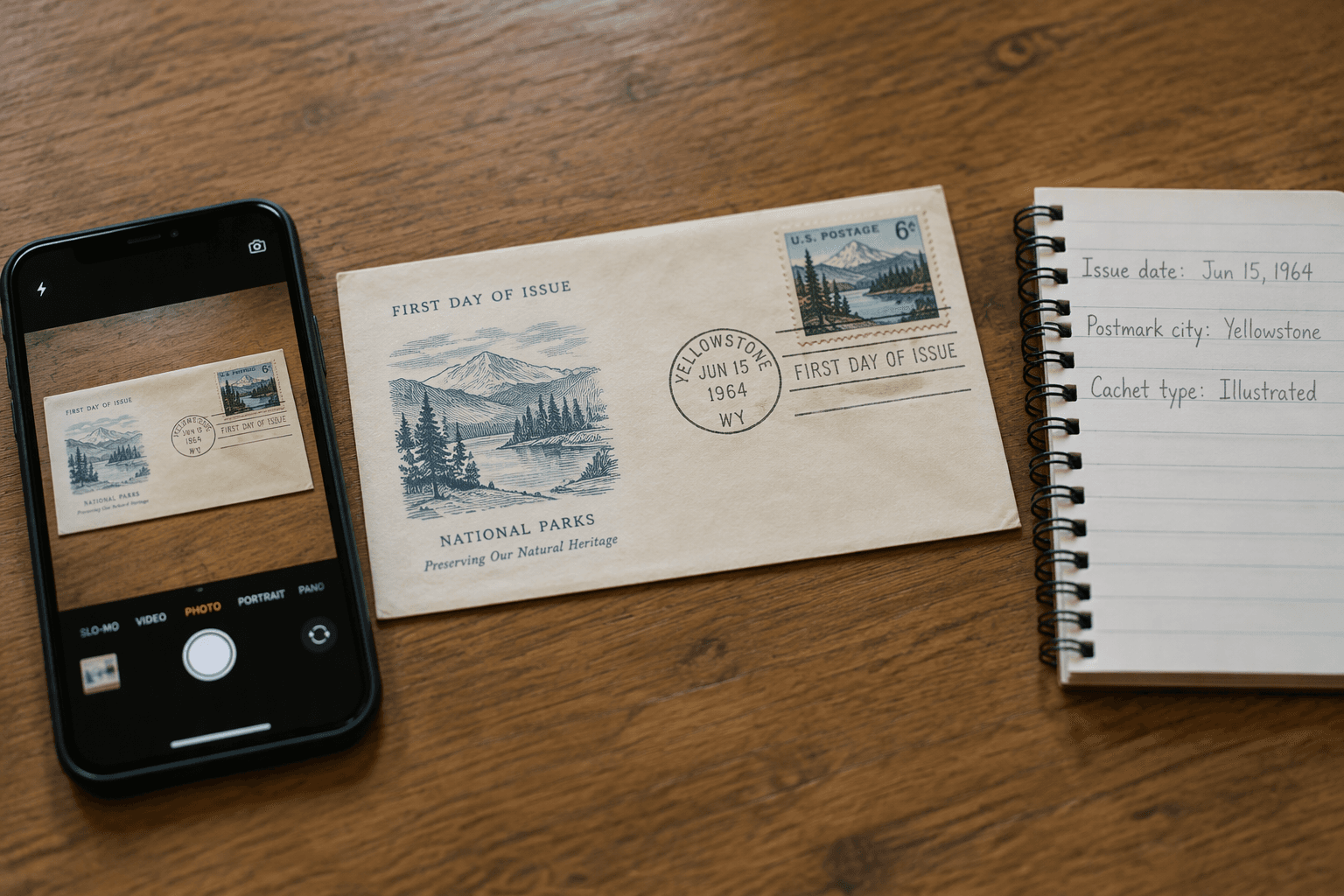
The three zones in the photo above are the same three fields: the stamp in the corner, the first-day cancellation crossing it, and the printed cachet illustration on the left. When you record a cover, those three fields are the minimum.
First day of issue stamps vs an ordinary used stamp
The stamp itself may be identical on both. What changes is the event and the carrier. Collectors call the stamps used this way first day of issue stamps, and once one is affixed to an envelope and canceled on day one, it becomes part of a different collectible: the cover documents the release date in a way a loose stamp never can. An ordinary used stamp carries no date record at all.
That distinction also changes how you handle it. A loose stamp gets identified by its perforations, watermark, and printing, which is its own workflow (our stamp identification guide). A cover gets identified by the combination of stamp, postmark, and cachet on the envelope, and the envelope itself becomes the thing you protect.
Do first day covers have value?
Here is the honest framing from the American First Day Cover Society (AFDCS), a non-profit collectors' organization:
- There are general rules about FDC values, but they are not universal (AFDCS: Valuing Your FDCs).
- Most uncacheted FDCs, those without artwork on the envelope, are of minimal value, although not always.
- Most addressed FDCs from the 1960s to date are of low value, although not always.
- Most common issues since the 1950s are of low value, although not always.
- Some subjects stay in demand even when addressed or uncacheted, and good cachet art enhances a cover's value while bad art detracts from it.
Two practical notes from the same source: AFDCS does not buy first day covers, publish value catalogs, or appraise collections, and the earliest cacheted first day covers date to 1923, when philatelist George Linn printed a simple text decoration on envelopes for the Harding memorial issue (Wikipedia).
This article is a reference framing, not an appraisal. If your inherited pile also contains loose stamps, the same calm logic applies to checking what they might be worth (how much are my stamps worth).
How to sort and record an inherited pile of covers
An inherited shoebox is overwhelming only until it is sorted. A workable first pass:
- Sort into rough piles by decade or theme. Paper tone and cancellation style usually make the decades easy to tell apart. Themes such as space, birds, or buildings group naturally once you look at the cachets.
- Photograph the front of each cover. One photo per cover captures the stamp, postmark, and cachet together.
- Record three fields per cover. Issue date, postmark city, and cachet type. Those come straight off the envelope in most cases.
- Move sorted covers into an archive book or pages. Once recorded, each cover can live in a structured collection instead of a pile.
Recording is what turns a pile into a collection. A photo of the envelope plus its issue date, postmark city, and cachet type is enough to find any cover again later, and it is enough context for anyone who inherits the collection from you.
If you want the record to live in one place, Folidx lets you photograph a cover and file it in an archive book with its own notes, so the issue date, postmark city, and photo stay attached to the envelope's record rather than to a shoebox.
Handling and storing covers
Covers are paper objects, so the rules are gentle ones:
- Handle covers by the edges, and keep food, drink, and direct sunlight away from the sorting table.
- Store covers flat in archival protective sleeves, and avoid stacking heavy objects on top of them.
- Do not glue or hinge a cover into an album the way loose stamps are sometimes mounted. For the loose-stamp version of that decision, see hinges vs mounts (stamp hinges vs mounts).
- Keep the original envelope intact. The envelope is the collectible; removing the stamp destroys the cover.
The detailed care of loose stamps, such as humidity and album choices, is a separate topic and is covered in the storage guide rather than repeated here.
FAQ
Are any first day covers worth anything?
Some are, but by the AFDCS's own framing, most common issues since the 1950s and most addressed covers from the 1960s onward are of low value, while covers with good cachet art, earlier dates, or in-demand subjects are the ones collectors look for. No one can appraise a cover from a photo alone, and AFDCS does not buy covers or appraise collections (AFDCS).
What is meant by first day cover?
A first day cover is an envelope, postal card, or stamped envelope bearing a postage stamp that was canceled on the first day the stamp was authorized for use, usually with a first day of issue postmark naming the city and date, and often with a cachet illustration on the envelope (Wikipedia; Find Your Stamps Value).
Sources
- Wikipedia: First day of issue - definition, postmark and cachet features, official first-day cities, George Linn's 1923 cacheted covers.
- American First Day Cover Society: Valuing Your FDCs - value framing, no-appraisal boundary, dealer guidance.
- Stamp News Now: First Day Covers - FDC definition and cachet history context.
- Find Your Stamps Value: First Day Cover (FDC) - term definition cross-check.