Barber Dime Value: Match the Date, Mint, and Condition
Learn how to check Barber dime value by matching the issue and condition, comparing sourced references, and saving a dated collection record.
By Folidx Team
Barber dime value depends on the exact date, mint, strike type and condition. There is no single reliable amount for an unidentified coin. Confirm that it is a dime, read both sides, then choose a reference for that issue. A different mint or certified proof cannot establish your worn dime's worth.
Use this table before opening a price chart:
| What you can establish | Reference branch to choose | What to keep unresolved |
|---|---|---|
| ONE DIME on the reverse; date and mint readable | Barber dime row for that exact date and mint | Any uncertain digit or letter |
| Ordinary circulation issue identified | Regular-strike section, with an appropriate condition comparison | Numeric grade if the coin is ungraded |
| Proof identification supported by a credible attribution | Separate proof section and matching designation | Proof status based only on shine |
| A possible variety | Recognized variety entry and its diagnostics | Attribution until the details match |
| Date, mint or condition still uncertain | Identification and condition references first | A personal value range |
The NGC Barber dime guide separates date/mint entries and strike designations. Pause the price comparison when a detail is missing.
Make sure the coin is a dime
The Barber portrait appears on more than one denomination. Turn the coin over: the dime has ONE DIME inside a wreath. PCGS's Barber dime reference describes the shared Liberty motif and this reverse. Its Barber quarter reference shows an eagle and QUARTER DOLLAR; the half-dollar reference shows HALF DOLLAR.
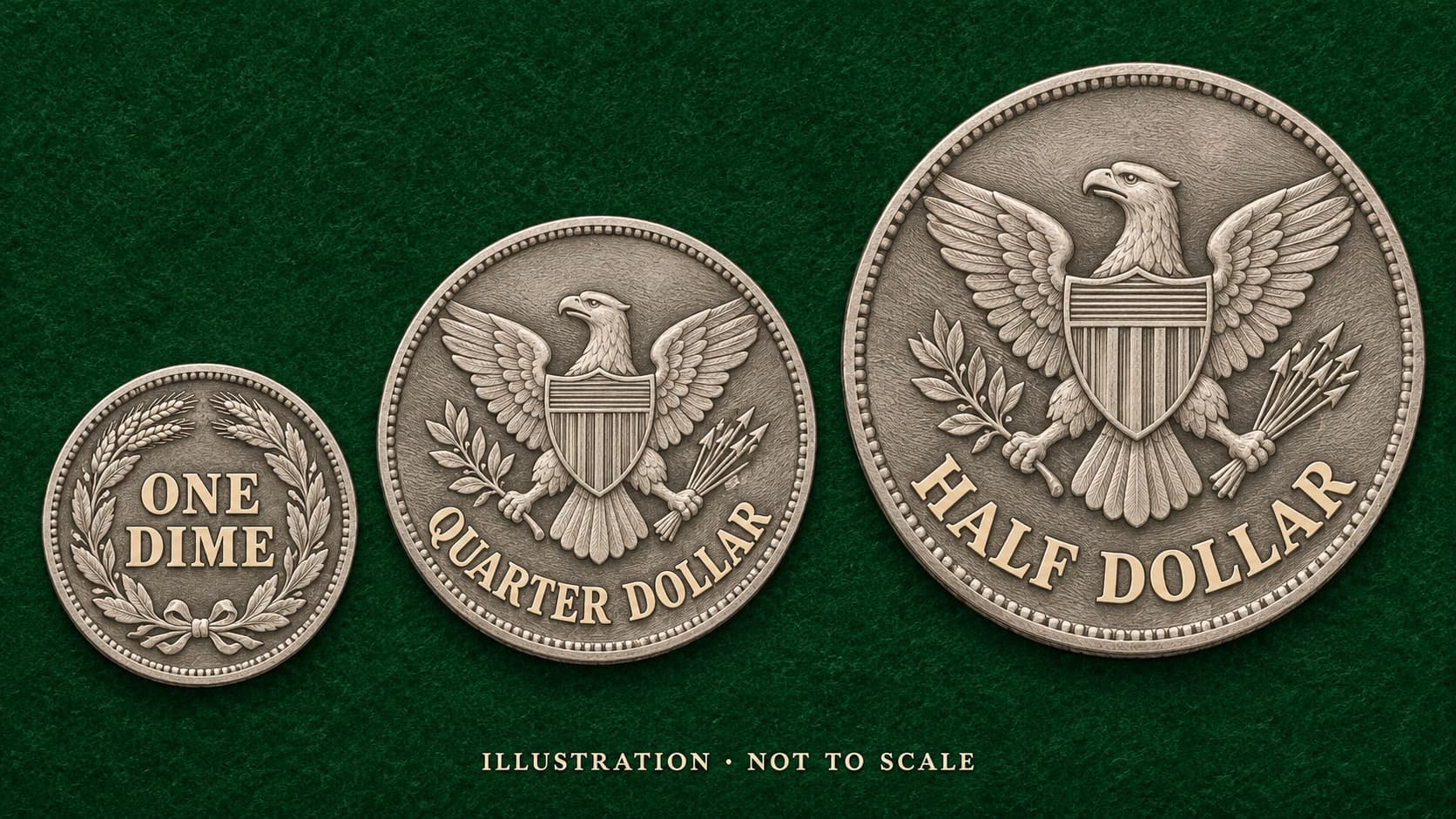
Illustration, not to scale. These simplified reverses show where to start reading the denomination. Use the linked reference photographs to identify your coin; this illustration cannot establish authenticity, grade or a variety.
For the silver-content question, PCGS lists the 1900 regular-strike dime as 90% silver and 10% copper, with a specified weight of 2.50 grams. Those specifications cannot authenticate your coin. A silver-content calculation also answers a different question from collector value. It does not establish a buyer's offer.
Record the date, mint and visible wear
Photograph both sides before transcribing the date. Add a close view of the mint-mark area if the letter is faint. Keep "letter unreadable" separate from "no mint mark confirmed"; those observations lead to different lookups. Compare the complete issue label against the PCGS series list, which lists dates and mint combinations separately.
Write visible notes such as "date legible; cheek detail flattened; scratch across reverse." Avoid turning a count of surviving LIBERTY letters into a professional grade. NGC's Barber dime grading discussion explains why that shortcut fails: the headband detail differs in later dates, and strike weakness can affect the appearance of some issues.
If a holder carries a grade, transcribe the grading service, grade and any qualification exactly. For a raw coin, meaning one without certification, retain descriptive observations and leave the professional-grade field blank. Our guide to grading vocabulary provides background for reading labels.
Do not clean the coin to make a date or letter easier to read. NGC notes that cleaning and altered surfaces can affect a Barber dime's eligibility for certification. Try another photograph and light angle instead, and keep any remaining uncertainty in the record.
Select the ordinary issue or a verified variety
Keep the basic identification separate from a possible die variety. NGC VarietyPlus lists recognized Barber dime varieties, including the 1905-O Micro O. Compare a possible match with the listed diagnostics before choosing a variety-specific price.
An odd feature is not automatically a mint error, either. NGC distinguishes varieties from mint errors. In your notes, separate "possible variety, unconfirmed" from the ordinary date/mint entry. Do not add an error premium merely because a feature looks unusual.
Also keep exceptional proof references out of an ordinary dime comparison. NGC's guide places the 1894-S in a separate PF entry. A headline about that issue cannot establish the value of another date, mint or strike type. If you think your coin is an 1894-S, resolve identification and authenticity with qualified help before using its prices.
Compare references without turning them into an offer
Barber dime values are useful only with their comparison basis attached. Start with the exact issue in a primary guide, then look for completed sales with comparable condition and certification. An asking price does not establish what a buyer paid.
For a small example of how grade changes the lookup, the PCGS Barber dime price guide, checked November 7, 2026, Beijing time, showed these cells for the ordinary 1900 issue, PCGS number 4821:
| Issue and grade column | Observed guide amount | State and price basis | Buyer premium |
|---|---|---|---|
| 1900 regular strike, grade 4 | USD 15 | PCGS-graded comparison; average dealer asking-price guide | Not applicable: not an auction result |
| 1900 regular strike, grade 40 | USD 55 | PCGS-graded comparison; average dealer asking-price guide | Not applicable: not an auction result |
These are dated guide observations, not a USD 15-55 range for your coin. PCGS explains its guide basis: the figures are average dealer asking prices for PCGS-graded coins. A similar photograph does not justify assigning either amount to a raw dime.
The NGC guide uses average dealer retail prices for NGC-certified coins and explains that figures may lag short-term market changes. Keep each source's price label.
For an auction comparison, open the auction house's original lot page. Check the full issue, grade, grading service, surface qualifications, sale date and currency. Record whether the realized amount includes the buyer premium. If that basis is unclear, keep the result separate. Exclude an unsold lot, an asking listing or a mismatched proof from a sold-price comparison.
No comparable sold lot is established here for the coin you own, so this guide does not establish a reliable personal value range. Do not fill that gap with a record sale or multiply guide cells into a collection total. For the broader workflow, see how to check a coin reference value.
Save an editable record and a next review step
Keep observations and questions beside the reference. The blank worksheet below is an editorial aid, not a Folidx screen or a customer record.
| Item record | Your entry |
|---|---|
| Original photos | Front: _; back: _; detail: _ |
| Exact issue | Denomination: _; date: _; mint: _ |
| Uncertain identification fields | _ |
| Raw or certified | _; service, grade and qualifications if present: _ |
| Visible surface notes | _ |
| Next review step | _ |
Use one comparison row per source:
| Exact reference issue and state | Reference URL | Observed date | Currency and amount | Price basis; buyer premium | Keep or exclude, and why |
|---|---|---|---|---|---|
| _ | _ | _ | _ | _ | _ |
| _ | _ | _ | _ | _ | _ |
These fictional, unpriced rows assume a working identification of a raw, ordinary 1900 dime. They show how to record a rejected comparison, not actual research results.
| Illustrative candidate | Amount | Decision |
|---|---|---|
| 1900-O dime reference | _ | Exclude: different mint |
| 1900 proof dime reference | _ | Exclude: different strike type |
Even a matching ordinary 1900 certified reference still needs a condition and certification check.
To build the record, photograph both sides, transcribe only what you can read and flag every unresolved detail. Add each reference link and the date you consulted it. Preserve the original question when you later change an identification; otherwise, a tentative reading can become a false fact.
Folidx is an optional archive for this work. Its photo-to-record workflow produces editable identification reports, reference ranges and visible condition clues, with records organized in archive books and pages. Review and edit AI suggestions against your coin and sources. Those suggestions do not replace authentication, professional grading or an appraisal.
Keep the photos, source links and uncertain details together in an editable Folidx record.
Short reader questions
Can I compare a raw coin with a certified guide row?
Use the row as context after matching the issue, while retaining its certification basis. Do not copy the certified price into your raw coin's record as an established value or infer the grade from a photograph.
What should I do if the date or mint is unreadable?
Take clearer photographs and compare them with the series reference. Record the field as unreadable until you can resolve it. Do not choose a rare date or treat an unreadable letter as a confirmed absence of a mint mark.
Does a reference price mean someone will pay it?
No. A guide price, a seller's asking price and a completed sale describe different things. Keep those labels and dates with the numbers. An offer requires someone to assess the actual coin and propose terms.
Can I use a Barber quarter or half-dollar chart for a dime?
No. Confirm ONE DIME on the reverse and use the dime series. The similar portrait does not make another denomination's issue or price row comparable.
Sources
- PCGS Barber dime series reference: design, denomination and issue list.
- PCGS Barber quarter reference: the related portrait and different denomination.
- PCGS 1900 regular-strike dime: issue specifications.
- NGC guide to grading Barber dimes: strike, headband detail and surface cautions.
- NGC Barber dime VarietyPlus and variety versus mint error: attribution boundaries.
- PCGS Barber dime guide, PCGS price methodology and NGC Barber dime guide: comparison rows and guide limitations. Checked November 7, 2026; recheck prices before a transaction.
About the author: The Folidx team writes guides to documenting collections and using Folidx.