Barber Half Dollar Value: Find the Right Issue and Comparison
Learn how to check Barber half dollar value by matching the issue and condition, comparing sourced references, and saving a dated collection record.
By Folidx Team
Barber half dollar value depends on the exact year, mint, strike type and condition. There is no single reliable amount for an unidentified coin. First confirm the HALF DOLLAR denomination, then select the matching issue and compare references that describe a similar coin. A certified price-guide row is a reference, not an offer for a worn coin from your collection.
Use this table before copying a number:
| What you can establish | Which reference to open | What to leave unresolved |
|---|---|---|
| HALF DOLLAR reverse and a readable date | Barber half dollar series, 1892-1915 | Any date digit you cannot read |
| Date and mint attribution | Exact year/mint entry | A missing or unclear mint detail |
| Regular strike, including a worn example | Regular-strike branch, often headed MS, then the appropriate circulated or uncirculated grade column | The grade until reviewed |
| Proof attribution supported by evidence | Separate PR or PF branch | Proof status if appearance alone prompted the guess |
| Possible 1892-O Micro O | Separate variety entry | Attribution until checked against a reliable reference |
The PCGS Barber half dollar index separates regular-strike issues, the Micro O variety and proofs. Selecting a branch comes before selecting a price.
Identify the half dollar, not just the Barber portrait
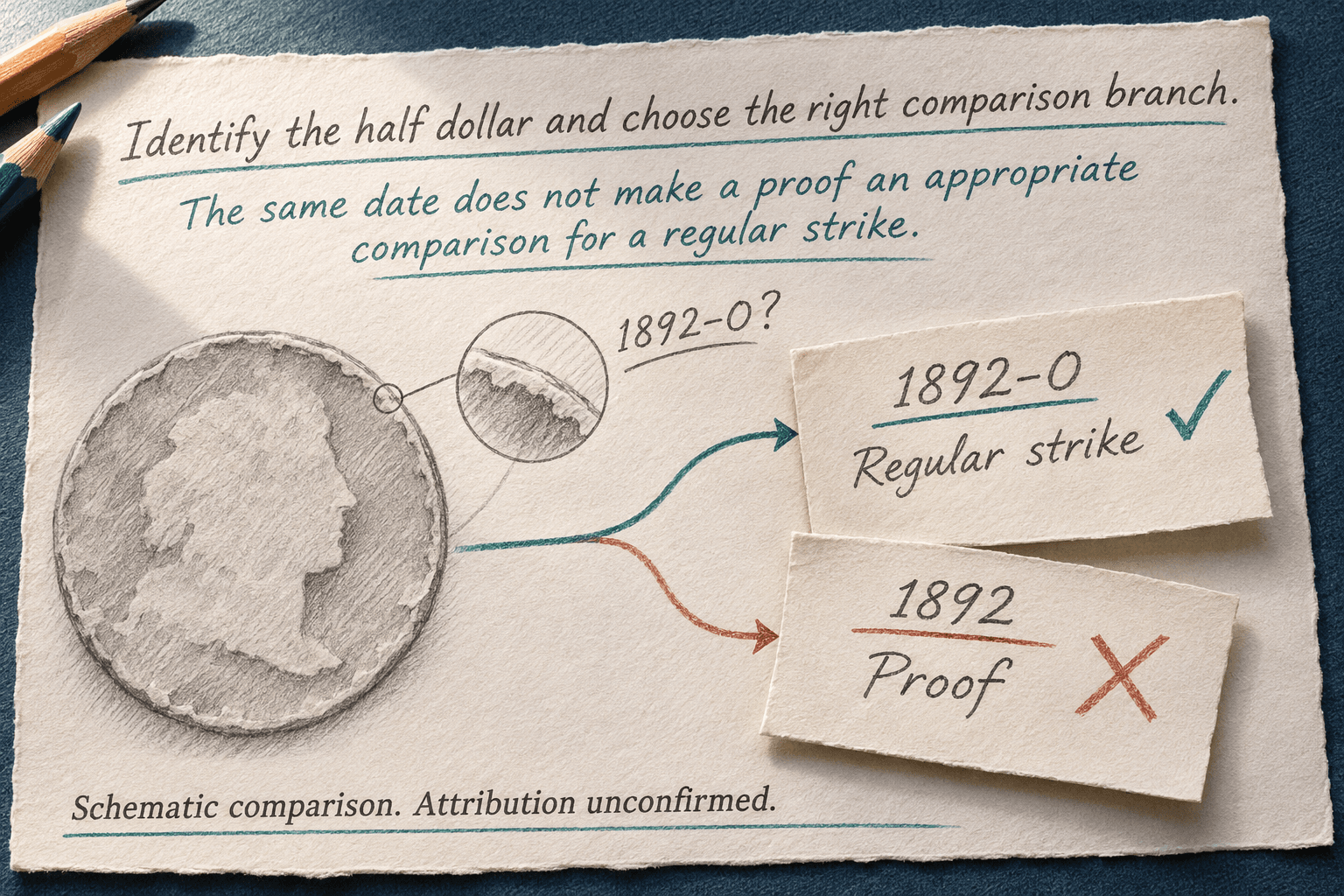
Turn the coin over. The Barber half dollar has a heraldic eagle and the words HALF DOLLAR on its reverse. The portrait alone is insufficient: Barber's Liberty also appears on dimes and quarters. PCGS describes these design features in its series overview.
Barber half dollars run from 1892 through 1915; the PCGS half-dollar catalogue places the Walking Liberty half dollar next, starting in 1916. Barber dimes and quarters extend into 1916, as the PCGS price-guide directory shows. A search result headed “Barber 1892-1916” may concern another denomination.
Photograph both sides before transcribing the date. If you can read only “189?”, record exactly that and add “last digit unreadable.” Do not choose 1892 because it is the first catalogue entry or the closest-looking example. Until the issue is established, no reliable range has been established for that particular coin.
Choose year, mint and MS or proof reference
Match the complete catalogue description. For example, PCGS lists 1892-O regular strike separately from 1892-O Micro O. It also has a distinct 1892 proof entry. Those entries answer different identification questions even though their dates overlap.
An MS heading can cause confusion. In the Barber half dollar price guide, the MS section contains the regular-strike issues and includes circulated grade columns such as 4 and 12. Opening that section does not mean your worn coin is Mint State. Choose the issue first, then read the correct condition column.
Proof is a separate strike format. NGC's grading scale distinguishes MS, which applies to Mint State grades 60-70, from PF, its proof designation. Do not move a coin into the proof branch simply because it looks shiny. If the strike type remains uncertain, retain both the question and the reference you need to resolve it.
Record wear and surface questions before estimating a range
Write down what the photographs show: a flattened portrait, incomplete lettering, a rim nick or lines across an open area. Keep an observation such as “parallel lines visible under angled light” separate from a conclusion such as “improperly cleaned.” The latter needs review.
NGC's Details grading guidance explains that improper cleaning, scratches and other surface problems can prevent a coin from receiving a numeric grade. Remaining detail alone therefore does not settle the comparison. A coin with a surface problem should not inherit the price of a coin with a normal numeric grade just because both retain similar lettering.
A high-grade certified auction coin is a poor direct comparison for a worn raw coin. “Raw” means the coin is not encapsulated with a grading service's certification. Keep that status in your notes, and use the grading vocabulary to understand a reference label without assigning yourself a professional grade.
Compare references without turning them into an offer
Two observed guide entries show why the issue matters. These are individual references, not a range for an unidentified coin:
| Exact issue and column | Observed amount | Basis and certification | Source and observation |
|---|---|---|---|
| 1892 regular strike, grade 4 | USD 60 | PCGS guide, average dealer asking price for a PCGS-graded coin; buyer's premium not applicable | Barber half dollar guide, accessed November 7, 2026, Beijing time |
| 1892-O regular strike, grade 4 | USD 375 | Same guide and certified asking-price basis; buyer's premium not applicable | Same source and access date |
The guide displayed an update of November 5, 4:58 p.m. EST when checked. These figures do not establish either coin's sale proceeds or the value of a raw example. The PCGS guide methodology describes its figures as average dealer asking prices for PCGS-graded coins and a starting point for assessing value. A different grade, variety or surface assessment can make the row unsuitable.
For a sale comparison, open the auction house's original lot page. Match the full issue, strike, grade and any Details notation; inspect both coin photos. Record the sale date, currency, certification and whether the reported amount includes the buyer's premium. A dealer's asking listing, a guide reference and a completed sale need separate labels. An unsold lot is not a realised sale.
This guide has not established a set of sold lots comparable to a particular reader's coin, so it gives no personalised price range. When you find several suitable sales, keep their context beside the amounts instead of averaging every result with “Barber” in the title. Exclude a different mint or proof strike, and explain the exclusion. A lone record sale or a calculation based on silver content cannot establish what a buyer will pay for your coin. Do not multiply a catalogue row by the number of coins in a box to create a collection total.
For the broader process, see how to check a coin reference value.
Save an editable record and a next review step
Start with a blank record you can revise. Take one clear photo of each side, then closer views of uncertain details. Transcribe what is visible, record the reference URL and access date, and distinguish your reading from any catalogue attribution. If a new photo changes “189?” to a confirmed date, preserve the earlier uncertainty in a note so the reason for changing the comparison remains clear.
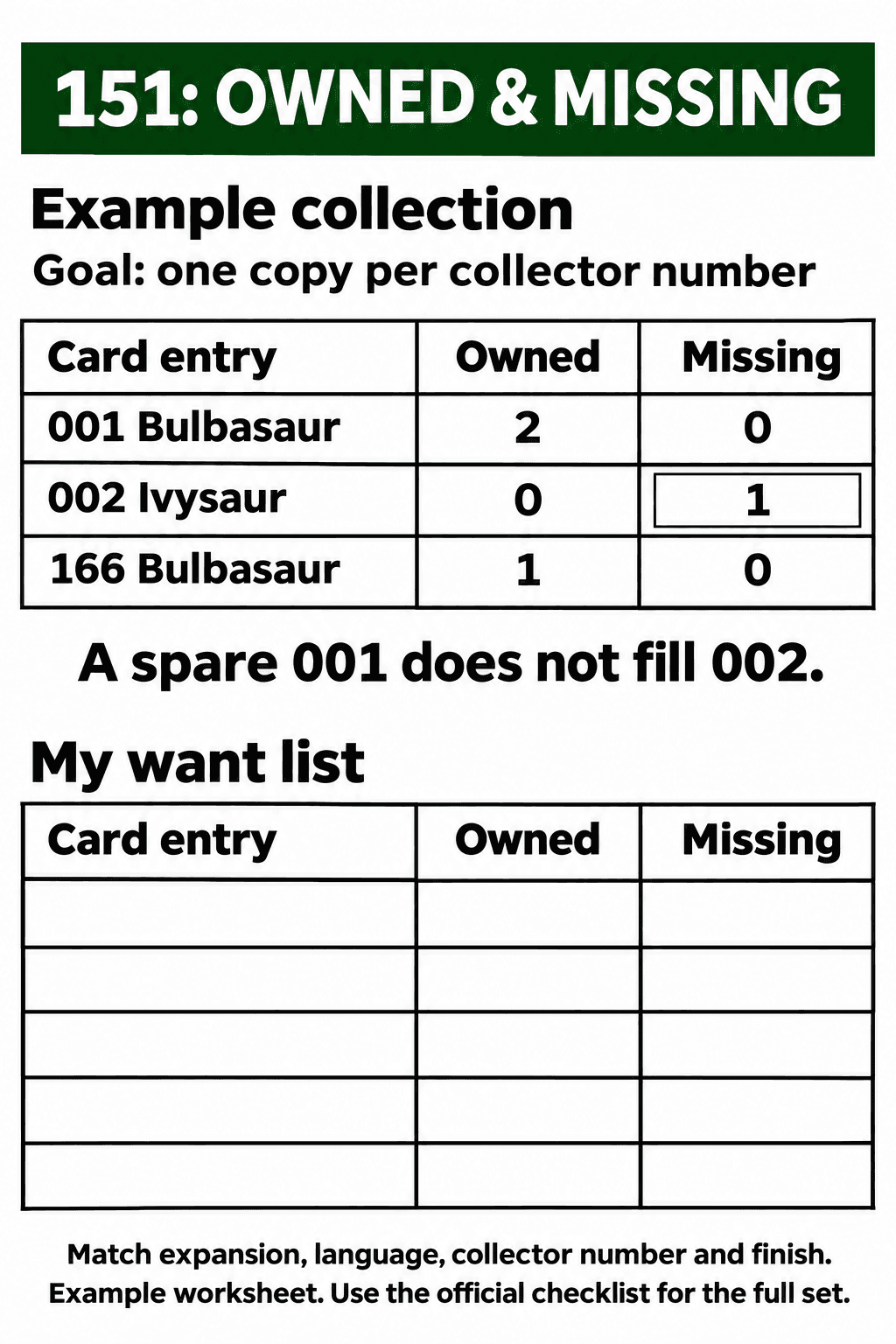
Illustrative blank comparison worksheet
This is an editorial worksheet, not a customer record or a Folidx screen. Blank cells are intentional; enter a monetary amount only after checking its source.
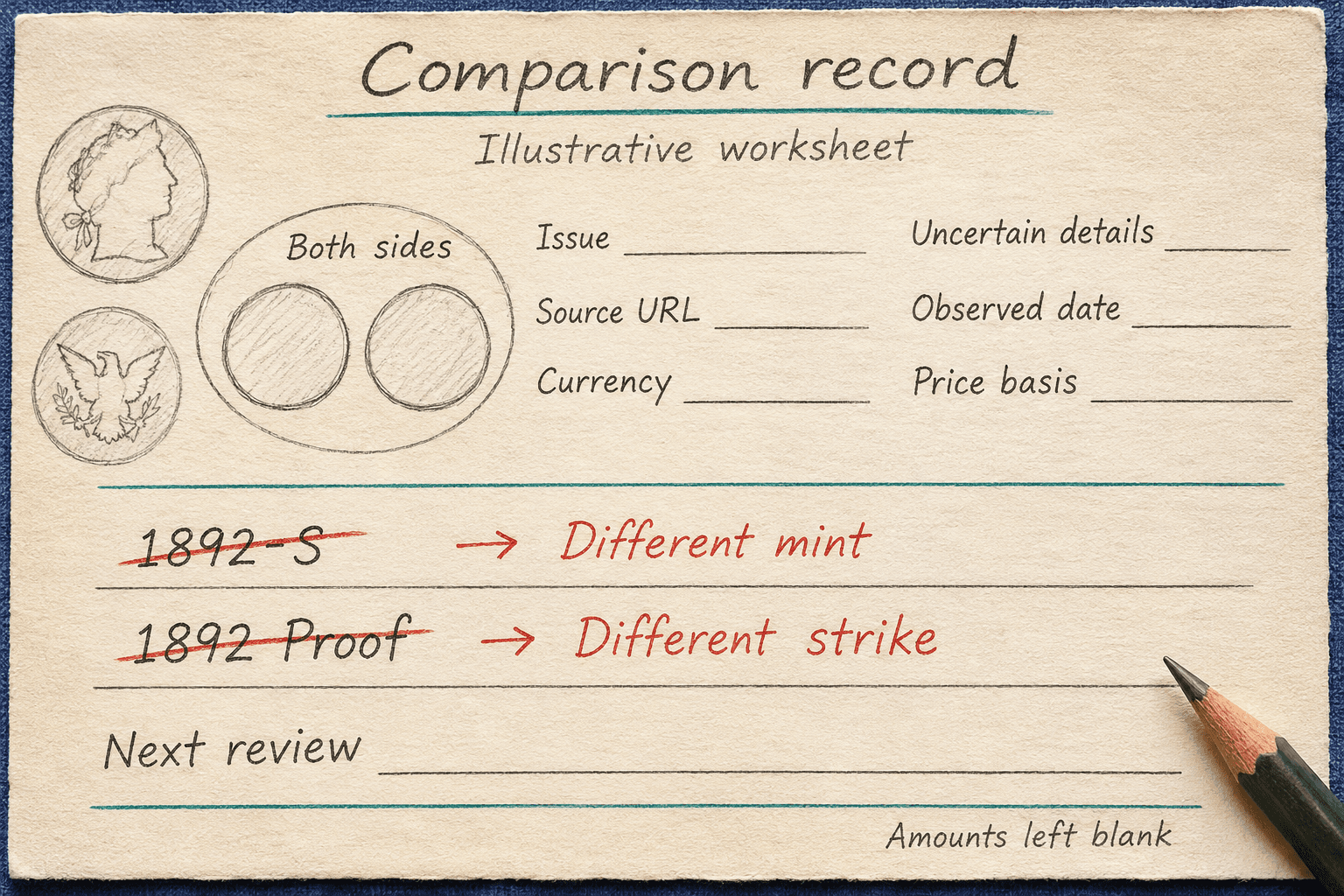
Illustrative record: the coin sketches do not establish an identification. Keep amounts blank until the reference has been checked.
| Item photos | Exact issue / strike | Uncertain identification fields | Raw / certified status | Visible surface notes |
|---|---|---|---|---|
| Reference URL | Reference / observation date | Currency | Amount and price basis | Buyer's premium included? | Reason excluded / next review |
|---|---|---|---|---|---|
Two fictional exclusion examples show what belongs in the last column:
| Candidate comparison | Why reject it for the proposed match? | Amount |
|---|---|---|
| An 1892-S reference for an item tentatively read as 1892-O | Different mint; resolve the item's attribution first | |
| An 1892 proof reference for an item being checked as a regular strike | Different strike type; the shared year is insufficient |
Choose a specific next step: retake the date photo, confirm the mint attribution, or ask a qualified specialist to review a possible variety or surface problem. “Needs review” is more useful than a precise-looking number attached to the wrong issue.
After checking the issue and references, you can save the record in Folidx. Its coin workflow turns photos into editable identification reports with reference value ranges and visible condition clues, organised into archive books and pages. Review and edit AI suggestions against your photos and sources. They do not replace professional grading, authentication or an appraisal. The worksheet above is a documentation method, not a promise that Folidx has those exact fields.
Keep the photos, source links and uncertain details together in an editable Folidx record.
Short reader questions
Can I compare a raw coin with a certified guide row?
Use it as a labelled reference while keeping the certification and condition differences visible. It does not establish that your coin merits the same grade or amount. Avoid applying a fixed discount to turn the certified row into a raw-coin price.
What should I do if the date or mint is unreadable?
Save both-side photos and write which detail is uncertain. Leave the issue and value unresolved until better evidence or a specialist's review supports the match. Do not turn “I cannot see a mint mark” into a confirmed attribution.
Does a reference price mean someone will pay it?
No. A guide figure is a reference with a stated basis. A completed sale documents one transaction; an asking listing documents a seller's request. Neither is an offer for your coin.
Is every 1892-O half dollar a Micro O?
No. PCGS lists the standard 1892-O and Micro O as separate entries. Record a suspected Micro O as unconfirmed until the variety has been checked; do not borrow its reference price because an O looks small in a photograph.
Sources
- PCGS Barber half dollar series index: design, issue list and strike branches.
- PCGS Barber half dollar price guide and guide methodology: the dated reference examples and their asking-price basis.
- NGC grading scale and Details grading: grade terminology and surface-problem distinctions.
The Folidx team writes guides to documenting collections and using Folidx.