Eisenhower Dollar Value: Check Clad, Silver, and Proof Issues
Learn how to check Eisenhower dollar value by matching the issue and condition, comparing sourced references, and saving a dated collection record.
By Folidx Team
To check Eisenhower dollar value, identify the date, mint mark, composition and finish, then consider condition and whether the coin is raw or certified. An S mint mark can appear on a clad proof or a silver issue, so it cannot select the reference by itself.
This guide does not establish a reliable dollar range for your coin. Use this table to select a reference before copying a price.
| What you have established | Reference branch to select | What still needs checking |
|---|---|---|
| Clad, non-proof issue | Matching year/mint in the MS branch | Condition and any listed type |
| Silver, non-proof collector issue | Matching SILVER row in the MS branch | Issue evidence and condition |
| Proof issue | Matching PF branch, with composition specified | CLAD versus SILVER and designation |
| Bicentennial dollar | 1776-1976 row | Mint, composition, finish and listed type |
| Uncertain composition or finish | Pause the price comparison | Resolve identification first |
These are reference-selection branches, not grade assignments. NGC's Eisenhower directory separates these issue categories. Selecting an MS row does not establish that a loose coin qualifies for an MS grade.
Separate Eisenhower dollars from other dollar coins
The Eisenhower series dates from 1971 to 1978. Look for Dwight D. Eisenhower's left-facing portrait. The usual reverse honors the Apollo 11 Moon landing; the Bicentennial version pairs the Liberty Bell with the moon. The U.S. Mint's dollar history distinguishes this series from Morgan, Peace and Susan B. Anthony dollars.
Copy the date as it appears. If it reads 1776-1976, keep both dates. The Mint issued the Bicentennial design during 1975 and 1976, so the dual date does not establish which production year applies to an individual coin. Leave that question open.
Photograph the front, back and any readable mint mark before narrowing the issue. If you cannot read something, enter "unreadable" or "uncertain." A missing observation should remain a question, rather than becoming a guessed catalogue entry.
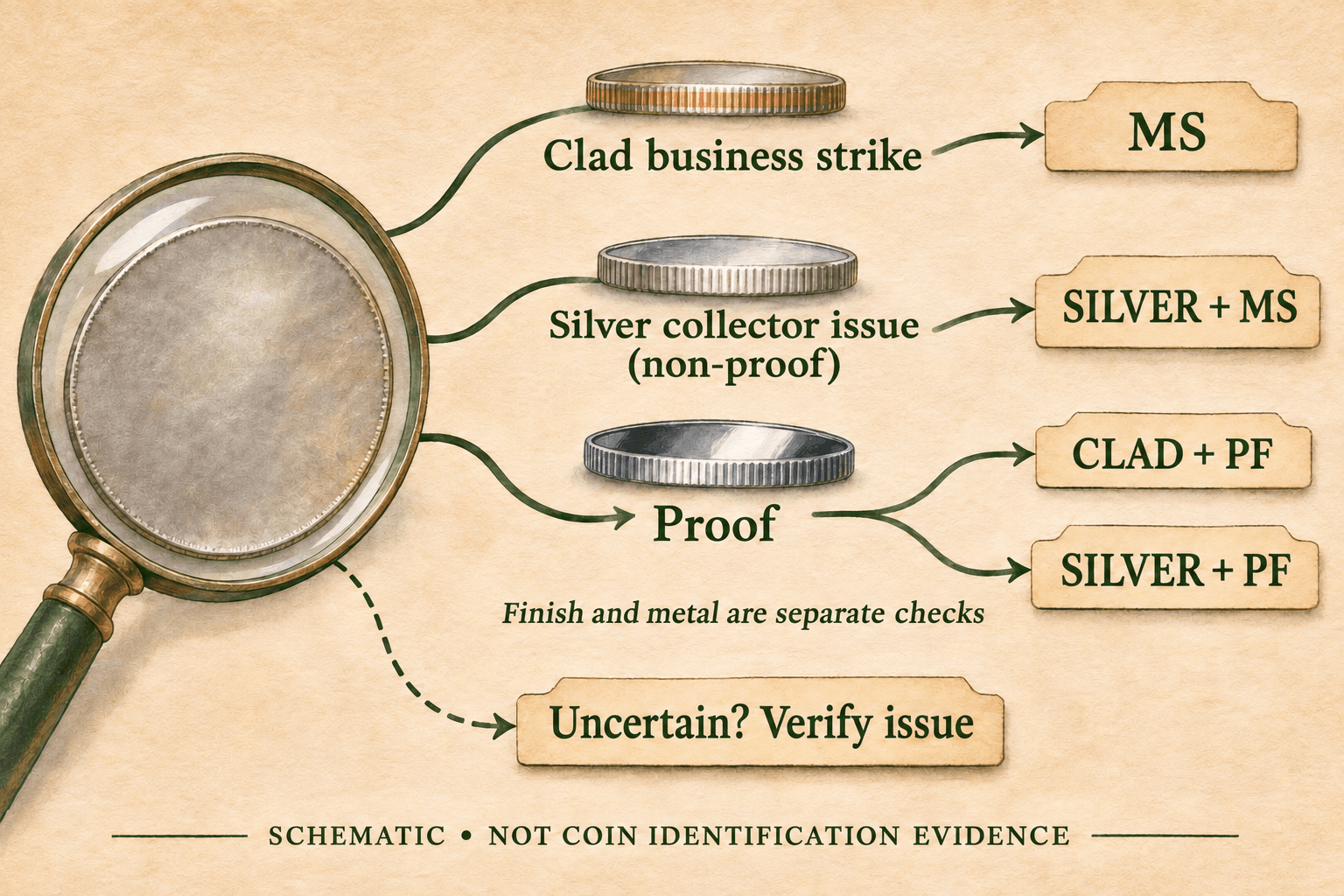
AI-generated schematic of reference selection. The symbolic metal surfaces cannot identify a coin's composition or authenticate an issue. MS and PF labels select catalogue branches; they do not grade your coin.
Choose clad, silver or proof before opening a price table
Composition and finish answer different questions. Clad and silver describe the metal branch. Proof describes how the coin was made, as the Mint's explanation of proof production explains. A proof can therefore require a further composition check.
Searching for "Eisenhower silver dollar value" does not establish your coin's metal. PCGS lists separate 1973-S clad proof and 1973-S silver proof issues. Their date, mint mark and proof status match; their composition does not. The clad entry specifies copper-nickel outer layers over a copper center, while the silver entry specifies silver-bearing layers.
Bicentennial dollars need the same care. The U.S. Mint records both copper-nickel and 40 percent silver versions, including proof and uncirculated production. The Liberty Bell reverse alone does not select a silver reference.
Use issue documentation to resolve the branch. Keep any original packaging information with the photos, and compare the details against the catalogue description. If the evidence conflicts, leave composition unresolved and seek an informed examination before assigning a value.
Compare the matching year and issue
Try a lookup without entering a price. Suppose you can read "1973" and "S," and you have evidence that the coin is a proof. That still leaves the two PCGS entries above. A silver-proof comparison belongs outside your working set if documentation establishes the clad issue. If composition remains uncertain, keep both as identification leads rather than treating either as a valuation.
Next, open the NGC directory and match the complete issue label. Keep SILVER, MS and PF distinctions intact. For Bicentennial coins, retain any listed type distinction as well. Leave a variety attribution pending until a source supports it; a more valuable row is not evidence that it is the right row.
Then compare the reference's condition description with what you know. Record visible marks or wear separately from a numerical grade. For the broader process, see how to check a coin reference value; use the grading vocabulary guide if a label is unfamiliar.
Compare references without turning them into an offer
To answer "what is my Eisenhower dollar worth?", decide which kind of price you need. Keep these labels separate:
| Reference | What to record | How to use it |
|---|---|---|
| Dealer retail guide | Issue, grade, certification basis and guide date | A reference for that stated category |
| Completed auction lot | Exact issue, holder/grade, sale date, currency and premium treatment | Evidence of one transaction |
| Asking listing | Seller's description, asking amount and observation date | An advertised request, not a completed sale |
NGC describes its guide as average dealer retail for NGC-certified coins, excluding sales tax. It also warns that updates do not capture every short-term market change. A raw coin is one without third-party certification; a guide entry for a certified coin is not a cash offer for it.
For a sale comparison, start with an auctioneer's own record, such as the GreatCollections Eisenhower archive. Open the individual lot and check its issue and condition before using the result. Confirm whether the stated amount includes the buyer's premium. If that is unknown, record it as unknown and avoid comparing the total with a hammer-only result.
This guide supplies no monetary example or range because no suitable sold comparison has been established for your coin. A record sale, an archive-wide range or a silver-metal calculation cannot establish an individual sale price. Do not multiply a catalogue figure into a collection valuation.
Save an editable record and a next review step
Keep identification evidence attached to the reference so you can distinguish an issue correction from a price change.
- Save clear photos of both sides, plus close-ups of uncertain details. Preserve the original images.
- Transcribe the date and mint mark. Separate what you can read from what you suspect.
- Record composition and finish with the source that supports each. Keep unresolved fields open.
- Add the reference URL, observation date, currency and price basis. Record the reference's own update or sale date separately.
- Set a concrete next step, such as confirming composition or finding an issue-matched completed lot. Leave the value blank until the evidence supports an entry.
Fictional blank comparison worksheet
This is an editorial worksheet, not a customer record or a Folidx screen. The example rejection reasons show how to document a mismatch; all monetary fields are blank.
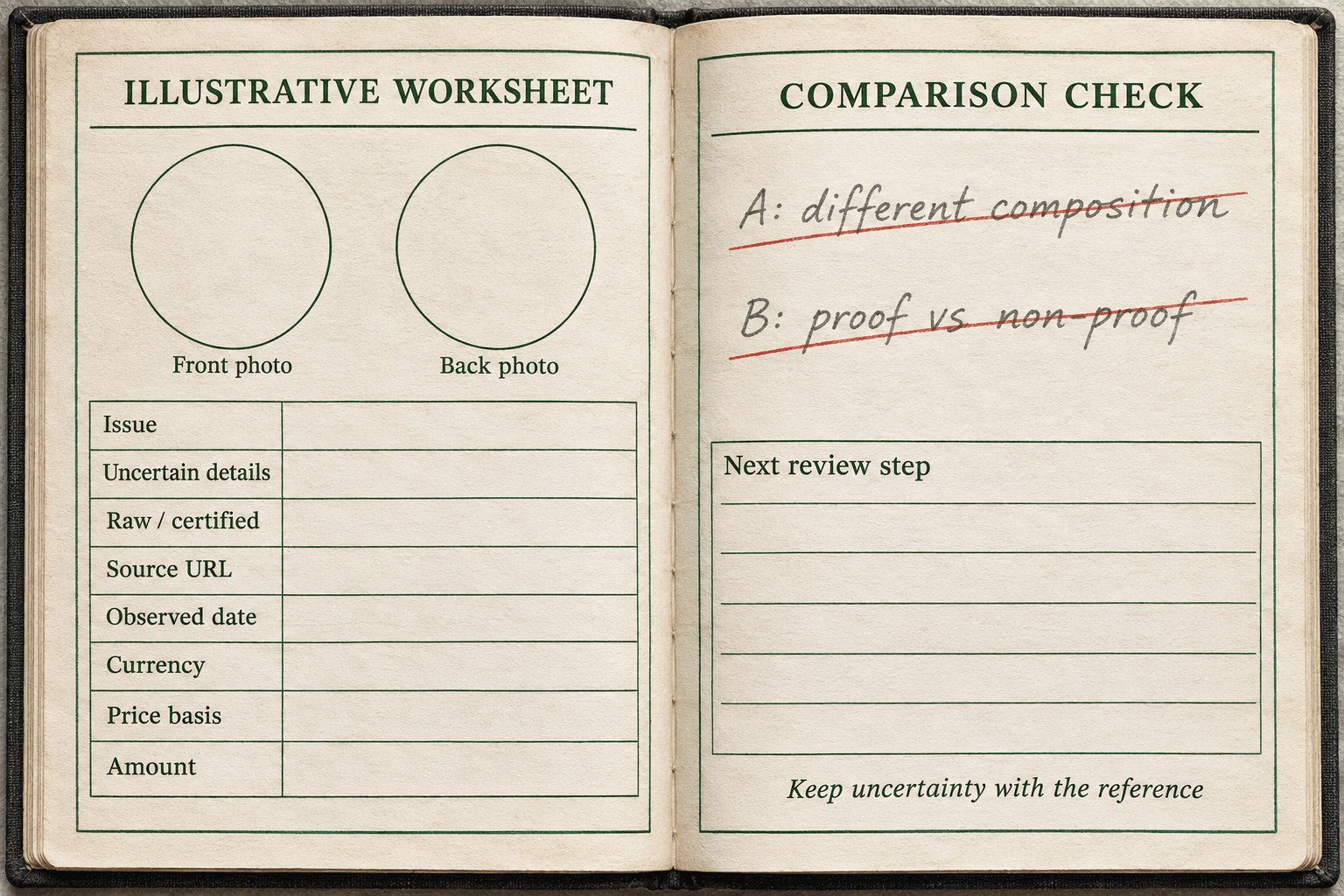
AI-generated worksheet illustration. The rejected rows are fictional examples; the amount field is blank.
| Field | Your entry |
|---|---|
| Item photos | Front: _; back: _; detail: _ |
| Exact issue | Date: _; mint: _; composition: _; finish: _ |
| Uncertain identification fields | _ |
| Raw or certified | _; holder/grade if certified: _ |
| Visible surface notes | _ |
| Reference URL | _ |
| Observation date / source update or sale date | _ / _ |
| Currency / price basis / buyer's premium | _ / _ / _ |
| Reference amount | _ |
| Comparison excluded | Example A: different composition; example B: proof compared with non-proof |
| Next review step | _ |
Folidx is an optional place to continue that archive. Its photo-to-record workflow produces editable identification reports, reference ranges and visible condition clues, with records organised into archive books and pages. Review the AI identification and edit it against the evidence you have gathered. Keep uncertainty visible: a photo-led reference does not authenticate a coin or assign a professional grade.
Keep the photos, source links and uncertain details together in an editable Folidx record.
Short reader questions
Can I compare a raw coin with a certified guide row?
Use it to understand the category, and record the certification mismatch. A matching date does not give your raw coin the displayed grade or retail figure. NGC's guide basis is certified coins.
What should I do if the date or mint is unreadable?
Retain the photos and mark the field unreadable. Try another clear photograph, or ask for an informed examination. Keep issue-specific pricing pending rather than selecting the nearest-looking entry.
Does a reference price mean someone will pay it?
No. A guide is a reference, an asking listing is a seller's request, and a completed lot records a particular transaction. An actual offer requires a buyer to assess your coin and agree to terms.
Does an S mint mark mean my Eisenhower dollar is silver?
No. The separate 1973-S clad and silver proof entries demonstrate why the mint mark is insufficient. Establish composition as well as finish before selecting the reference.
Sources
- NGC: Eisenhower Dollars price guide and guide limitations
- U.S. Mint: Dollar coins and the Eisenhower series
- U.S. Mint: Bicentennial coins and medals
- U.S. Mint: Collectible coins and proof production
- PCGS: 1973-S clad proof and 1973-S silver proof
- GreatCollections: Eisenhower dollar auction archive
Reference pages checked November 7, 2026 (Beijing time).
The Folidx team writes guides to documenting collections and using Folidx.