Franklin Half Dollar Value: Read the Date, Finish, and Bell Details
Learn how to check Franklin half dollar value by matching the issue and condition, comparing sourced references, and saving a dated collection record.
By Folidx Team
Franklin half dollar value has no single reliable amount until you identify the date, mint, regular or proof issue, and condition used for comparison. Start with the exact coin, then choose the matching reference branch. A sharp photograph of the Liberty Bell can preserve useful detail, but it cannot establish a certified Full Bell Lines designation.
Quick answer: choose the reference before the price
Use this table before copying a number from a catalog. The PCGS Franklin series index separates MS and PR entries; its regular-strike pages also distinguish ordinary and Full Bell Line references.
| What you can establish | Reference branch to open | What to keep unresolved |
|---|---|---|
| Date and mint; regular strike | Exact year/mint under the regular-strike list | Grade, if the coin has no verified grading label |
| Date and evidence identifying a proof | The corresponding PR entry | Any cameo designation not established by the evidence |
| Certified label includes FBL | Same issue, grading service, numerical grade and FBL branch | Whether another service would reach the same conclusion |
| Raw coin with visible bell lines | Record the observation; inspect ordinary and FBL references separately | FBL status and numerical grade |
| Date, mint or finish remains uncertain | Identification references first | A price range for the coin |
An ungraded, or raw, coin does not acquire a grade because it resembles a catalog photograph. If identification or condition remains unresolved, no reliable range has been established for your coin. Leave that lookup open.
Confirm Franklin and the Liberty Bell
The Franklin series runs from 1948 through 1963. Look for Benjamin Franklin's right-facing portrait and the Liberty Bell reverse, with a small eagle beside the bell. The date sits to the right of the portrait. These are the identifying features described in PCGS CoinFacts.
Check above the bell on the reverse for a mint letter: D identifies Denver and S identifies San Francisco; Philadelphia issues carry no mint mark. Littleton's series guide, page 13, shows this location. A blurred photo does not establish that a mint mark is absent.
Transcribe the date exactly. Check the mint entry against the series list instead of choosing the nearest-looking year. For example, PCGS lists 1949, 1949-D and 1949-S as separate issues. An unreadable character belongs in your notes as a question, not as a guessed match.
A Kennedy half dollar needs a different reference page. Check the portrait as well as the denomination.
Keep proofs and Full Bell Lines references separate
PCGS records Franklin proofs from 1950 through 1963. A date by itself does not distinguish the finish: 1963 regular strike, PCGS #6684, and 1963 proof, PCGS #6704, have separate entries. The proof page also separates PR, Cameo and Deep Cameo references. Do not choose a proof branch just because a photograph looks bright.
Full Bell Lines, abbreviated FBL, is a separate question. PCGS's published criteria apply to Franklin halves graded MS60 or better and require separation of the lower bell lines without major disturbances. NGC describes its own criteria: all horizontal bell lines must be distinct, and it does not use FBL for Franklin proofs. Keep the grading service attached to a designation when comparing references.
For a raw coin, write an observation such as "horizontal lines visible in reverse photo; designation unverified." Photograph the bell under another lighting angle if glare hides it, and keep the original image alongside the new one. Use the separate guide to grading vocabulary if the abbreviations are unfamiliar.
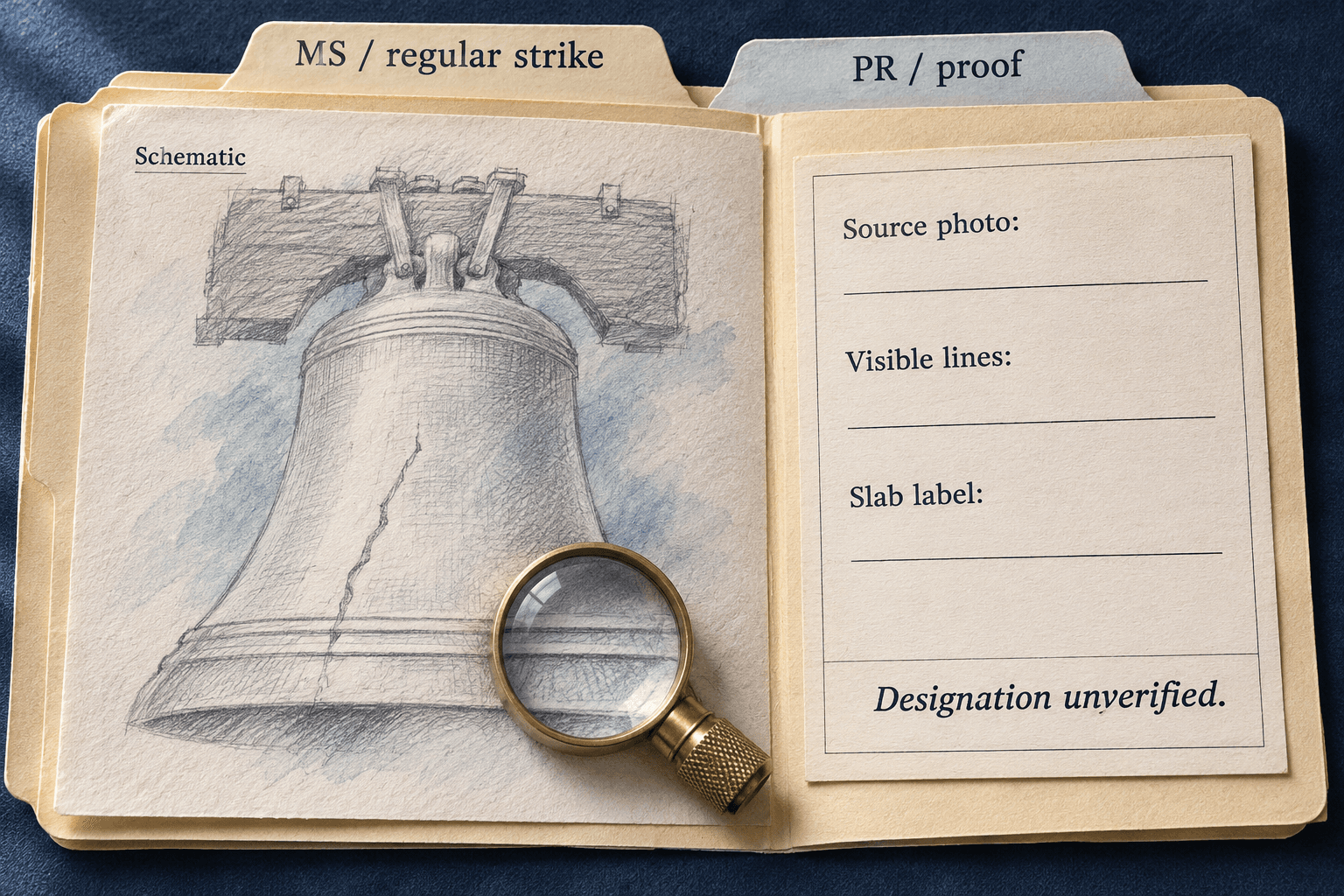
Editorial illustration: a bell schematic and recording slip. This is not a coin photograph or grading evidence.
Build a dated reference comparison
Choose one row whose issue and stated condition you can explain. For a worked lookup, the PCGS price guide displayed USD 90 for the 1955 regular-strike half dollar, PCGS #86670, at MS65 FBL when checked on November 7, 2026, Beijing time. This is a certified-guide reference, not a price established for a raw coin. The page displayed a November 4 update; the observation date records when the reference was checked.
| Evidence | Exact comparison identity | Price basis and date | Amount |
|---|---|---|---|
| PCGS guide row | 1955 50C, PCGS MS65 FBL, #86670 | Guide reference observed November 7, 2026; no auction buyer's premium applies | USD 90 |
| Heritage auction 131615, lot 23221 | 1955 50C, PCGS MS65 Full Bell Lines | Historical sale, April 10, 2016; buyer's-premium treatment not verified in the retrieved archive | USD 89 reported sold |
The Heritage archive entry, observed November 7, 2026, identifies that sold lot and its grade. Its age and unresolved premium basis exclude it from establishing a current range here. The two amounts are documentation examples, not a valuation range.
For your own lookup, keep the guide row and sale evidence on separate lines. Check the original sold lot, its photographs, certification, sale date and fee basis before accepting it as comparable. Exclude a different mint, proof issue, grade or designation, and write down the reason. If no suitable sold comparison survives those checks, leave the range unresolved.
Compare references without turning them into an offer
An asking listing records what a seller requests. A guide records its publisher's reference measure. A realised auction price records a transaction under that sale's terms. Keep those labels visible instead of averaging them together.
NGC explains that its US guide concerns average dealer retail prices for NGC-certified coins, excludes sales tax, and may lag short-term changes. It treats the guide as one input among several. A raw coin does not meet that certified-reference description.
A buyer's premium can change the comparison: establish whether the reported sale amount includes it, and record taxes or shipping separately when relevant. An unknown fee basis should remain unknown. A record auction result or a spot-metal calculation cannot establish what someone will offer for your particular coin. Do not multiply a catalog row by the number of coins in a box to produce a collection total.
For the broader process, see how to check a coin reference value.
Save an editable record and a next review step
Photograph both sides, then take a closer image of any uncertain date, mint detail or bell lines. If the coin is already in a grading holder, retain a readable label photo too. Separate transcribed label information from your own observations.
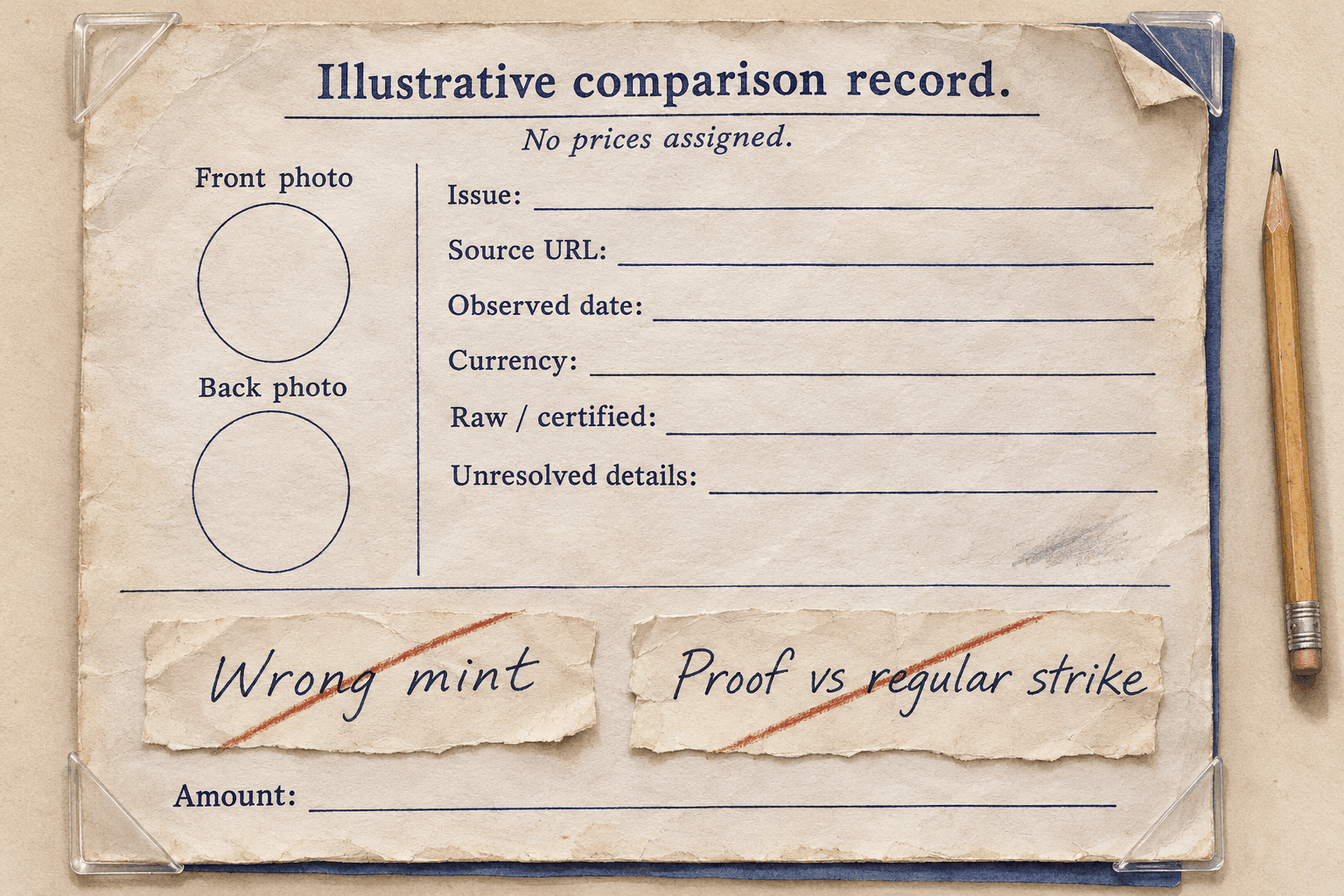
Illustrative paper worksheet. Photo slots and money fields are blank; the rejected notes show why an issue or finish mismatch must stay out of the comparison.
Copy this fictional blank worksheet into a notebook or document. It is an editorial template, not a customer record or Folidx screen. Fill an amount only when you have a suitable source.
| Record field | Your entry |
|---|---|
| Item ID and front/back photo filenames | |
| Exact issue: series, denomination, date, mint, finish | |
| Uncertain identification fields | |
| Raw or certified; service and exact label if present | |
| Visible surface and bell-line observations | |
| Reference URL, row or sold-lot ID | |
| Observation date and sale date, if applicable | |
| Currency and amount | |
| Basis: asking, guide or realised; premium included/excluded/unknown | |
| Excluded comparison and reason | |
| Next question and review date |
Make the next step specific: photograph the unreadable mint detail again, verify the holder label, or locate a recent matched sold lot. Keep the original uncertainty in the record even if a later note resolves it.
Folidx offers an optional archive after this comparison work. It can generate editable identification reports from coin photos, with reference value ranges and visible condition clues, and organise records in archive books and pages. Review and edit AI suggestions against your photos and sources; they do not establish professional grading or authentication. The worksheet above remains useful on its own and does not imply dedicated Folidx fields for every column.
Short reader questions
Can I compare a raw coin with a certified guide row?
You can use it to understand the reference category, but record the mismatch. Do not assign the guide's grade or designation to your coin. If those are unresolved, the row does not establish your coin's value.
What should I do if the date or mint is unreadable?
Keep the field uncertain, retain the original photo and try another close image with different lighting. Resolve the identification before choosing an issue-specific price reference.
Does a reference price mean someone will pay it?
No. A reference is evidence to consider, while an offer depends on the actual coin and transaction. Save the source, date and price basis for review.
Is a 1963 Franklin proof the same reference as a 1963 regular strike?
No. PCGS lists separate entries for them. Confirm the issue before selecting the PR or regular-strike branch, and keep any FBL reference separate from proof comparisons.
Keep the photos, source links and uncertain details together in an editable Folidx record.
Sources
- PCGS CoinFacts: Franklin half dollar series and MS/PR issue lists
- PCGS: 1963 regular strike and 1963 proof
- PCGS: Full Bell Lines criteria
- NGC: Full Bell Lines criteria
- PCGS Franklin price guide
- Heritage: auction 131615 archive, lot 23221
- Littleton Collectors Guide to Franklin Half Dollars, page 13
- NGC Franklin price guide and methodology
Folidx Team, Editorial team. The Folidx team writes guides to documenting collections and using Folidx.