How to Check Pokemon Card Values: A Careful Way to Price Your Cards
Step-by-step Pokemon card value check: identify the card, note visible condition, check raw and graded market references, and save each price with its source.
How to Check Pokemon Card Values: A Careful Way to Price Your Cards
Checking Pokemon card values is a four-part job, not a single lookup: identify the exact card, note its visible condition, compare raw and graded market references, then save every price with its source and date. One warning up front: a listing price is an asking price. What a card actually sold for is usually lower, and that gap is where most estimates go wrong.
Here is the full path, step by step.
What you need before you check anything
Have these three facts ready, because every price database is organized around them:
- The card name, printed at the bottom of the card.
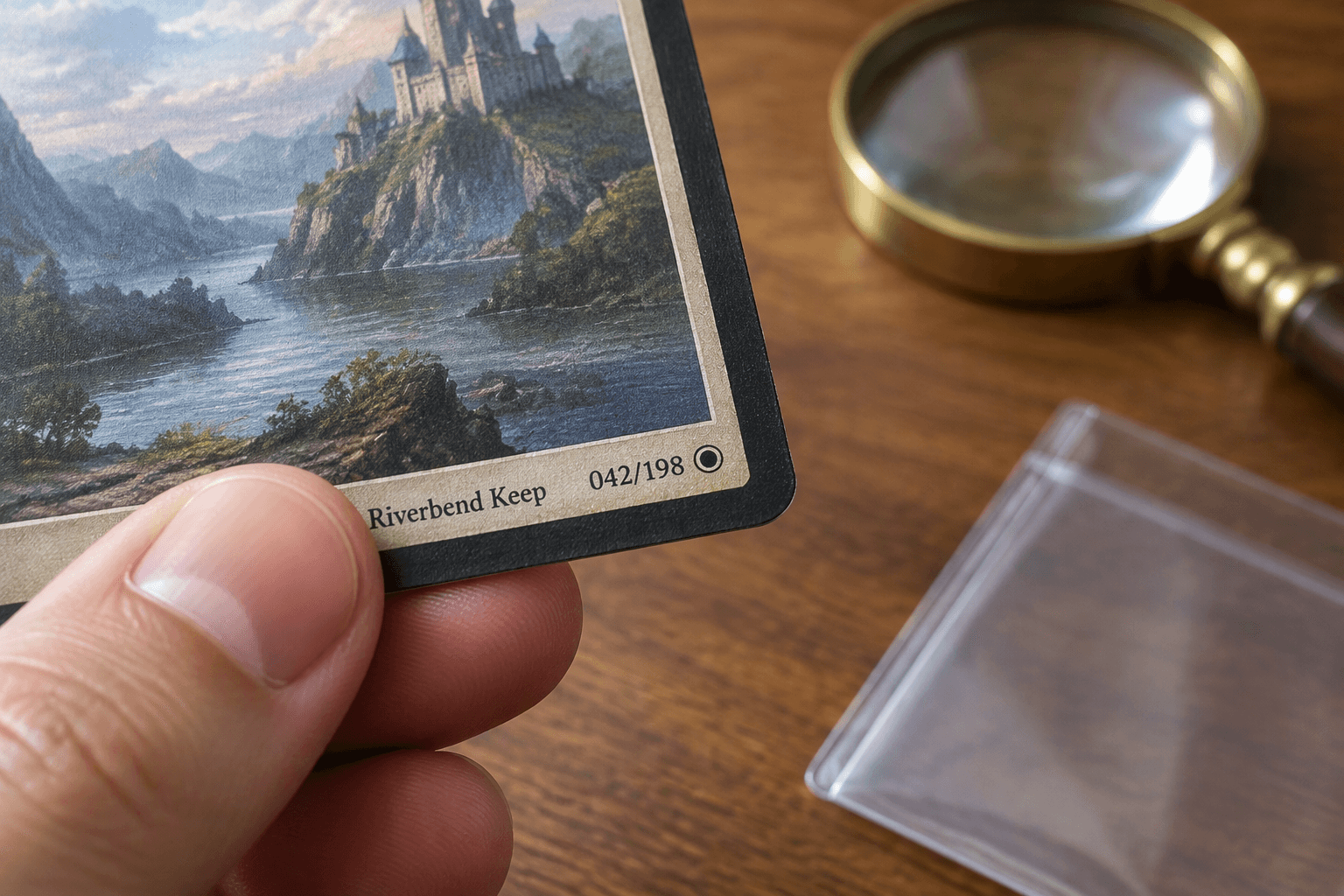
- The set number, printed next to the name in the form of two numbers separated by a slash, such as 042/198.
- The variant: is it a standard print, a holo, a full art, or a secret rare? Different variants of the same card name can differ in value by a large margin.
The bottom corner of the card carries most of this information. Read it first.
If you are unsure which symbol means what, the guide to Pokemon rarity symbols walks through the marks card by card.
Step 1: Identify the exact card
The set number is the key. It tells you which set the card belongs to and which card within that set it is, so the database returns prices for the right print, not a similarly named one. Two cards can share a name and differ in set, and their prices can differ by orders of magnitude.
Read the bottom corner as one unit: name, set number, rarity symbol. Write the combination down before you open a price site. This one minute of reading is what separates a checked value from a guess.
Step 2: Note the visible condition
Condition moves price as much as rarity does. A card that came out of a pack clean is worth far more than the same card with a crease or edge whitening, and professionally graded high-grade copies often see significant price jumps, as value guides such as Rare Candy's explainer note.
What you can judge from a look:
- Creases or bends in the card body.
- Whitening along the edges, visible when you tilt the card against light.
- Scratches on the surface or the holo layer.
- Print centering and corner wear.
Record what you see, not what you hope. And keep the boundary clear: a look at a photo tells you about visible condition only. It does not confirm the card is authentic, and it does not detect anything inside the card or under the surface.
At this stage you also choose which of two price lines you will check. An ungraded card, often called raw, trades against raw sold prices. A card sealed in a grading slab trades against sold prices for that specific grade. They are different markets.
Step 3: Check raw market references
For a raw card, compare at least two sources before you treat any number as a reference:
- PriceCharting's Pokemon guide monitors eBay sales and assigns each sale to a card and grade, so its figures are built from sold transactions rather than asking prices, and it keeps historic prices so you can see direction.
- TCGplayer lists a market price alongside seller listings, which gives a quick read on what the market is asking today.
- eBay's sold listings filter shows individual completed transactions, which many collector communities treat as the ground truth for what buyers actually paid.
Now the pitfall this article exists for: asking prices and sold prices are different numbers. A seller can list a card at $120 while the same card sells at $48, $36, and $27. A stack of listings is not evidence of value; completed sales are.
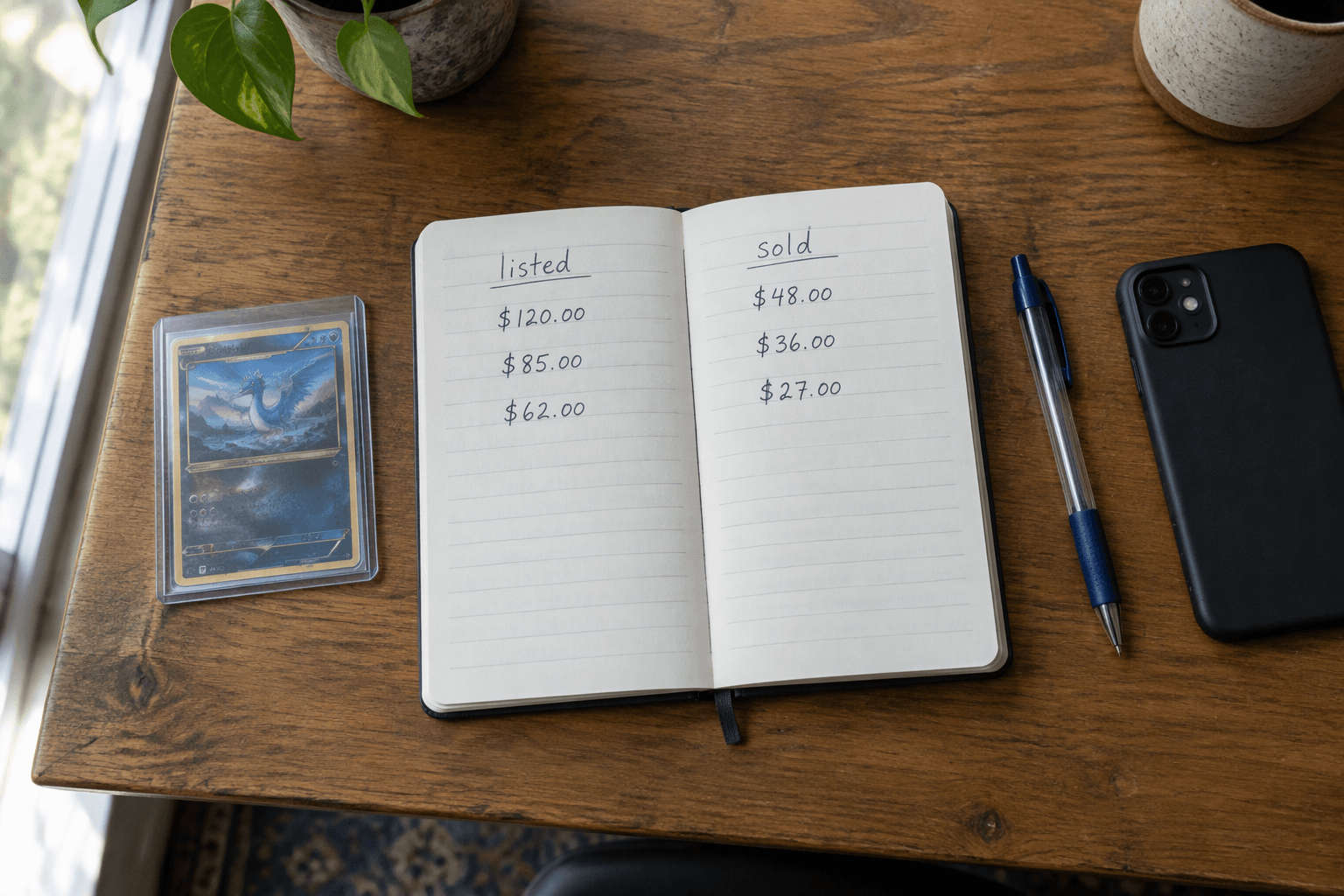
When the sources disagree, prefer the one built from sold data, and note the spread rather than picking a single number. A range such as $30 to $45 is a more honest reference than one confident figure, because Pokemon card values shift as demand moves.
Step 4: If it is graded, look up the slab
If the card sits in a sealed grading case, the label on the slab names the grading company and the grade. Look up sold references for that exact grade, not for raw copies of the same card. PriceCharting tracks prices per grade for Pokemon cards, which makes this comparison direct.
A grade of 9 and a grade of 10 of the same card are separate price points, and the difference can be large. If you are weighing whether to submit a card for grading, the guide to card grading explains the scale and what submission involves before you spend anything.
Step 5: Save the reference with its source
A price you cannot trace later is barely better than a price you never checked. When you finish a lookup, record four things together:
- The reference range you accepted.
- The source link you took it from.
- The date you checked.
- A flag for anything based on thin evidence, so you know it needs a recheck.
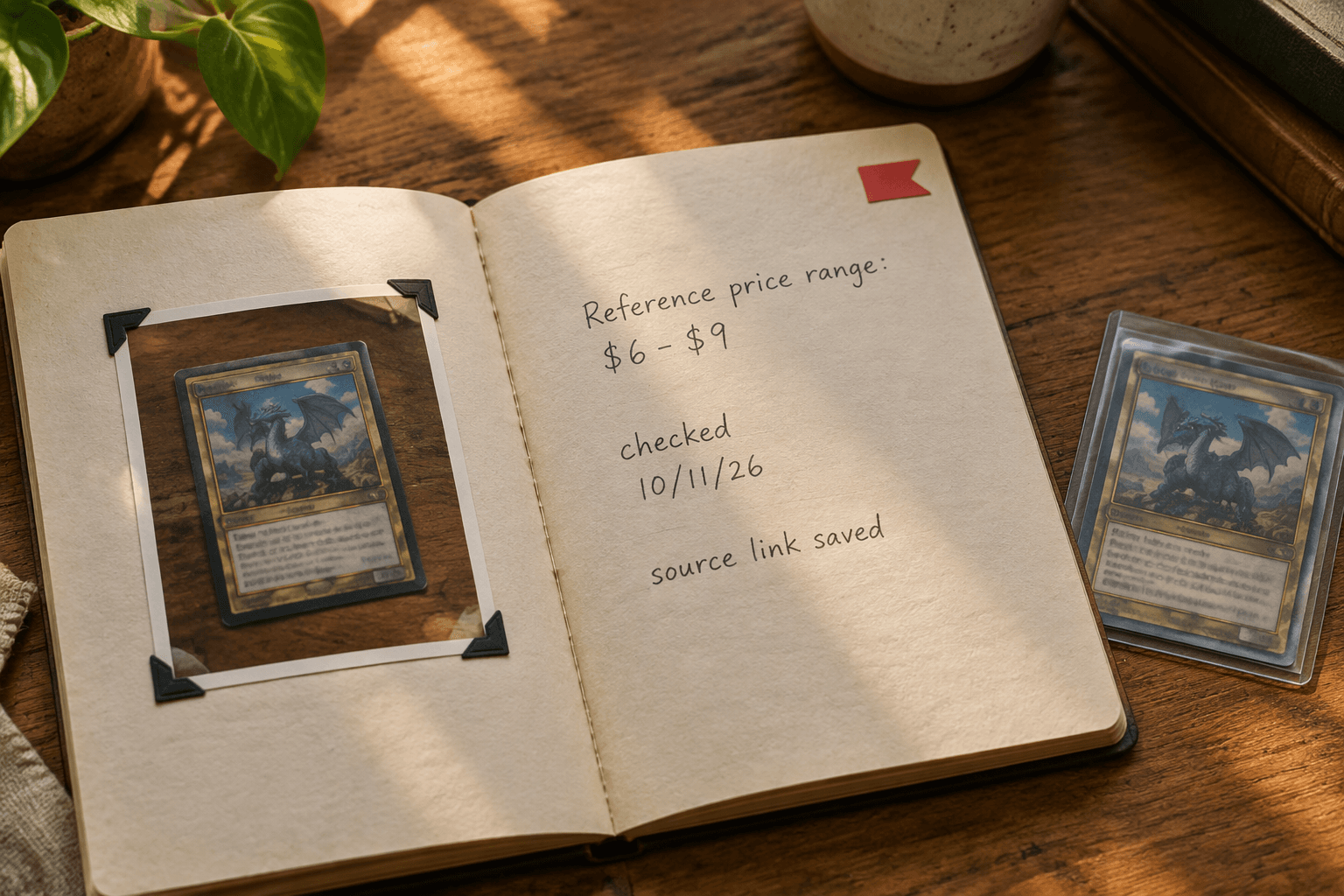
If you keep your collection in Folidx, the workflow is the same idea built in: the original photo stays with the record, each price is stored as a reference snapshot with its source, currency, and timestamp, and low-evidence figures are marked for review rather than presented as settled facts. The archive also keeps every event on a card's timeline, so the next recheck starts from what you already verified instead of from memory.
To be plain about the limit: these are market references, not appraisals. Prices move, and no reference range is a promise about what a card will sell for.
Are my Pokemon cards worth anything?
Most cards pulled from recent packs are worth little on their own; common cards printed in bulk hold little value. Value concentrates in a much smaller group: older sets, cards featuring enduringly popular Pokemon, limited or secret rare prints, alternate arts, and promos from limited releases, all adjusted by condition.
If you are holding a stack and want a fast triage, check three things per card:
- The set number and set year. Older sets and certain modern sets carry more value.
- The rarity symbol and variant. Secret rares and alternate arts sit at the top of the range.
- The visible condition. Creases and heavy whitening pull a card toward bulk value even when the print is desirable.
Anything that passes those three checks deserves a full lookup with the five steps above. Everything else can wait in a binder until you are curious again.
FAQ
Do I need to scan or photograph the whole pack to check values?
No. Prices are looked up per card, so you only need the cards you actually want to price. If you are working through a stack, taking one clear reference photo per card keeps the original evidence attached to each record; the guide to scanning Pokemon cards covers the capture workflow.
Is it worth sending my card in for grading?
It depends on what the raw card already sells for, what grading costs, and how long the turnaround takes. If the raw value is close to the cost of submission, grading rarely pays for itself. The card grading guide covers the scale, the major companies, and what submission looks like, so you can make that call with the numbers in front of you.
Sources
- TCGplayer: How to Check the Value of Pokemon TCG Cards
- PriceCharting: Pokemon Card Prices, PSA and Ungraded Price Guide
- Rare Candy: Pokemon Card Value, How to Check Prices
- r/pokemoncardcollectors: How to Value Your Cards, A Guide
```json
{
"@context": "https://schema.org",
"@graph": [
{
"@type": "Article",
"headline": "How to Check Pokemon Card Values: A Careful Way to Price Your Cards",
"datePublished": "2026-10-11",
"author": {
"@type": "Person",
"name": "Nina@Aurcue",
"jobTitle": "Chief Marketing Officer at Aurcue"
}
},
{
"@type": "FAQPage",
"mainEntity": [
{
"@type": "Question",
"name": "Do I need to scan or photograph the whole pack to check values?",
"acceptedAnswer": {
"@type": "Answer",
"text": "No. Prices are looked up per card, so you only need the cards you actually want to price. One clear reference photo per card keeps the original evidence attached to each record."
}
},
{
"@type": "Question",
"name": "Is it worth sending my card in for grading?",
"acceptedAnswer": {
"@type": "Answer",
"text": "It depends on what the raw card already sells for, what grading costs, and how long the turnaround takes. If the raw value is close to the cost of submission, grading rarely pays for itself."
}
}
]
}
]
}
```