Card Grading 101: What PSA, CGC and the 1-10 Scale Mean
What third-party trading card grading is, what graders check, how to read the PSA 1-10 scale, who the major companies are, and how to record a graded slab.
Card Grading 101: What PSA, CGC and the 1-10 Scale Mean
If someone offers you a "PSA 10" Charizard or you see a card sealed in a plastic case with a grade on the label, you are looking at the result of card grading: an independent company inspecting a card's condition and sealing it in a tamper-evident holder, usually called a slab. This guide explains what grading measures, how to read the 1 to 10 scale, who the major grading companies are, and what to do after a graded card comes back.
What card grading actually is
Card grading is a condition assessment, not an appraisal. In PSA's own words, authentication verifies that a card is genuine and original, while grading assesses its quality and condition. A grading company inspects your card, assigns a grade from 1 to 10, and seals the card in a clear plastic holder with a label showing the grade, the company name, and a serial number.
Two things follow from that definition:
- The grade describes condition only. It says nothing about whether a card is a good purchase or what it will sell for in the future.
- The slab exists to keep the condition from changing. Once graded, the card stays in the holder, and buyers can compare cards by grade instead of guessing from photos.
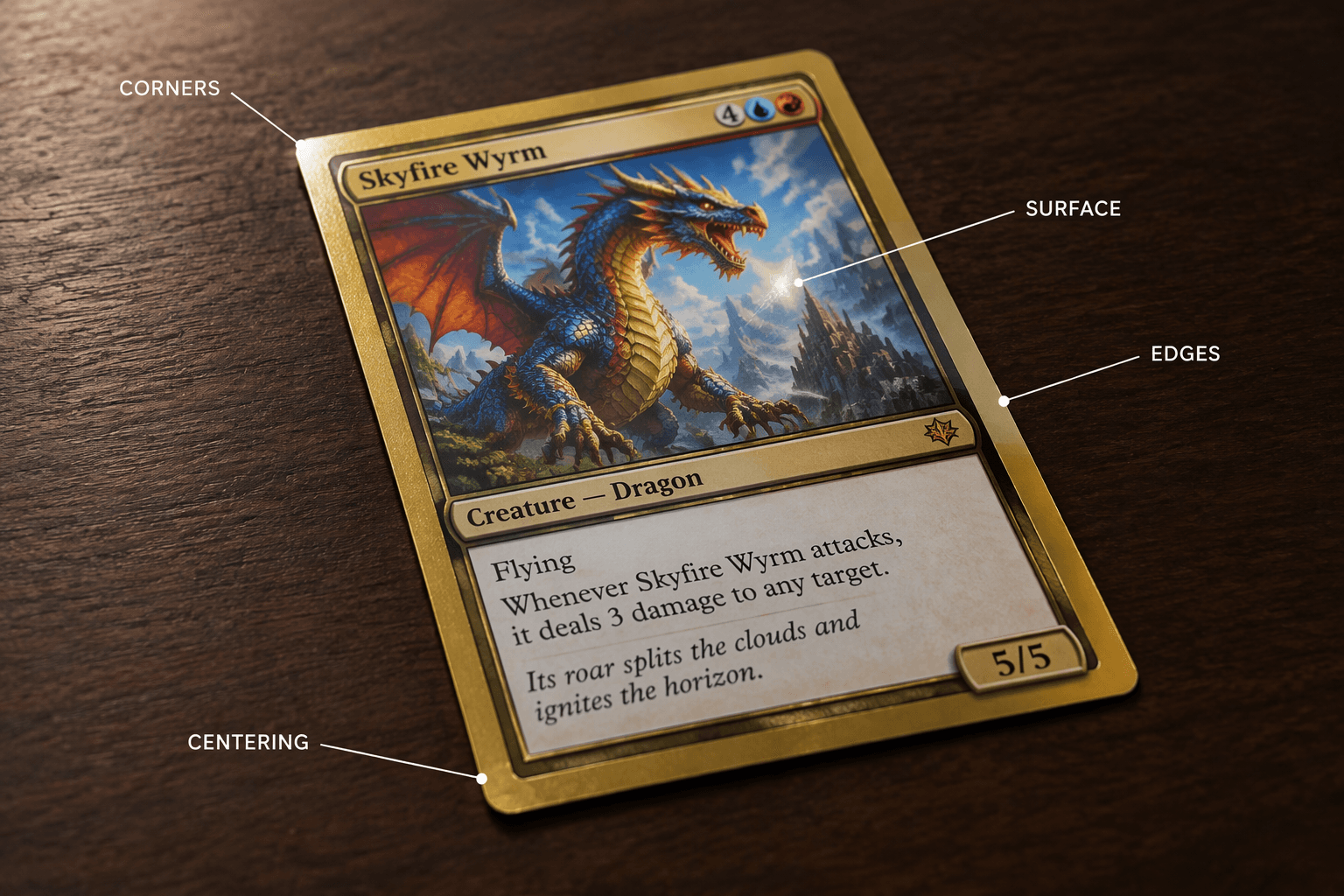
The four things graders check
Grading companies look at the whole card, but the inspection comes down to four visible areas. PSA's Getting Started guide describes it as examining everything from the card surface to its edges: whether the image is centered, whether there are folds or creases, and whether the card is stained or damaged.
- Centering. How evenly the printed image sits inside the borders. A card whose left border is twice as wide as the right border loses points here.
- Corners. Sharp, unbroken points score highest. White spots and rounding from binder storage are the most common defects.
- Edges. The border lines between front and back. Chipping and whitening along an edge shows up under close inspection even when the corner looks fine.
- Surface. The printed face. Graders look for scratches, print spots, scuffs, loss of gloss, and creases.
The same four areas explain almost every grade difference you will see on a label. A card can have perfect centering and still grade lower because of one soft corner.
Reading the grading scale: 1 to 10
Most grading companies in the hobby use a 10-point scale. Here is the range in PSA grading terms, condensed from PSA's official descriptions:
| Grade | Label | What it means |
|---|---|---|
| 10 | Gem Mint | Essentially perfect: well-centered, pristine corners, no surface damage or blemishes |
| 9 | Mint | Nearly perfect with one minor flaw, such as a minor printing imperfection or very slight off-centering |
| 8 | NM-Mint | Excellent condition that may show slight fraying on one or two corners, a minor printing imperfection, or very slight off-centering |
| 7 | NM | Minor surface wear such as fraying or a small printing blemish, and may be off-centered |
| 6 | EX-MT | More visible wear, rounding of corners, or a light scratch |
| 5 | EX | Minor corner rounding and more visible surface wear or printing defects |
| 4 | VG-EX | More visible surface wear, several light scratches, noticeably off-center |
| 3 | VG | Apparent surface wear, rounding of corners, yellowed or discolored borders, creasing |
| 2 | Good | Obvious surface wear, accelerated corner rounding, chipping, several creases |
| 1 | Poor | Major creasing, missing pieces, extreme discoloration, warping or other destructive defects |
Companies differ in the details at the top of the scale. CGC's card grading scale adds a Pristine 10 above Gem Mint 10, for a card that is virtually flawless to the naked eye with 50/50 centering, and uses half grades such as Mint+ 9.5 and NM/Mint 8.5 down to Poor 1. Beckett (BGS) also grades on a 10-point scale and is known for printing sub-grades for individual criteria on its labels. The numbers are comparable across companies, but the labels and the exact cutoffs are not identical, so read the scale page of whichever company graded the card.
One context note from PSA's own data: PSA reports that roughly 90 percent of ultra-modern sport cards and modern trading card games (2003 to present) have graded at PSA 8 or higher. Most modern cards are not damaged; what separates a 10 from an 8 is small, and the four checks above are exactly where those small differences show up.
Who the grading companies are
Five names cover most of the market. This is a neutral list, not a ranking or a recommendation:
- PSA: one of the largest grading services for sport cards and TCG cards, using the 1 to 10 scale described above.
- Beckett (BGS): a long-running service that grades on a 10-point scale and is known for adding sub-grades for individual criteria.
- CGC Cards: grades sport cards and TCG cards on a 1 to 10 scale with a Pristine 10 tier and half grades.
- SGC: a long-established service with a following among vintage card collectors.
- TAG: a newer service built around a documented, technology-driven grading process.
Service availability, pricing, and turnaround times change often, so treat the companies' own pages as the source of truth. The choice of company is yours; it depends on the card, your budget, and what you plan to do with the graded result.
How to get Pokemon cards graded
The process is similar across companies. Using PSA's Getting Started guide as the reference:
- Assess the card first. Slip it into a penny sleeve and a semi-rigid holder, then check it against the four areas above. A realistic pre-grade helps you pick the right service level.
- Identify the card. Note the year, manufacturer, set, character or player, card number, and parallel if any. For Pokemon cards these details sit on the front.
- Research value before you submit. Check completed sales for your card in the grade you expect. Our guide on how to check Pokemon card values walks through that step, and PSA suggests using completed sales to set your declared value.
- Submit. Register an account, choose a service level, and send the cards to the grading company, either directly or through a local shop that batches submissions. Fees and turnaround times vary, so confirm them on the company's official page.
- Wait for encapsulation. The company grades, labels, and seals the card, then returns it in the slab.
Folidx does not grade cards, authenticate cards, or submit on your behalf. Grading is the grading company's job; yours is deciding whether a card is worth sending and keeping the records straight.
Is grading worth it?
There is no universal answer, and any article that promises one is selling something. A framework instead:
- Condition ceiling. If the card has visible wear, grading will confirm a mid grade. That is still useful for vintage cards, which PSA notes can be valuable even in low grades, but it rarely pays for itself on a common modern card.
- Rarity and sentimental value. PSA notes that any card, regardless of condition, could be worth grading due to rarity, scarcity, or sentimental value.
- Purpose. A slab protects the card and makes condition comparable for a future sale. If you plan to keep the card loose in a binder forever, grading buys you less.
Before deciding, price the card in its expected grade and compare that against submission cost. If the numbers do not work, archiving the card with good photos may serve you better than a slab.
After the slab comes back: record it
A graded card is a record as much as an object. When the slab returns, write down what is on the label before the envelope gets lost in a drawer: the grading company, the grade, the certification or serial number, the date it came back, and the original photo of the card before grading.
That is where a collector archive earns its keep. In Folidx, you can keep the graded slab's details together with the original pre-grading photos on the same item record, add a grading event to the item's timeline, and find it again later by searching your archive. Folidx does not grade or authenticate cards; it keeps the paper trail that the slab created.
The same habit works across a mixed collection. If you also collect coins, the coin grading scale article explains how the 1 to 70 Sheldon scale maps to the same idea, and our photo capture guide for scanning Pokemon cards covers how to shoot a card before it goes into a sleeve.
FAQ
Is card grading worth it?
It depends on the card and your goal. For common modern cards, the grade often comes back 8 or higher, and grading fees can exceed the value the slab adds. For genuinely rare, sentimental, or high-condition cards, a slab protects the condition and makes the card easier to compare and sell. PSA itself notes that vintage cards in low grades can still be very valuable, and that any card can be worth grading for rarity or sentimental reasons.
What is better, PSA or BGS?
There is no objective answer, and anyone who tells you otherwise is usually selling one of them. Both are established grading companies that use a 1 to 10 scale; they differ in scale details, label formats, and typical turnaround times. Compare each company's published grading scale and current service terms, then pick based on your card and budget.
Sources
- PSA: Getting Started With Grading (definition of grading vs authentication, PSA 1 to 10 condition descriptions, condition distribution data, submission steps)
- CGC Cards: Standard Card Grading Scale (Pristine 10 through Poor 1, half grades)
- PSA Trading Card Grading service page (submission overview)
- Live US Google SERP for "card grading", collected 2026-10-09 via DataForSEO organic_serp, used to confirm that service pages dominate results and that a neutral explainer fills the gap.