Mercury Dime Value: Identify the Issue Before You Compare Prices
Learn how to check Mercury dime value by matching the issue and condition, comparing sourced references, and saving a dated collection record.
By Folidx Team
There is no single reliable Mercury dime value without the year, mint, condition and kind of reference behind it. Before comparing prices, identify the exact issue, record whether the coin is raw or certified, and separate ordinary strikes from Proof and Full Bands references. If the date or mintmark is unclear, leave the price unresolved too.
A search for "mercury head dime value" returns numbers for different coins. First check which reference describes yours.
| What you can establish | Reference branch to choose | What to leave unresolved |
|---|---|---|
| Readable year and mint; worn, raw coin | Same date and mint, with comparable circulated condition | A professional grade or certified-price equivalent |
| Coin in a certified holder | Same issue, grading service, grade and designation | Any mismatch between the label and the coin |
| Full Bands designation on the holder | The corresponding FB row, not the ordinary row | An FB claim inferred from a blurry photograph |
| Evidence identifies a Proof | The Proof section for that issue and grade | Proof status inferred from shine alone |
| Unreadable date or mintmark | Identification references first | A narrow price range |
The NGC Mercury dime guide separates MS, MSFB and PF references. Select the branch before reading a number. For the broader method, see how to check a coin reference value.
Identify the Mercury dime and read its mintmark
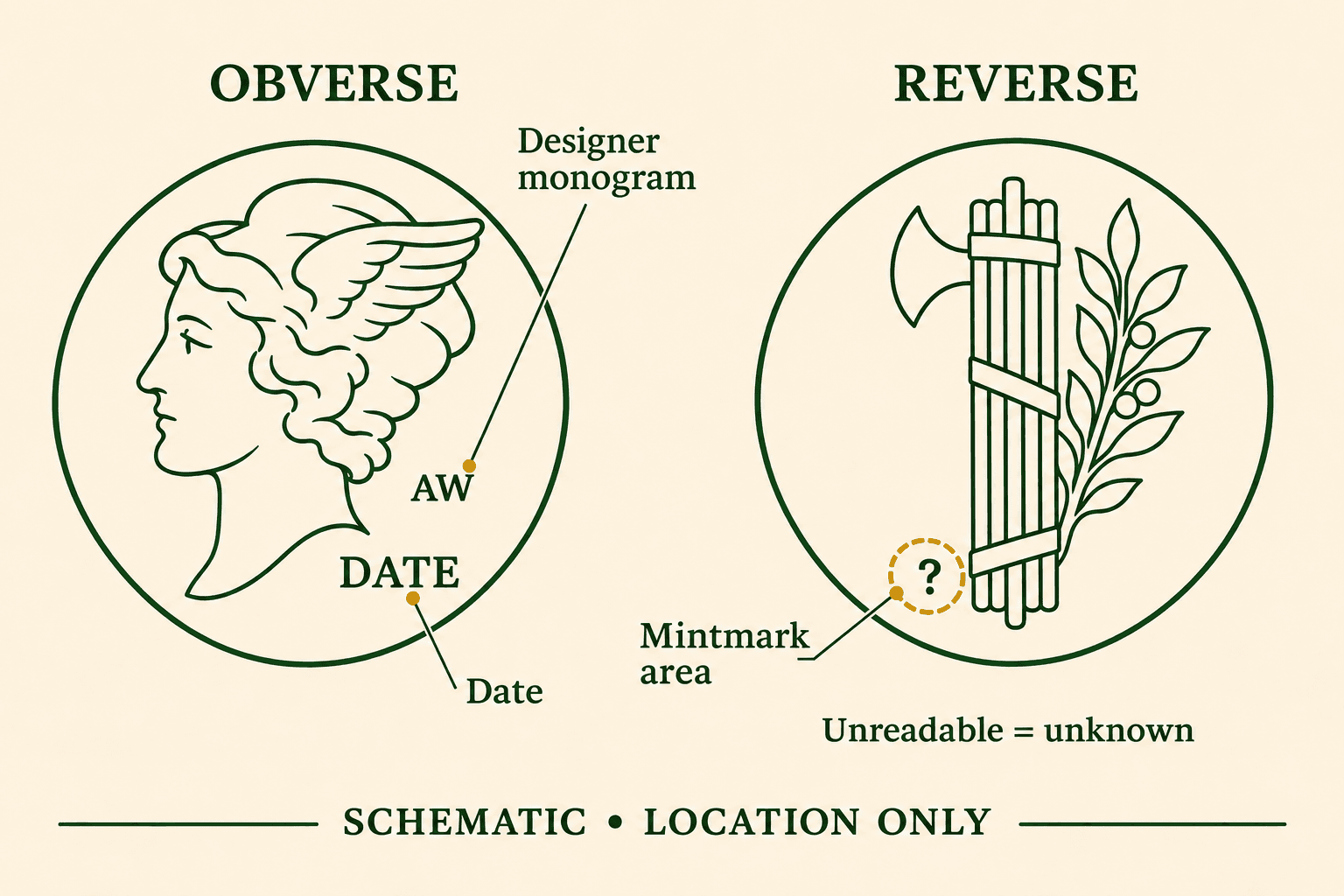
Simplified location schematic. Use photographs of the actual coin for variety, authenticity and Full Bands checks.
The Mercury dime is also called the Winged Liberty dime. Look for Liberty facing left in a winged cap, with the date below, and a fasces, a bundle of rods with an axe blade, on the reverse. Stack's Bowers describes this design for the 1916 to 1945 series. Confirm both sides rather than identifying the coin by its year alone. Series reference.
The small AW monogram to the right of Liberty's neck is the designer's mark. It is not the mintmark. On the reverse, look near the bottom, just left of the fasces, for the mintmark. PCGS identifies D as Denver and S as San Francisco. PCGS identification guide, pages 2 and 3.
Philadelphia issues have no mintmark, as shown in Littleton's Mercury dime checklist. But "I cannot read the area" and "the area has no mark" are different observations. Photograph it under a different light angle and retain "mintmark unknown" if the detail remains unclear. Do not digitally reconstruct a letter and then treat it as evidence.
Choose a comparable reference row
Copy the whole issue description before comparing the value of a Mercury dime: year, mint, variety if established, strike type, grade and any designation.
A raw coin has no third-party certification attached. A guide row for a certified coin can show what that reference covers, but it does not establish the raw coin's grade or authenticity. Keep your surface observations separate from any professional label. Note visible wear, marks or rim damage without turning those notes into a numerical grade. The grading vocabulary guide explains the labels.
Full Bands, abbreviated FB, concerns the separation of the central bands on the reverse fasces. PCGS generally applies it to qualifying Mint State coins, with exceptions for certain issues in About Uncirculated grades. A photograph showing a line is not enough to assign the designation yourself. Use the service's exact label when selecting an FB comparison. PCGS Full Bands criteria.
Proof references are another branch. Stack's Bowers records Philadelphia Proof production from 1936 through 1942. Do not select a Proof row just because a coin looks reflective; keep the finish unresolved until you have evidence for it. Mercury dime series reference.
Handle a possible 1916-D attribution carefully
A possible 1916-D deserves an attribution check before a rare-coin price comparison. PCGS warns that counterfeits include ordinary 1916 dimes with an added D mintmark. A visible D shape alone cannot establish authenticity. PCGS 1916-D reference.
Keep full photographs of both faces, a date close-up and clear views of the mintmark and surrounding surface. For a certified coin, retain the holder label and certification details. Take these to a qualified numismatic professional or certification service for assessment; photographs cannot replace their examination.
Apply the same discipline to an apparent overdate. The 1942/1 and 1942/1-D have separate references in the series checklist. An unclear digit belongs in an open question, not in a confirmed variety field.
Compare references without turning them into an offer
Start with a currently accessible primary guide such as the NGC Mercury dime price guide. NGC describes its figures as average dealer retail references for NGC-certified coins, excluding sales tax. It also warns that updates do not capture every short-term market change. A guide figure is one comparison measure, rather than an offer to buy your coin.
For an auction comparison, open the auction house's original sold-lot page. Match the issue, grade, designation and visible condition. Record the sale date as well as your lookup date. Check whether the result includes the buyer's premium; if that is unclear, mark it unknown and avoid combining it with totals on a different basis.
Keep these categories separate in your notes:
| Reference type | What to record | What it can establish |
|---|---|---|
| Dealer asking listing | Asking amount, currency, date and seller's description | What the seller is requesting |
| Published guide | Exact row, grade, certification basis and lookup date | The guide's reference for that category |
| Completed auction lot | Lot URL, sale date, certified/raw state and premium basis | The reported result for that particular coin |
No issue-matched sold comparison or reliable range for your coin has been established here. Follow the lookup procedure before assigning a range. A record sale or metal-value calculation does not establish a buyer's offer. Do not multiply selected catalogue figures into a collection total.
When researching the value of Mercury dime issues, keep rejected comparisons too. Write "different mint" or "Proof rather than regular strike" beside them so you can see why a number did not belong in your range.
Save an editable record and a next review step
Photograph both sides before opening a price reference. Keep a separate close-up of any uncertain detail, then transcribe what you can read. Preserve the original uncertainty even if a later suggestion seems plausible.
Use this blank editorial worksheet in a notebook or document. It is a documentation method, not a Folidx screen or customer record.
| Field | Your entry |
|---|---|
| Item photos | Obverse, reverse and detail-image filenames: __ |
| Exact issue | Year: __; mint: __; variety if established: __ |
| Uncertain identification | Unreadable digits or letters; finish questions: __ |
| Raw or certified | State: __; service, grade, designation and cert number if present: __ |
| Visible surface notes | Observations and locations, separate from a grade: __ |
| Reference | Source URL and exact guide row or auction lot: __ |
| Dates | Lookup date: __; sale date or source update date: __ |
| Currency and price basis | Currency: __; asking/guide/sold: __; premium included: __ |
| Amount or range | __; leave blank until a suitable reference is established |
| Excluded comparison | URL: __; reason for exclusion: __ |
| Next review | Missing evidence, person to consult or reason to revisit: __ |
For a fictional example of exclusion, a 1944-D regular-strike record would reject a 1944-S reference because the mint differs. It would also reject a 1942 Proof reference because the year and strike type differ. Neither rejected row needs a money value.
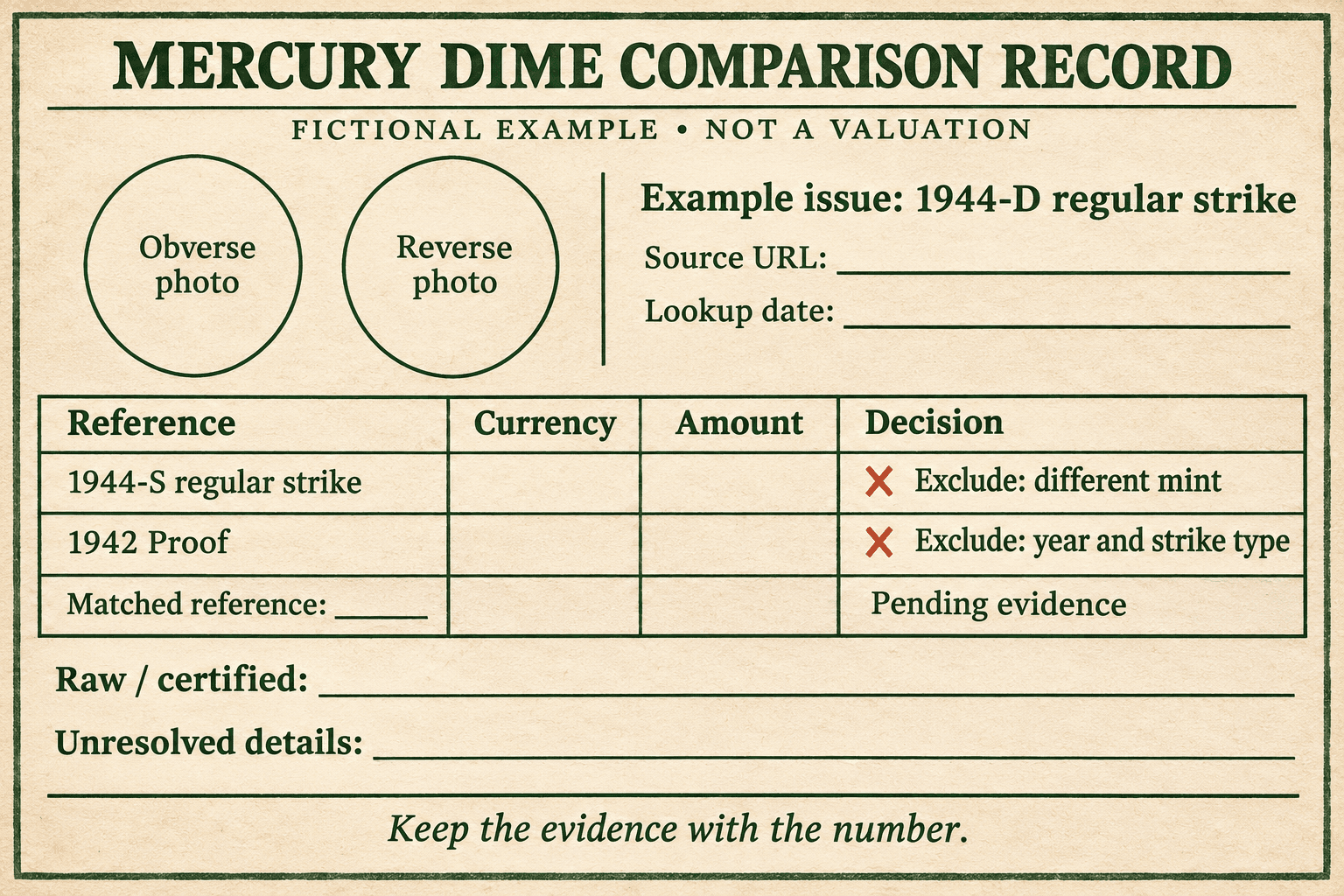
Fictional editorial example. The mismatched references are excluded, and the amount cells remain blank pending evidence.
Folidx can turn coin photos into editable identification reports with reference ranges and visible condition clues, then organise records in archive books and pages. If you use it after this reference check, review and edit the AI suggestions against your photos and sources. They do not replace professional grading, authentication or an appraisal.
Keep the photos, source links and uncertain details together in an editable Folidx record.
Short reader questions
Can I compare a raw coin with a certified guide row?
Use it to understand the category the guide covers. Keep the certification difference visible and avoid treating the figure as the raw coin's established value. Your own grade estimate does not create a certified match.
What should I do if the date or mint is unreadable?
Record the uncertain field, keep both-side photos and take clearer detail images. Leave the price unresolved until identification improves. An unreadable mintmark is not evidence of an absent mintmark.
Does a reference price mean someone will pay it?
No. A guide, an asking listing and a completed sale describe different things. A buyer must still assess the particular coin and agree to a price.
Does visible band detail mean I should use the Full Bands row?
Do not assign FB from a casual visual impression. Keep the observation in your notes, check the grading service's criteria, and use a certified FB comparison only with the certification difference made explicit.
Sources
- PCGS Mercury dime guide: AW monogram and reverse mintmark location, pages 2 and 3. Its undated prices and conflicting silver-ounce figures are not used.
- Littleton Mercury dime checklist: mintmark key and separate overdate entries.
- Stack's Bowers Mercury dime reference: design and Proof years. Historical price and mintage examples are not used.
- PCGS Full Bands explanation: designation criteria and exceptions.
- PCGS 1916-D CoinFacts: added-mintmark risk.
- NGC Mercury dime price guide: reference branches and retail-price limitations.
About the author: The Folidx team writes guides to documenting collections and using Folidx.