Roosevelt Dime Value: Separate Silver, Clad, and Collector Issues
Learn how to check Roosevelt dime value by matching the issue and condition, comparing sourced references, and saving a dated collection record.
By Folidx Team
There is no single Roosevelt dime value that applies to every coin in the series. Start with its date, mint mark, composition and issue type, then compare condition and any documented certification. A silver circulation coin, a clad circulation coin and a silver proof belong in different reference rows, even when two share a year.
Choose the reference branch before copying a price.
| What you have established | Reference branch to open | What still needs checking |
|---|---|---|
| Ordinary circulation issue dated 1946-1964 | Roosevelt silver, exact date and mint | Condition, surface concerns and raw or certified status |
| Ordinary circulation issue dated 1965 or later | Roosevelt clad, exact date and mint where applicable | Confirm the design and exclude a special collector issue |
| Later silver collector issue | Exact silver issue and finish | Do not choose the clad row merely because the date is after 1964 |
| Proof or another special finish | That issue's proof or special-finish reference | Composition, certification and any recorded designation |
| Date, mint or issue remains unclear | Identification references first | Leave the amount blank until the comparison can be justified |
The silver and clad branches follow PCGS's Roosevelt dime categories. No reliable range for your particular coin has been established by this table.
Confirm the date and issue
Check that the coin has Roosevelt's profile on the front and the torch with branches on the back. The U.S. Mint's dime history identifies that design and its 1946 introduction. Its current page also describes the different Emerging Liberty design used for 2026. A modern dime is not automatically a Roosevelt dime.
Photograph both sides and transcribe the date as seen. If a digit is unclear, write a question mark rather than choosing the year whose guide price looks attractive. Record the mint mark separately, along with anything known about the original set or packaging. The year alone does not authenticate a coin or establish its metal.
A missing mint mark needs context. The Mint confirms that circulating coins dated 1965-1967 had no mint marks; its account places the wider introduction of Philadelphia's P after the 1979 dollar, in 1980. An absent letter is therefore not, by itself, an error identification. See the Mint's mint-mark history.
Separate circulation coins from later silver collector issues
For ordinary circulation references, 1964 and 1965 are the useful dividing dates. PCGS places the earlier Roosevelt issues in its silver category and the circulation series beginning in 1965 in its clad category.
Keep the collector branch open. The silver index includes later issues beginning with 1992-S Silver. The clad index also lists a 1992-S proof. That overlap shows why a year and S mint mark do not settle which reference to use: check the exact issue description and composition before comparing condition.
PCGS lists the 1964 regular-strike dime as 90% silver and 10% copper. That does not establish the composition of every coin called a silver Roosevelt dime. Check later collector issues individually.
The Mint's current specifications list a nominal clad dime weight of 2.268 grams and diameter of 17.91 millimeters. Those are current production specifications, not historical authentication tolerances. Do not use a weight reading, color or photograph alone to certify an unusual composition.
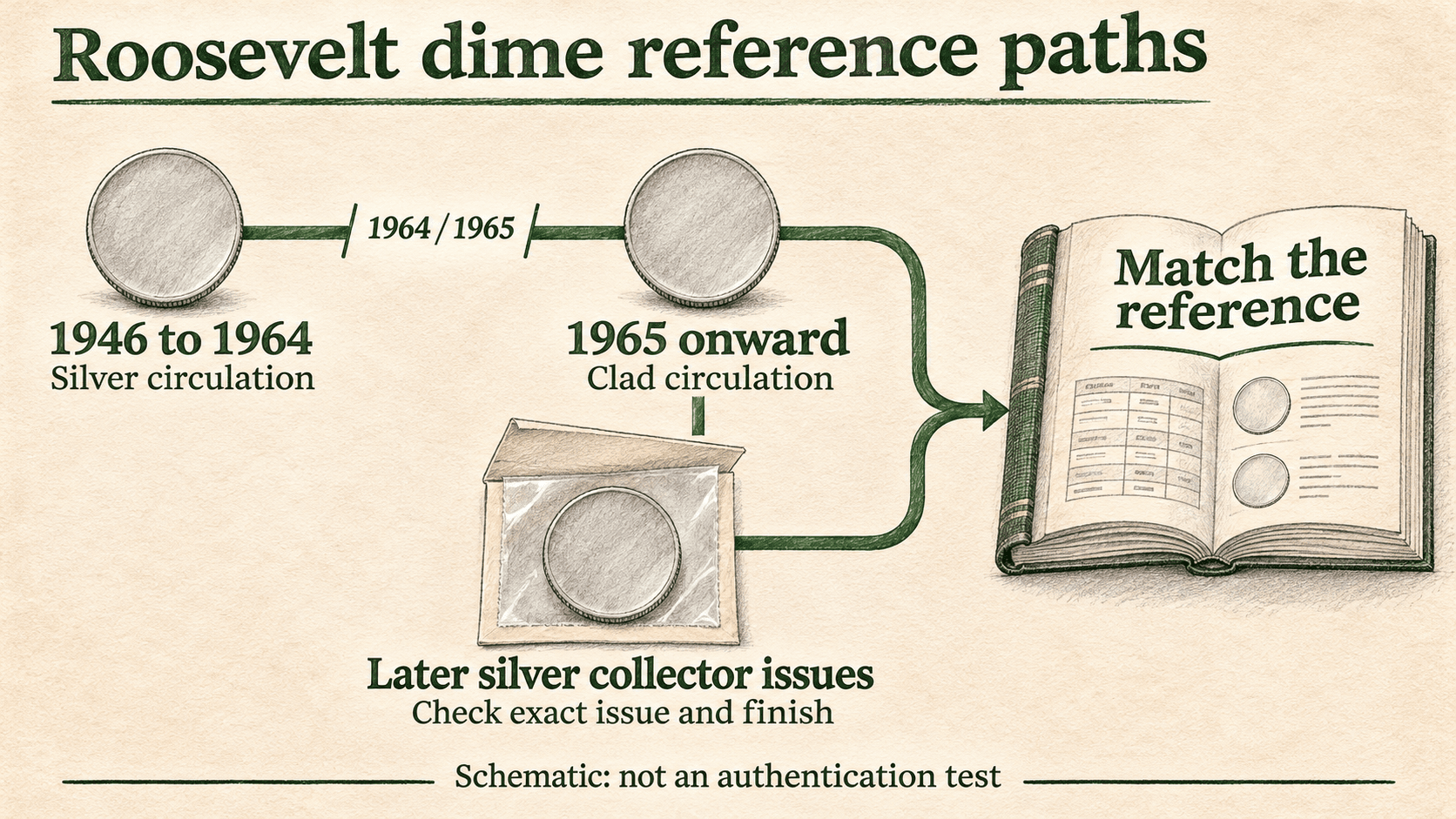
Illustrative reference paths. The unmarked tokens do not show identifying coin details or authenticate metal.
Choose a condition-matched comparison
Keep your own observations separate from a grading service's label. For an ungraded, or raw, coin, notes such as “date readable; marks visible beside portrait” leave less room for misunderstanding than an unsupported numeric grade. The guide to grading vocabulary explains the terms without replacing a professional assessment.
Roosevelt dime values can also be listed under different strike-detail designations. These belong to the named service and documented coin:
- PCGS Full Bands (FB): PCGS requires MS60 or better, full separation of both upper and lower horizontal torch bands, and no significant cuts or marks across them. See PCGS's Full Bands definition.
- NGC Full Torch (FT): NGC requires the horizontal band pairs to be split and the vertical torch lines to be defined without major interruptions. Its definition excludes proof coins. See NGC's Full Torch definition.
Do not turn “I can see lines on the torch” into a certified FB or FT record. If a reference has a designation your coin has not received, mark that mismatch. Likewise, an exceptional no-mintmark proof result is not a comparison for an ordinary circulation coin with an absent letter. PCGS's clad index separates ordinary issues from named no-mintmark varieties and proof issues.
Compare references without turning them into an offer
Open the NGC Roosevelt dime price guide and select the exact date, mint and strike type. NGC describes its guide as average dealer retail for NGC-certified coins, generally in standard holders and labels. It warns that updates do not capture every short-term change and that guide figures are one measure among several.
For a second reference, use the PCGS Roosevelt auction index to locate an issue, then follow a sale through to the auction house's original lot. Read its condition, designation, sale date and price terms. An index's headline auction record is a starting point for investigation, not a range for your coin.
Label each reference by its basis:
| Reference type | What to record | What it cannot establish |
|---|---|---|
| Dealer asking listing | Exact item, asking amount, currency and observation date | That a sale occurred at that amount |
| Published guide retail | Issue, grade, certification basis, currency and lookup date | A cash offer for a raw coin |
| Completed auction lot | Original lot URL, sale date, grade, currency and whether buyer premium is included | What a different coin will bring |
If the original sale page does not state whether premium is included, record “unknown.” Do not silently compare a hammer price with a total that includes fees. When learning to check a coin reference value, keep these price types separate.
This article establishes no price range for an unidentified or ungraded reader's coin. Leave the amount blank when a comparable issue and condition have not been verified. A lone record sale or a spot-metal calculation does not resolve those gaps, and multiplying catalogue figures across a collection does not establish its sale value.
Save an editable record and a next review step
Photograph the front and back under steady light, retain the originals, and give the item a location you can find again. Transcribe what you can read. Keep “mint unclear” or “finish unconfirmed” beside the relevant field.
The blank worksheet below is an editorial template. It is fictional, contains no customer data and does not depict Folidx's interface. Repeat the reference columns for each source you consider.
| Item photos | Exact issue | Uncertain identification fields | Raw/certified state | Visible surface notes | Reference URL | Reference date | Currency | Price basis | Amount | Reason excluded |
|---|---|---|---|---|---|---|---|---|---|---|
For an illustrative target of a 1964 circulation issue, reject a 1992-S silver proof comparison because it is a different issue. Reject a 1964 proof comparison because the finish differs. Neither rejected row supplies an amount for the target.
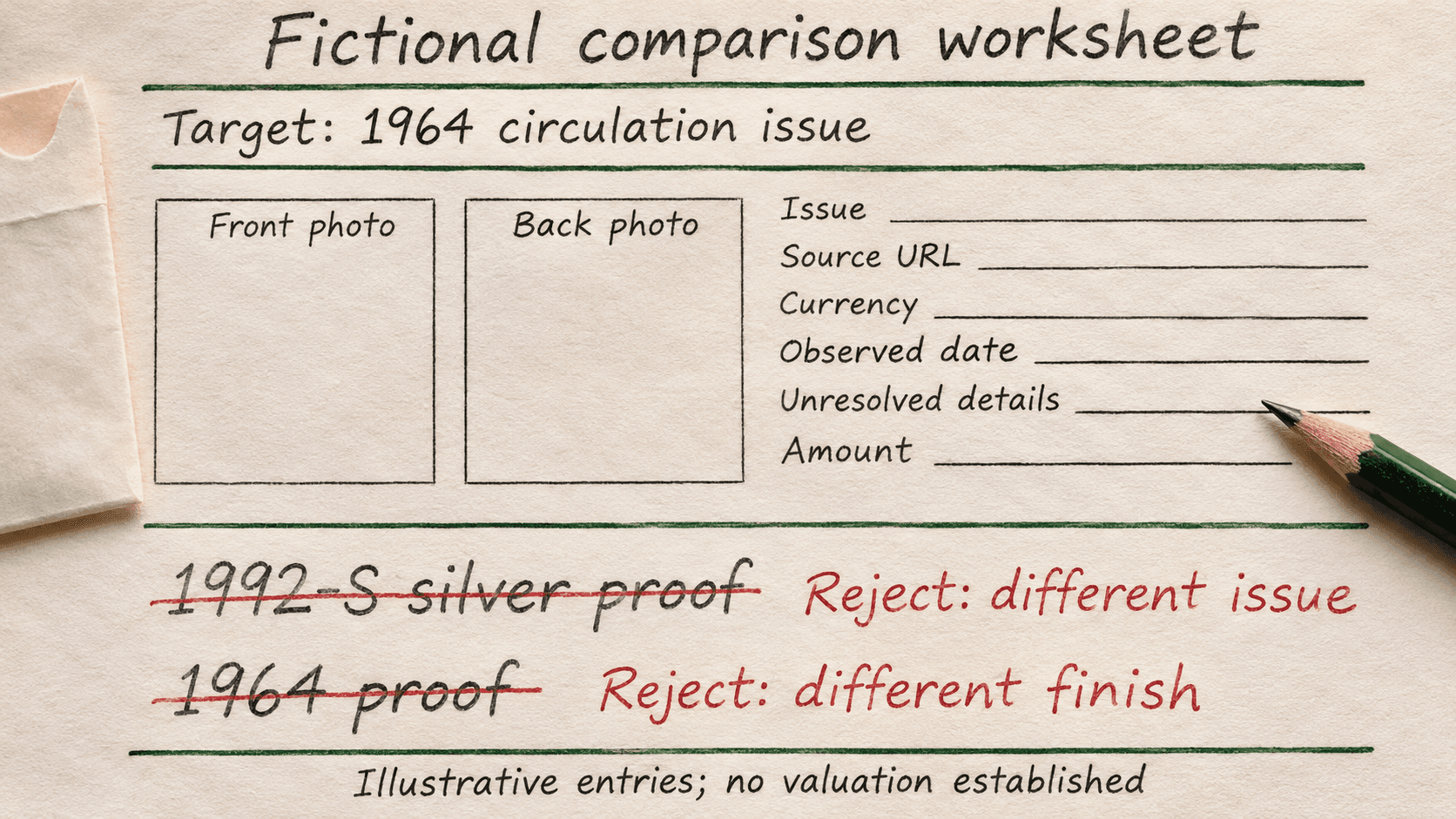
Illustrative worksheet with blank amounts. The crossed-out entries explain exclusions; they are not sale records.
Choose the next action from the unresolved field: retake the date photo, verify a set's exact issue, check a documented certification, or find another comparable sale. Revisit the record when that evidence changes.
Folidx is an optional archive for this work. It can turn coin photos into editable identification reports with reference ranges and visible condition clues, organised in archive books and pages. Review and edit the AI identification and condition clues against your coin and sources. They are not professional grading, authentication or an appraisal.
Short reader questions
Can I compare a raw coin with a certified guide row?
Use the row to understand the reference category, but keep its certification and grade attached to it. Do not copy that grade or price into your raw coin's record as an established conclusion.
What should I do if the date or mint is unreadable?
Keep the field unresolved, save both-side photos and seek a clearer identification. “Unreadable” and “confirmed absent” are different observations; neither justifies choosing a rare variety's price.
Does a reference price mean someone will pay it?
No. Guide retail, an asking listing and a completed sale answer different questions. None is a commitment to buy your coin. Keep the source, date and basis with any number.
Are all Roosevelt dimes dated after 1964 clad?
No. The circulation transition does not cover every collector issue. PCGS lists later silver issues as well as clad ones, including separate silver and clad 1992-S proof entries. Establish the exact issue before choosing a row.
Keep the photos, source links and uncertain details together in an editable Folidx record.
Sources
- U.S. Mint: Dime, design history and the 2026 design distinction.
- U.S. Mint: Mint Marks, mint-mark history.
- U.S. Mint: Coin Specifications, current nominal specifications.
- PCGS: Roosevelt Dime, silver and clad reference categories, with issue pages linked above.
- PCGS: Full Bands on Roosevelt Dimes and NGC: Full Torch Designation Defined, service-specific designation criteria.
- NGC: Roosevelt Dime Price Guide and PCGS: Roosevelt Auction Prices, reference selection and price-basis checks.
Author: Folidx Team, Editorial team. The Folidx team writes guides to documenting collections and using Folidx.