What Is Philately? The Stamp Collector's Term, Explained
Learn what philately means, how it relates to stamp collecting, and which basic terms help describe a stamp or postal-history record.
By Folidx Team
The Short Answer: What Philately Means in One Paragraph
Philately refers to the collection, appreciation, and systematic study of postage stamps and related postal material. While popular perception often associates the hobby with simply saving colorful bits of paper from old mail, the field encompasses a much wider range of artifacts and history. Philatelists examine adhesive stamps, stamped envelopes, postmarks, postal stationery, revenue stamps, and transit markings. The pursuit connects everyday communication to broader world events, graphic design, and political geography. Whether someone collects stamps from a single country, builds a topical collection around nature or space exploration, or inspects historic postal routes, philately combines personal enjoyment with curiosity about how the world delivers its mail. The Australian Philatelic Society's dictionary describes these areas of collecting and study.
Merriam-Webster's philately definition includes both collecting and study; it gives the pronunciation as fə-ˈla-tə-lē, roughly "fuh-LAT-uh-lee."
Takeaway: Philately means collecting and studying stamps, with related interests in postal material and history.
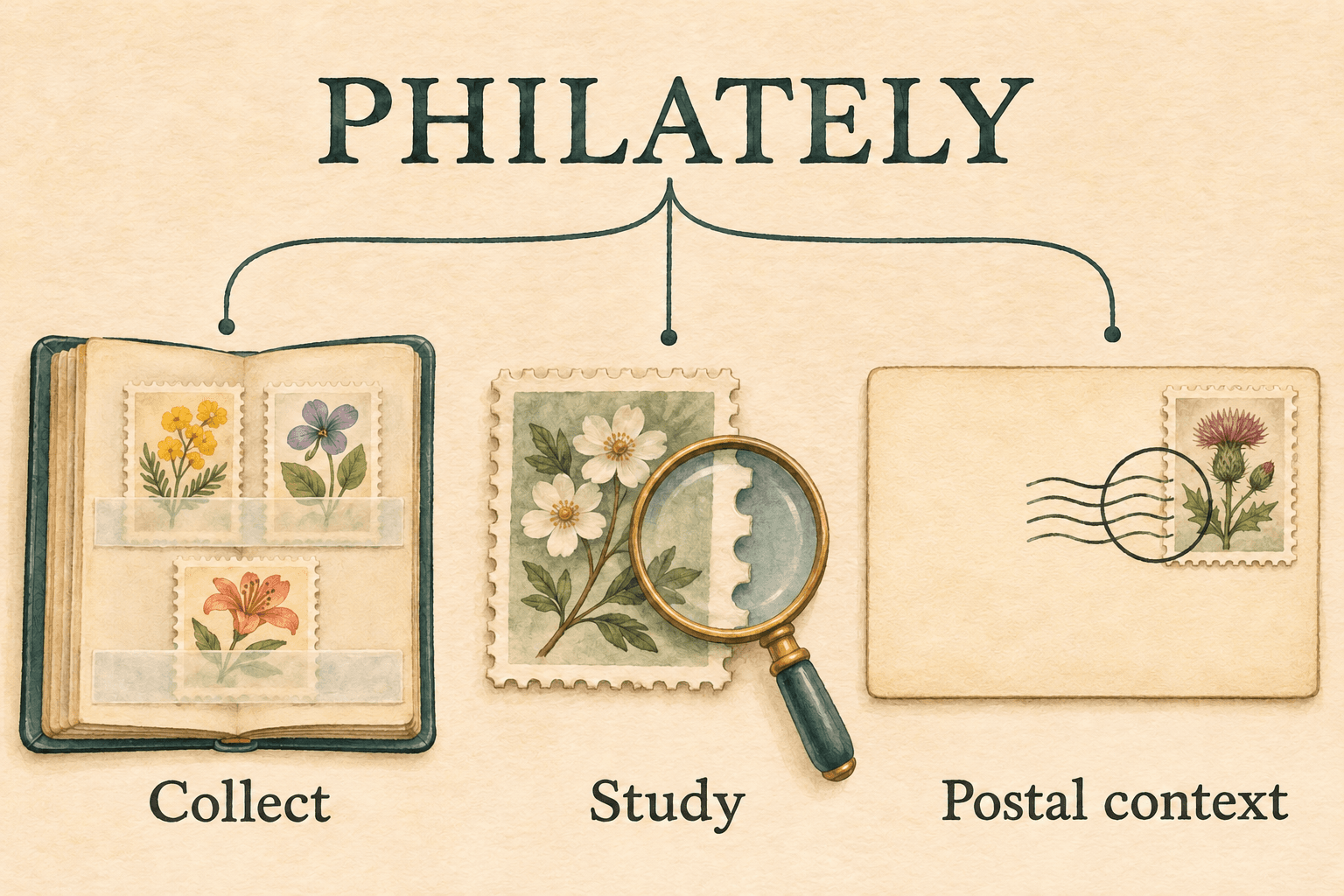
Illustrative map: collecting, studying stamp features, and retaining postal context are connected interests. The stamp motifs are original illustrations, not identified historical specimens.
Where the Word Comes From: Etymology and First Use
The term has a specific nineteenth-century origin. As documented by Etymonline, the French word philatélie was coined by collector Georges Herpin on November 15, 1864, with the English form appearing in print by 1865. Herpin assembled the term from elements meaning "loving" and "free from tax or charge."
This phrasing often surprises newcomers because it sounds as though collectors claim tax exemptions or that stamps were free. It commemorates prepaid postage. As Etymonline explains, the carriage charge formerly fell to the recipient; a stamp indicated that the sender had paid it. Prepaying postage with a stamp relieved the recipient of that carriage charge, delivering the mail with the fee already settled. That is the philately meaning behind the word's roots.
Takeaway: The name connects an interest in stamps with their role in prepaid postage.
What Philatelists Actually Do: Collecting, Postal History, and Study
Gathering stamps is often the starting point, but philatelic activity routinely extends into careful study. Enthusiasts inspect physical details to understand how an issue was produced and circulated. The Australian Philatelic Society's entry on philately includes stamp design, production, and use within its scope.
This examination includes looking at paper varieties, watermarks, perforation spacing, printing methods, and ink shades. Collectors use standard reference catalogs to investigate different printings or varieties. The American Philatelic Society's guide to tools explains the role of catalogs, perforation gauges, and watermark checks. Our stamp identification guide covers that separate task in more detail.
Beyond individual stamps, many practitioners focus on postal history. This branch investigates postal systems and their operation, including rates, routes, and markings, as described by the Australian Philatelic Society. An intact cover can retain evidence that a loose stamp does not: the address, postal markings, or routing notes may help explain its journey. Not every cover carries all of these clues, and complete envelopes are not the only sources for postal-history research. Keep an unfamiliar older envelope intact while you investigate its context.
Takeaway: Philatelists study how stamps were made and used; a complete cover may preserve clues beyond the stamp itself.
Philately Versus Stamp Collecting: Is There a Difference?
In everyday conversation, stamp collecting and philately overlap. Merriam-Webster includes stamp collecting in its definition, while the Australian Philatelic Society draws a distinction between acquiring stamps and studying them. Its dictionary notes that a person can study stamps without owning them. These are different emphases, rather than a reason to exclude casual collectors. Merriam-Webster and the society's definition show that range of usage.
Many people begin as stamp collectors, gathering specimens by country, visual theme, or personal aesthetic interest. An individual might enjoy assembling stamps featuring wildlife, maritime history, or art without needing to investigate technical printing details. This accessible approach brings pleasure and remains a way to enjoy the hobby. The American Philatelic Society's introduction describes collecting as accessible without special skills or great wealth.
At the same time, collecting and study are frequently combined. When a collector starts checking perforation gauges, reading about why a postal rate changed, or comparing color shades, they are engaging in philatelic study. Philately emphasizes the historical, postal, and manufacturing context behind the stamps. Neither approach is superior to the other; casual collecting and deeper study complement one another.
Takeaway: Stamp collecting and philately overlap in common usage; philately can emphasize the study behind the collection.
Six Terms That Make a First Record Easier
These words help you describe an object before deciding exactly what it is. The physical and postal definitions below follow the Association of British Philatelic Societies' vocabulary; the postal-history definition follows the Australian Philatelic Society.
| Term | Meaning in a first record |
|---|---|
| Cover | An envelope bearing a stamp or another indication of paid postage. |
| Cancellation | A postal mark showing that a stamp has been used. |
| Postmark | A mark giving handling details, such as place, date, or route. It may also cancel a stamp, but the terms are not identical. |
| Postal history | Study of how postal systems operated, including covers and related material. |
| Perforation | One of the separating holes made between stamps. Record the visible edges before attempting a measurement. |
| Watermark | A pattern formed within the paper. It may need a separate check rather than an ordinary front photograph. |
A dated postmark can also act as a cancellation when it marks a stamp as used. Another cancellation may provide no readable date or place. Preserve what you can read and leave missing details unknown. For a particular kind of cover, see first day covers explained. For reference numbering, use the separate stamp catalogs and Scott numbers guide.
What Philately Is Not: Honest Notes on Value and Modern Stamps
Popular assumptions often frame stamp collecting around discovering hidden financial fortunes in attics or old desks. Approaching philately with realistic expectations helps beginners focus on what makes the hobby rewarding.
Age alone does not establish rarity or market value. Precise identification and condition need to be checked before making a value judgment. For example, centering, gum, damage, and cancellation are condition details worth recording, as the ABPS vocabulary explains. Do not turn an old date or an attractive design into a price claim.
There are no price guarantees in a personal collection record. If you need an opinion on selling a collection, the ABPS guidance on valuations points readers to specialist dealers or auction houses. You can enjoy design, history, and organizing a collection without assigning every object a monetary value.
Takeaway: Keep identification and condition evidence separate from assumptions about financial value.
How Beginners Practice Philately Today: Photograph, Document, Archive
Practicing philately today involves thoughtful physical care combined with practical digital organization. Beginners do not need specialized equipment, but following standard preservation habits protects stamps from accidental damage.
Physical care begins with clean, dry handling and the use of smooth-ended stamp tongs rather than fingers. The American Philatelic Society's tool guide explains that even washed hands can transfer skin oils; it also describes albums and stock books, and warns against sticky album pages, tape, and glue. USPS's storage guidance describes albums and protective mounts. Choose materials intended for stamps rather than assuming any plastic sleeve is suitable.
Digital documentation offers a convenient way to record visible features such as centering, design details, and legible cancellation dates. However, photography has clear limitations. A standard front photograph does not establish every identification feature: the American Philatelic Society describes separate tools for perforations and watermarks. An uncertain identification in a photograph remains uncertain until verified. Use digital photos to document visible characteristics and track collection inventory rather than claiming definitive professional identification.
Takeaway: Protect the object and record what the photo shows; leave features that need another check unresolved.
Getting Started: One Evening Setup with Folidx Archive Books and Pages
You can begin with one stamp, then repeat the process for a small starter batch, such as five loose stamps from a collection. Leave stamps on unfamiliar older covers while you research the whole object.
Using Folidx, collectors can photograph a stamp to generate an editable candidate identification, enter notes on visible condition and acquisition source, and view private reference value ranges. Because every entry remains editable, you can verify and adjust the details before confirming the item into digital archive books and pages. Once filed, items can be located through searches by photo, name, tag, or page.
These tools serve as personal cataloging aids to help organize a collection; they do not provide formal authentication, professional grading, or certified appraisals. By recording what you observe and organizing the entries into digital pages, you create a foundation that can grow over time.
For a first record, try this illustrative example, rather than copying an unverified catalog identity:
| Record part | What to save |
|---|---|
| Photos | Front and back of the same loose stamp, where safe to handle. |
| Visible observations | Copy the country lettering and denomination you can read; describe the design, such as "bird on a branch." |
| Object source | Where the stamp came from, such as "family album; earlier history unknown." |
| Reference checked | Save the exact catalog edition and entry, or source URL, with the date checked. If none has been checked, say so. |
| Open question | "Similar designs found; watermark and exact issue not confirmed." |
Keep observations separate from proposed identification. Revise the candidate when evidence supports it, rather than filling an empty field with a guess. Folidx's current categories are Coin, TCG Card, and Stamp; this stamp workflow does not establish support for every cover or specialist postal object.
Keep the photos, reference sources and open questions together in your Folidx archive.
Questions About the Word
Does philately mean only buying stamps?
No. Collecting and study are both part of common definitions, and study need not involve ownership. The Australian Philatelic Society gives studying stamps in museum collections as an example.
What does philatelist mean?
A philatelist is someone who collects or studies stamps, according to Merriam-Webster. The word does not, by itself, establish grading or appraisal credentials.
Does a beginner need a valuable collection?
No. The American Philatelic Society says the hobby does not require great wealth or special skills. Start with an object that interests you and one question you want to investigate.
Sources
- Merriam-Webster: Philately and Philatelist.
- Etymonline: Philately.
- Australian Philatelic Society: Dictionary, Philately, and Postal History.
- Association of British Philatelic Societies: Stamp Vocabulary and Selling Stamps and Valuations.
- American Philatelic Society: Getting Started and Tools Needed.
- USPS: How Should I Store My Stamps?.
- Folidx: Product Features and Reference Boundaries.