Wheat Pennies Explained: How to Spot and Record Lincoln Wheat Cents
What wheat pennies are, how to spot the wheat reverse and the 1943 steel cent, and how to record year and mint mark in a private, reviewable archive.
Wheat Pennies Explained: How to Spot and Record Lincoln Wheat Cents
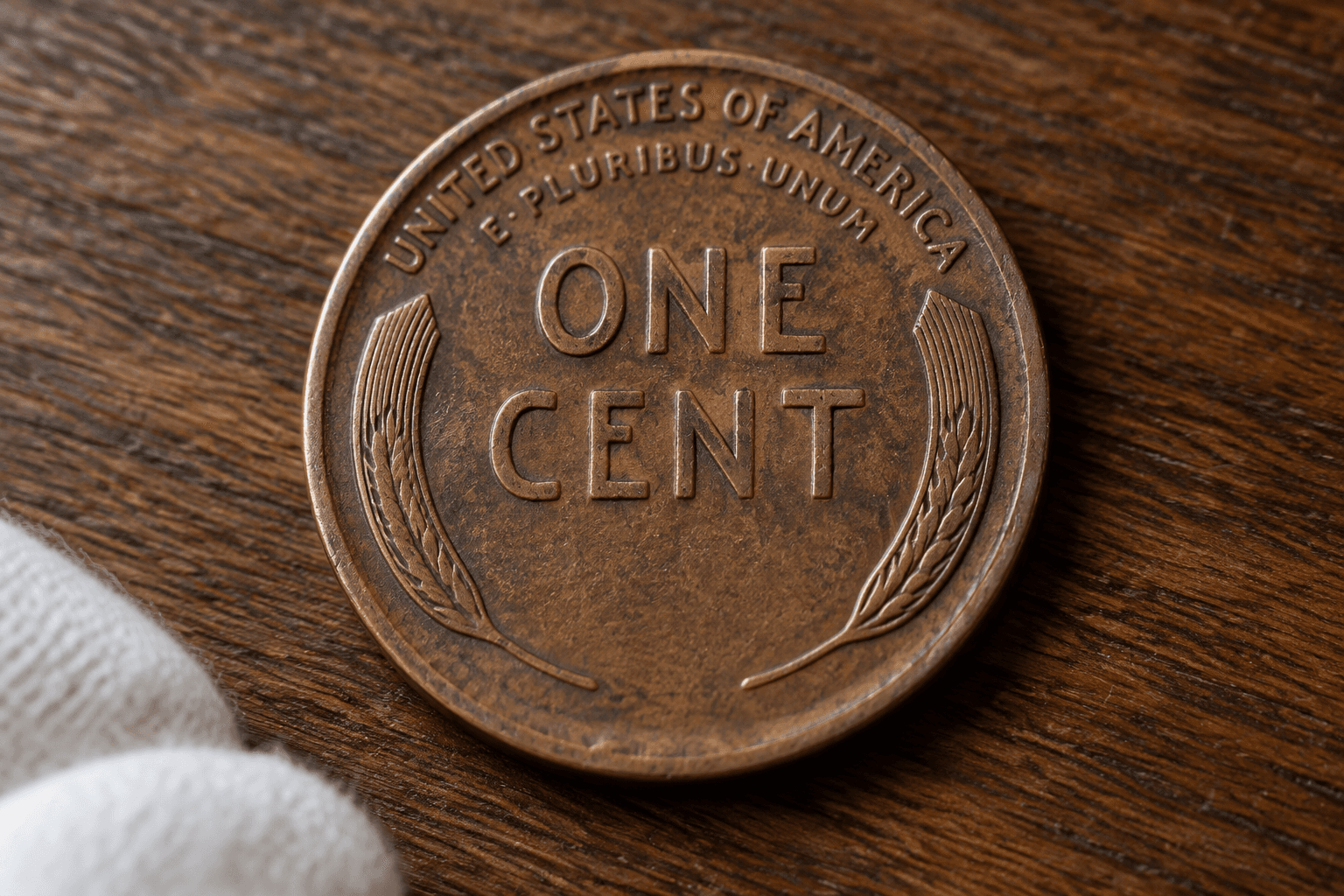
Wheat pennies are United States one-cent coins minted from 1909 to 1958. They carry Abraham Lincoln's portrait on the front, just like today's pennies, but the back is what gives them the name: two curved wheat stalks frame the words ONE CENT in the middle. If the back of your old penny shows wheat instead of a memorial building or a shield, you are holding a wheat cent.
This guide covers the three things most people want when a jar of old coins shows up: how to recognize a wheat penny at a glance, what makes the 1943 steel penny different, and how to write down the year and mint mark so the coin can be checked and referenced later.
What is a wheat penny?
A wheat penny is the everyday nickname for the Lincoln Wheat cent, the design that replaced the Indian Head cent in 1909 to mark the hundredth anniversary of Lincoln's birth. Sculptor Victor David Brenner created the portrait that still appears on the penny today, and his design put two wheat ears on the reverse as a symbol of national prosperity, which is where the "wheat" in the name comes from.
The wheat reverse stayed in production from 1909 through 1958. In 1959, for the sesquicentennial of Lincoln's birth, the reverse changed to the Lincoln Memorial design, and the wheat stalks disappeared. The Lincoln cent article on Wikipedia traces this full design history if you want the dates and engraver details in one place.
One useful boundary before we go further: wheat pennies are common coins. Billions were struck, and most of the ones pulled from drawers and inherited albums are ordinary circulation pieces. Recognizing one is the first step, not the last, and nothing in this article is an appraisal. If value becomes the question, there is a careful way to check it, covered later.
How to spot the wheat reverse in three seconds
You do not need any tools to answer the question "how do I tell if my penny is a wheat penny?" Flip the coin over and look at the back:
- Two wheat stalks rise along the left and right edges, ears pointing up and the stalks curving inward at the bottom.
- ONE CENT sits in large letters in the center.
- UNITED STATES OF AMERICA curves along the top rim, with E PLURIBUS UNUM in a smaller arc just below it, between the rim lettering and ONE CENT.
If you see wheat stalks where a memorial, a shield, or the Lincoln Bicentennial designs would be, that is a wheat cent. The front of the coin looks nearly the same across all these eras: Lincoln facing right, IN GOD WE TRUST above, LIBERTY and the date to the right. The reverse is the reliable tell.
The 1943 steel penny: why the mint changed metal for one year
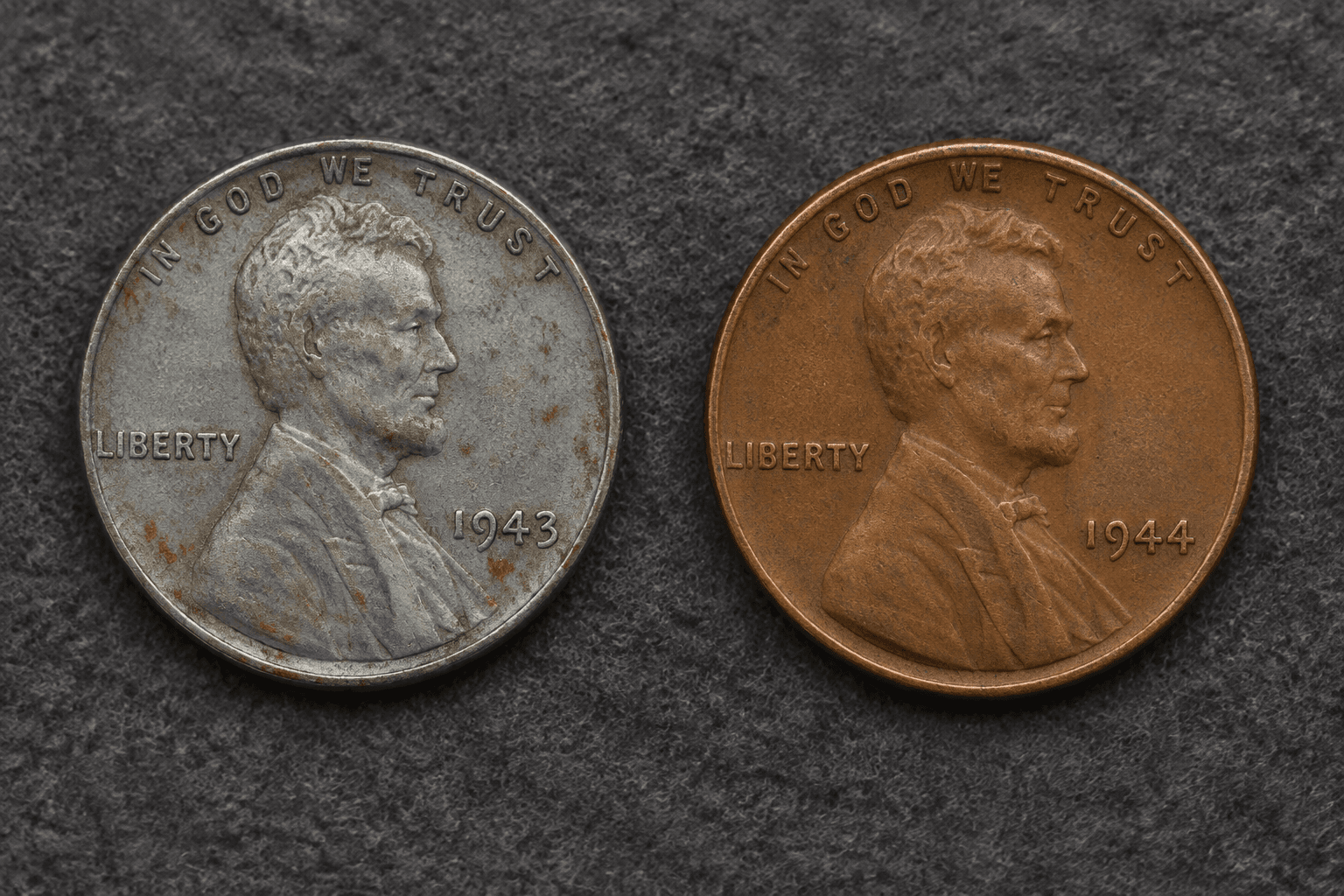
The 1943 steel penny is the most famous exception in the series, and it is usually the coin that starts the whole conversation. After the United States entered World War II in late 1941, copper was needed for shell casings and other war material. For the 1943 minting year, the Mint switched the cent to zinc-coated steel, which is why that one year's pennies look silvery gray instead of copper colored.
The switch lasted exactly one year. In 1944 the Mint returned to a bronze composition, using copper recovered from spent shell casings returned by the war effort, and the familiar copper color came back. The Great American Coin Company's wheat penny history covers this wartime substitution in more detail.
This one-year change explains two things people notice right away:
- A gray penny dated 1943 is the normal version, not an error. A copper-colored 1943 cent is the rarity, which is why that combination gets so much attention from dealers.
- Steel corrodes. Many surviving 1943 cents show rust spots or a dull zinc-gray surface, which is ordinary for the type, not a defect you caused.
The wheat penny years: a quick range table from 1909 to 1958
If you are asking "which years are wheat pennies?", the short answer is every one-cent date from 1909 to 1958. The longer answer is that the metal changed twice inside that range, which is why the date matters when you describe a coin:
| Years | Reverse | Composition |
|---|---|---|
| 1909 to 1942 | Wheat stalks | Bronze (copper-based) |
| 1943 | Wheat stalks | Zinc-coated steel |
| 1944 to 1946 | Wheat stalks | Bronze made from recovered shell casings |
| 1947 to 1958 | Wheat stalks | Bronze (copper-based) |
A few background notes, not value claims:
- The first year, 1909, produced the well-known San Francisco variety with the designer's initials VDB on the reverse rim. It is cited as a key date in the series, which is why dealer reference pages for 1909 to 1958 wheat cents lead with it. Most 1909 cents do not carry those initials.
- After 1958 the wheat design ended, so a 1959 or later cent with wheat stalks would be unusual and worth verifying carefully rather than assuming.
Where to find the year and mint mark
On a wheat cent, the year sits to the right of Lincoln's portrait, just as it does on modern pennies. The mint mark, when there is one, sits directly below the date:
- No letter means Philadelphia.
- D means Denver.
- S means San Francisco.
Look at the small letter tucked between the bottom of the date and the rim. On worn coins it can take good light and a magnifier to read. What D and S actually stand for, and how mint marks moved on other denominations, is covered in the separate US coin mint marks guide, which pairs well with this one.
The combination of year and mint mark is what makes each wheat cent a distinct entry in a reference catalog. "1953" alone is a broad date; "1953-D" points to one specific minting run. That distinction matters for any later research, which is why both belong in the record.
Other series names you will see: lincoln wheat penny
You will meet the same coin under several names, and none of them describe a different coin:
- Lincoln wheat penny and Lincoln wheat cent are the formal catalog names, and they are what reference books and dealer pages use.
- Wheat penny and wheat cent are the casual shortenings collectors actually say.
- Wheatie shows up in forum posts and roll-hunting threads.
All of them point to the same 1909 to 1958 series with the wheat reverse. If a listing, article, or forum thread uses any of these terms, this guide's recognition checklist applies unchanged.
How to record a wheat penny: photo, date, mint mark, condition notes
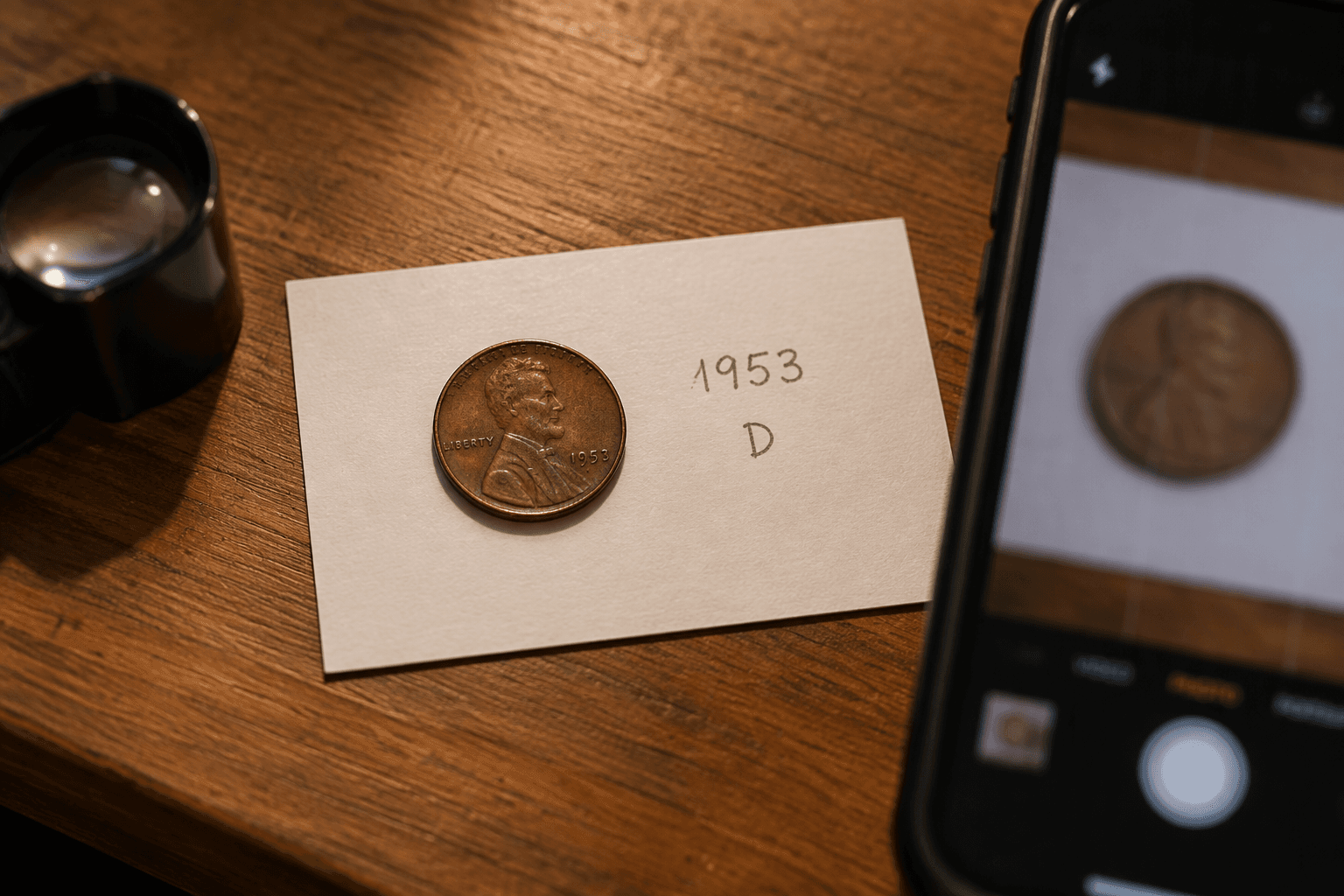
Recognition is fast, but a coin you cannot find again is a coin you have to re-research. Before you go looking up values or dates online, capture the four facts that describe the coin in your hand:
- Photo. One clear photo of each side in even light. Keep the original image; a photo is the evidence you can re-check later.
- Year. The four-digit date below Lincoln's shoulder.
- Mint mark. The letter below the date, or "none" if there is no letter.
- Condition notes in your own words. What you can actually see: wear on the high points, spots, cleaning marks if any. Write what you observe, not a grade you are guessing at.
Do this before researching value. If you start with price searches, your notes tend to be shaped by whatever number you found first. If you start with the facts, the record stays honest when you come back to it months later.
When you are ready to go from a note card to a searchable record, the general workflow of identifying an unknown coin covers the full path from a photo to a named, dated coin. For wheat cents specifically, you already have the series name from this article, so you are filling in date, mint mark, and condition rather than starting from zero.
Common misconceptions
"Every wheat penny is rare." The series ran for fifty years with mintages in the billions for most dates. A wheat cent pulled from pocket change or a family jar is, in the overwhelming majority of cases, a common coin. Specific dates and mint marks are the exceptions, and confirming those requires actual research, not excitement.
"Cleaning will make it worth more." Cleaning a coin almost always lowers its collector standing rather than raising it, because the original surface is what specialists examine. If a coin looks dirty, the safer move is to record it and leave the surface alone. The reasoning is laid out in Should You Clean Old Coins?
"A 1943 penny must be valuable because it is steel." The steel composition is the standard for that year, not a fluke. Over a billion were struck. Unusual 1943 combinations are a different question, and that question belongs to proper authentication, which this article does not attempt.
FAQ
What are wheat pennies? United States one-cent coins minted from 1909 to 1958 with two wheat stalks on the reverse instead of the Lincoln Memorial or shield designs used later.
How do I tell if my penny is a wheat penny? Flip it over. Two wheat ears flanking the words ONE CENT in the middle of the reverse identify the series at a glance. The obverse portrait looks the same as modern pennies, so the back is the deciding check.
What is the difference between a wheat penny and a regular penny? Only the reverse design and the era. Wheat cents circulated from 1909 to 1958; the Lincoln Memorial reverse ran from 1959 to 2008, and the Union Shield reverse has been on circulation cents since 2010. The front portrait has stayed the same throughout.
How much are wheat pennies worth? It depends entirely on the specific year, mint mark, and condition, and most dates are common. Folidx does not provide appraisals, authentication, or value guarantees. When you want to pursue the question, work through a structured process rather than a single search; How Much Are My Coins Worth? A Careful Way to Check walks through that method step by step.
Where to keep the record
A wheat cent documented with a photo, a year, a mint mark, and honest condition notes is ready for a place where it stays editable and searchable. If you want the record to live beyond a note card, Folidx keeps the photos, years, mint marks, and condition notes together as editable entries, organized in archive books and pages you can search later. It is an optional step, not a requirement: the checklist above works with a pencil and an index card too.
Sources
- Lincoln cent (Wikipedia), for the 1909 to 1958 wheat reverse, the Brenner design, and the 1959 memorial change
- The Wheat Penny (Great American Coin Company), for the 1943 zinc-coated steel composition and the wartime copper shortage
- Lincoln Wheat Pennies 1909 to 1958 (Bullion Exchanges), for key-date and mint mark background
- Folidx product overview, section 2.2, for the product boundary: no appraisal, authentication, or value guarantees
Written by Orion Wells, Founder of Aurcue. This article explains recognition and record-keeping only and makes no value claims about any specific coin.