Morgan Silver Dollars: History, Mint Marks, and How to Record Yours
What Morgan silver dollars are, how to read O, S, CC, and D mint marks, how they differ from Peace dollars, and how to record yours with sources.
A Morgan silver dollar is the large 38.1 mm US silver dollar designed by George T. Morgan, struck for circulation from 1878 to 1904 and once more in 1921, and struck again as a collector coin since 2021. It is 90 percent silver in the vintage issues, and it carries a small letter on its reverse that tells you which mint made it. If you found one in a drawer, an estate box, or a roll of old silver dollars, this article walks through what you are holding, which mint mark you have, how to tell it apart from the Peace dollar that replaced it, and how to keep a record of it with sources attached.
What a Morgan silver dollar is
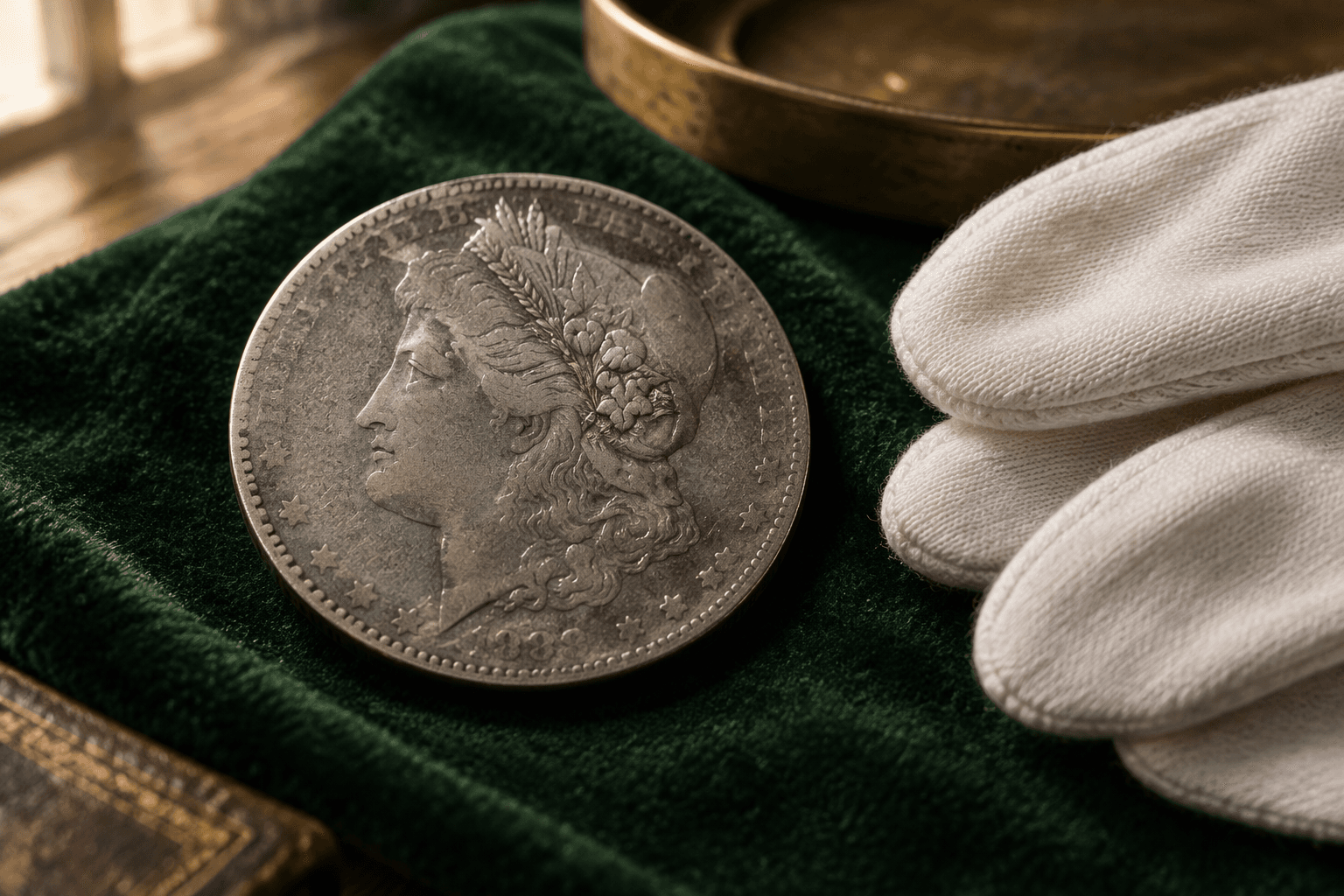
The Morgan dollar was authorized by the Bland-Allison Act of 1878, which required the Treasury to buy silver each month and coin it into dollars. It was the first standard silver dollar after the Coinage Act of 1873 ended the earlier Seated Liberty dollar. The design came from George T. Morgan, a British-born assistant engraver recruited to the Philadelphia Mint in 1876, and his Liberty profile is modeled on Anna Willess Williams of Philadelphia.
Three date facts define the series:
| Fact | Detail |
|---|---|
| Main run | 1878 to 1904, struck at Philadelphia, Carson City, San Francisco, and New Orleans |
| Final year | 1921 only, after the Pittman Act of 1918 authorized melting millions of silver dollars and required replacement coinage |
| Collector reissues | 2021 centennial issues, then annual releases from 2023 in 99.9 percent silver |
Production stopped in 1904 when the silver bullion purchased under the Sherman Silver Purchase Act ran out. The 1921 return was a one-year revival, and the design was replaced by the Peace dollar later that same year.
A quick orientation for anyone who only knows they have "an old silver dollar": the coin is large, about 1.5 inches across, shows a left-facing Liberty wearing a soft cap with the word LIBERTY on a headband, and carries a wreath of wheat and cotton in her hair. The reverse shows an eagle with half-spread wings holding arrows and an olive branch.
Reading the reverse: mint marks O, S, CC, D, and no mark
Flip the coin over. The mint mark, when there is one, sits on the reverse just below the eagle's tail feathers, in the small space between the D and the O of the word DOLLAR. It is easy to miss on a worn coin, so hold it under good light.
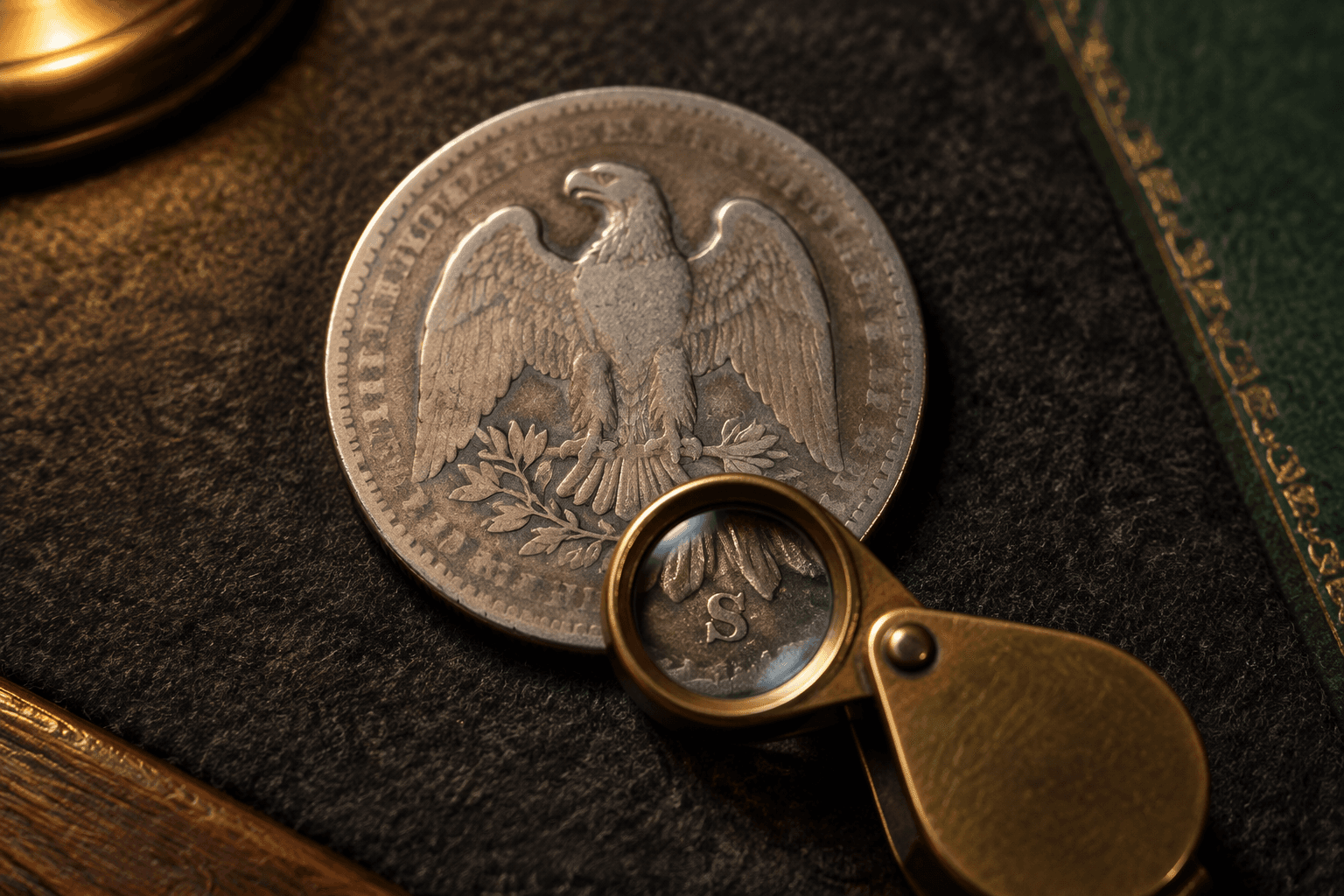
Each letter points to one of five mints:
| Mark | Mint | Notes |
|---|---|---|
| No mark | Philadelphia | The main mint; most early years carry no letter |
| CC | Carson City | About 2 percent of all Morgans, so these often carry a collector premium |
| S | San Francisco | Includes the famous key date 1893-S |
| O | New Orleans | Joined the series in 1879 |
| D | Denver | 1921 only, the last year of the original run |
If you see no letter at all, the coin came from Philadelphia, not from an unreadable or rubbed-off mark. For the wider system of mint mark letters across US coins, see US Coin Mint Marks: What They Mean and Where to Find Them.
The date and mint mark together identify your coin. The 1893-S is the standout key date: only 100,000 were struck, the lowest mintage in the series, and few survived in high grade because most circulated.
Morgan vs Peace dollar: the side-by-side check
Both coins are the same size and weight, 26.73 g and 38.1 mm with a reeded edge, and they overlap for exactly one year, 1921. If your dollar is dated 1921, the design itself settles it.
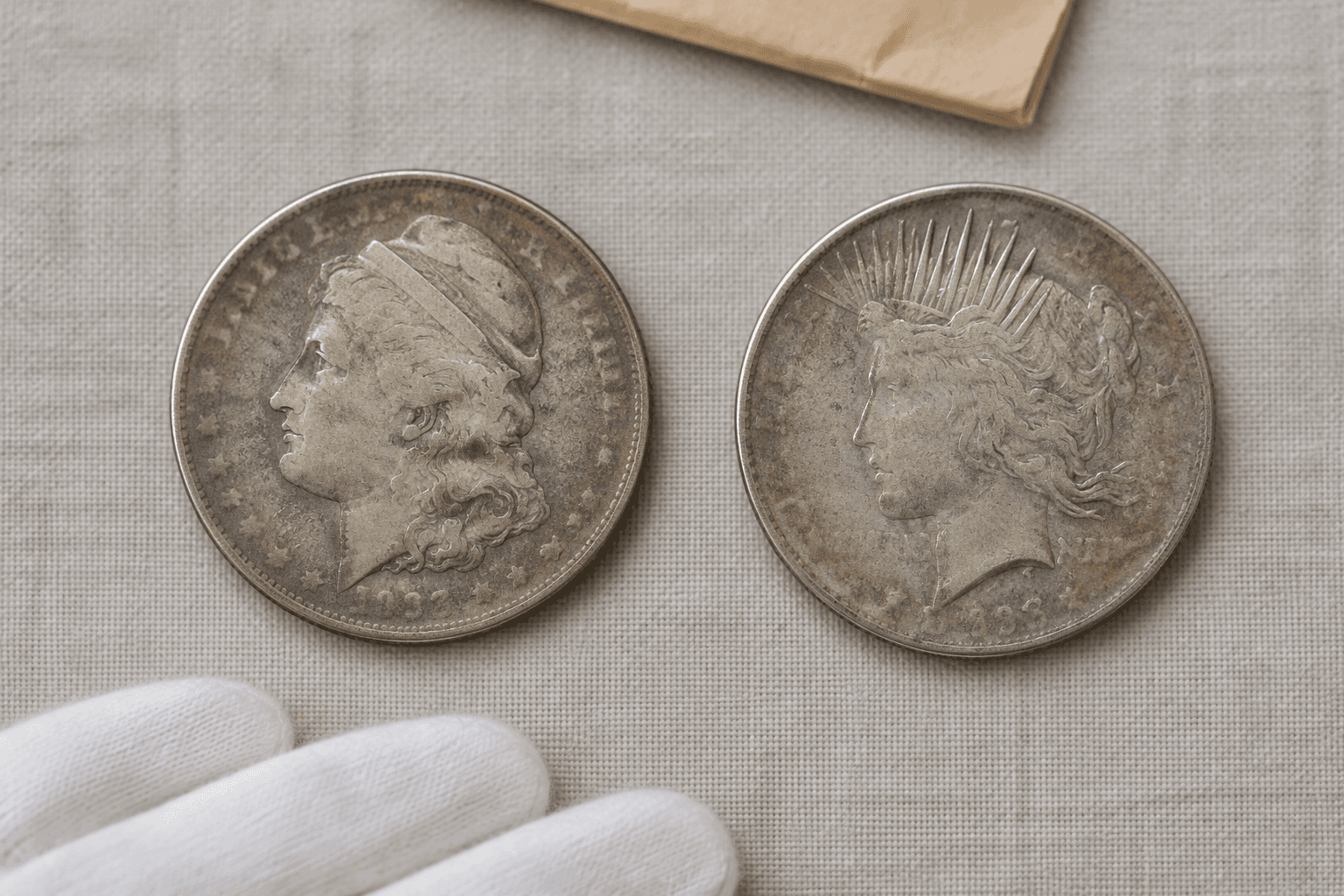
Two checks separate the series:
- The crown on Liberty. The Morgan Liberty wears a soft cap with a smooth LIBERTY headband and wheat and cotton in her hair. The Peace dollar Liberty wears a radiate crown of pointed spikes, modeled on the Statue of Liberty's crown by sculptor Anthony de Francisci.
- The reverse. The Morgan eagle stands with half-spread wings holding arrows and an olive branch. The Peace dollar eagle sits at rest clutching an olive branch, with the word PEACE below it.
Date ranges help too: Morgan dollars say 1878 to 1904 or 1921, while Peace dollars read 1921 to 1928, 1934 to 1935, or the modern collector issues. One small extra check if the date is worn: the Peace dollar's mint marks (D and S) sit above the tips of the eagle's wings, not below the tail.
Composition in one paragraph, sources included
A vintage Morgan dollar contains 90 percent silver and 10 percent copper, weighs 26.73 grams, and measures 38.1 mm across, giving 0.7734 troy ounces of pure silver. The 2021 and later collector issues are struck in 99.9 percent fine silver at 0.858 troy ounces. If you want to test what your coin is actually made of rather than trust the date alone, the simple checks in How to Tell If a Coin Is Silver cover date ranges, edges, and a few home tests.
Modern Morgan reissues since 2021
In 2021, Congress authorized new Morgan and Peace dollars to mark the 100th anniversary of the transition between the two designs. The 2021 Morgan dollars were struck in Philadelphia, Denver, and San Francisco, with special privy-mark versions carrying the old CC and O marks. Since 2023 the US Mint has released Morgan dollars annually in uncirculated, proof, and reverse proof finishes; a proof finish means mirror fields with frosted designs, which is different from the worn circulated surface on vintage coins. If a modern reissue is part of your find, the finish details in What Is a Proof Coin? explain what you are looking at.
A modern reissue is still a genuine US Mint product with real silver content, but it is a collector coin, not a circulated 19th-century survivor, and recording it as such keeps your archive honest.
How much is it worth?
Value pages for Morgan dollars are everywhere, and the numbers vary widely because value depends on the exact date, mint mark, and condition, not just the series name. This article deliberately quotes no price figures. A Morgan's worth is best treated as a research task with sources: identify the exact date and mint mark, note the visible condition, then compare against current dealer and auction references. The step-by-step method in How Much Are My Coins Worth? shows how to build that comparison without trusting a single number.
How to record a Morgan dollar
A record is what turns "a big silver coin I own" into a reference you can return to. For one coin, five entries cover it:
- Photo both sides. Shoot the obverse and reverse straight on in indirect light, plus a close-up of the mint mark area under the eagle's tail. Keep the original photos; they are your evidence.
- Date and mint mark. Write the exact date and the letter (or "no mark" for Philadelphia). This is the line that separates a common year from a key date.
- Visible condition notes. Record only what you can see: wear on the high points, tone, clean marks, dents. Do not assign a grade beyond a plain-language description; formal grading is a separate step.
- Sources attached. Keep the links you used to identify the coin, such as the US Mint program page or the NGC coin explorer, next to the record, so any claim can be checked later.
- Where it lives. Note which album page, box, or safe the coin sits in, and update that note if the coin moves.
If you use Folidx, the photo becomes an editable entry with the date, mint mark, condition notes, and source links kept together in one private archive, and the coin lands in a collection book you can browse later. The record is yours to edit; the identification is a reference to verify, not an appraisal or a grading certificate.
FAQ
How much is a Morgan silver dollar worth today?
It depends on the date, mint mark, and condition, and published figures vary a lot between sources. Treat value as a research task: pin down the date and mint mark first, then compare current dealer and auction references for that exact coin. Avoid any single quoted number without a source and date behind it.
Is a Morgan dollar a full ounce of silver?
No. A vintage Morgan dollar weighs 26.73 grams at 90 percent silver, which is 0.7734 troy ounces of pure silver. The 2021 and later collector issues contain 0.858 troy ounces in 99.9 percent silver.
What is the rarest Morgan dollar year?
The 1893-S, struck in San Francisco, is the key date with a mintage of only 100,000 coins, and most circulated heavily, so high-grade survivors are scarce.
Where is the mint mark on a Morgan dollar?
On the reverse, just below the eagle's tail feathers, between the D and O of the word DOLLAR. No letter means Philadelphia.
How do I tell a Morgan dollar from a Peace dollar?
Check the crown and the reverse. A capped Liberty with wheat and cotton in her hair is a Morgan; a Liberty with a radiate spike crown is a Peace dollar. On the back, a spread-winged eagle with arrows is a Morgan, while a resting eagle with the word PEACE is a Peace dollar. They overlap only in 1921.
Sources
- Morgan dollar - Wikipedia: series dates, designer, Bland-Allison Act context, composition, mint marks and their location, 1893-S key date, 2021 reissue details.
- Peace dollar - Wikipedia: Peace dollar dates, designer de Francisci, radiate crown, resting eagle with PEACE, mint mark location above the wings.
- US Mint: Morgan and Peace Silver Dollar Coins: official program page for the modern reissues.
- NGC Coin Explorer: Morgan Dollars 1878-1921: mint locations and production context.
- Value ranges vary by source and change over time; see the PGS Gold and Coin Morgan value guide as an example of why no figures are copied here. This article follows the Folidx boundary of reference ranges with sources, no appraisal or investment advice.